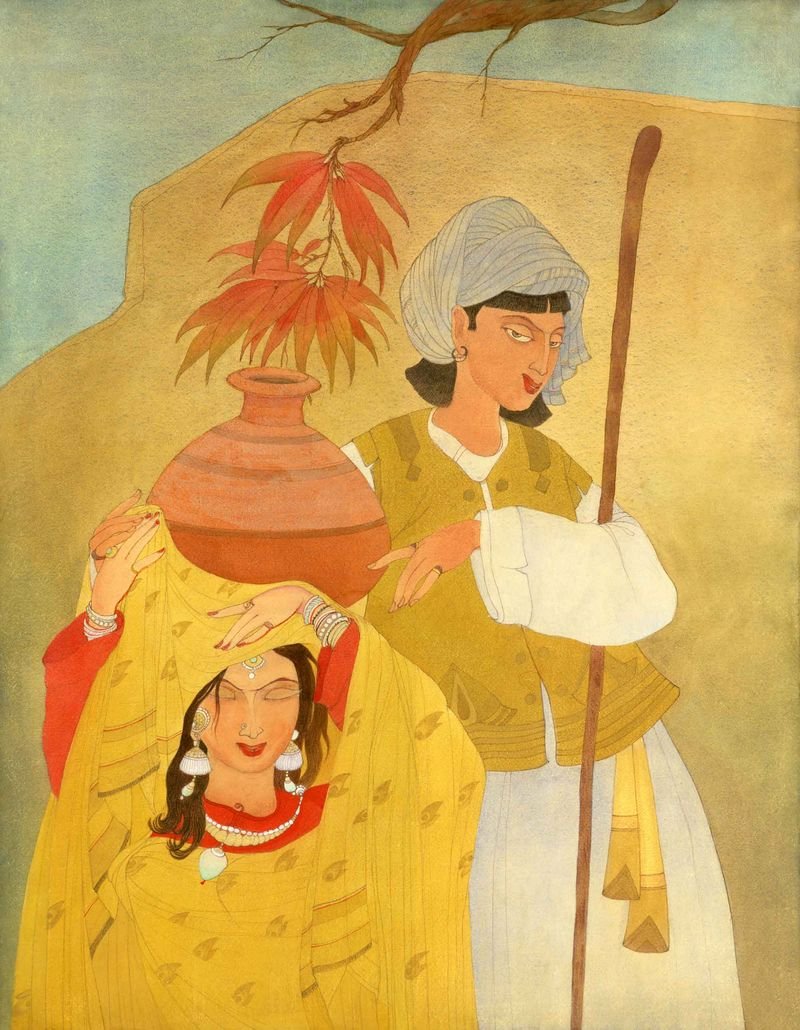

The news of Gloria Steinem’s passing into eternity got me thinking about our own literary roots in Punjabi writing, and wondering where our equivalent voice lies. Did Punjab have a feminist movement? Did our thinkers, writers, and literary giants ever ideologically conceptualise or debate issues of women’s equality and women’s choices through their written texts? Or has it always been the way men saw women? Did the male idea of a woman assert itself in the creation of women characters, or were women ever seen as flesh-and-blood beings, with their own agency and their own voice?We have always had brilliant, unruly women in our literature, and their trajectory tells a fascinating story of how women cut through social stratification in many epic tales, yet ultimately succumbed to the traditionalist point of view. Could they have been dealt another card? A different narrative, a more daring ending than death?Take the rebellious heroines of the qissa tradition, who are part of the Punjabi literary imagination. Desired, mourned, punished, mythologised, romanticised and made into archetypes, and yet, for most of her history, the woman has rarely been the one writing her own story.Look closely at heroines like Heer, Sahiban, or Sassi. They were remarkably radical, shattering feudal codes, rejecting arranged marriages, and boldly claiming their own desires. Yet every single one of them met a tragic end.A heroine can defy her family, run from home, choose her own lover — and still be entirely instrumental to a male poet’s point of view about fate, honour or the repercussions of loving a man outside the codified structure of acceptability. Agency in the plot is not the same as agency over the narrative.Heer-Ranjha, Sohni-Mahiwal, Sassi-Punnu and Mirza-Sahiban are the foundational romances of Punjabi literature, and their heroines are strikingly bold by the standards of their time. Heer defies caste and family to love Ranjha. Sohni swims across the river Chenab in an unbaked clay pot to reach her beloved. Sahiban’s choice sets off a chain of events that destroys her own family. On the surface, these are stories of female desire, female defiance and an unusual radicalism, set within a society driven by social constraints and patriarchy.But look at how each story ends. Almost without exception, the woman who is transgressive dies. Heer is poisoned by her own kin. Sohni drowns when her clay pot is sabotaged by her own sister-in-law and dissolves when she is crossing the river. Sahiban, fearing that her brothers will be killed by Mirza, breaks his arrows; a defenceless Mirza is killed and Sahiban takes her own life.The tragic ending is not incidental to the genre, it is structural. The narrative grants the heroine desire and voice only to extinguish her at the point where her defiance might actually threaten the social order, which, ironically, the poem otherwise upholds. Waris Shah, Pilu and Fazal Shah — the male poets who shaped these narratives — offer their heroines extraordinary freedom, but the plot unfolds in a manner that ultimately restores patriarchal order. The audience is invited to weep for the heroine’s unfortunate fate but the poet is unable to imagine a world reorganised around her survival. The heroine ostensibly chooses, but it is the poet who decides the consequences of her choice and the subsequent costs of that choice, and the poet who starts from a bold premise, timidly succumbs to the more acceptable and conservative resolution.An 18th-century Punjabi village had no script for a woman who broke every rule of patriarchy and survived. Death became the narrative safety valve to restore the status quo and punish the transgression. The male poets wrote themselves into a corner from which they could not escape, and death thus became the obvious resolution. They possessed the empathy to imagine a woman defying the social order, but lacked the framework to figure out what to do with her if she lived. Punjabi literature built its own indigenous feminist vocabulary through centuries of heartache. It evolved from a tradition where a female rebel had to be killed to keep the peace, into a modern movement where women writers ensured that their characters could live, breathe and write their own futures.Fast forward to the 20th century and here emerged writers like Ajit Cour and Dalip Kaur Tiwana, who refused to take refuge in the language of the suffering heroine. Tiwana mapped the claustrophobia of traditional courtyards endured by women in silence, yet her characters survived, despite the heavy psychological scars. In her seminal work ‘Eho Hamara Jiwana’, Tiwana didn’t wrap her female characters in romantic folklore; instead, she exposed the harsh feudal economics of rural Punjab where women like Bhano were traded and commodified like property. What makes Tiwana’s critique so sharp is her realisation that this patriarchal gaze wasn’t just held by men — it was deeply internalised by the domestic setup itself, often enforced by older women guarding the very systems that oppressed them as well. The women become carriers of patriarchy and often practised it even more ferociously than men.Ajit Cour brought in an unapologetic audacity with her writing about female sexuality, loneliness, and the hypocrisy of middle-class morality. Her women do not look for acceptance; they simply demand the right to take up space. ‘Gulbano’, her collection of short stories, marked her as a distinguished voice in Punjabi fiction. Her stories highlighted women’s unequal status and boldly addressed the physical aspect of man-woman relationships, drawing the ire of the establishment.In the film ‘Pinjar’, based on Amrita Pritam’s novel, Urmila Matondkar’s Puro redefines endurance rather than perishing under the circumstances.It is precisely against this backdrop that Amrita Pritam’s intervention becomes historically decisive — and it marks the first real rupture in the male-authored tradition. Her novel ‘Pinjar’ creates the character of Puro, a woman who becomes, in the popular literary imagination, a symbol of violence against women during Partition. The crucial difference is authorship: Puro is not a man’s symbol of a woman’s suffering. She is a woman’s own rendering of what that suffering meant from the inside. The shift from a “woman as depicted by men” to a “woman as narrated by a woman” is, arguably, the single-most consequential turn in this entire history. Puro survives the displacement of Partition, quietly redefining endurance rather than perishing under the circumstances.Pritam’s poem ‘Ajj Akkhaan Waris Shah Nu’ was a direct indictment of the old bards, questioning how poets could weep over the fictional death of a single Heer while thousands of real-life women were being slaughtered and abducted in 1947.Alongside canonical Sufi poets like Baba Farid, Shah Hussain and Bulleh Shah stands a lesser-known figure: Peero Preman, a 19th-century Punjabi mystic poet, perceived as a feministic voice in the context — though the modern label would be a trifle anachronistic. Her verses are now being recovered by scholars as an indigenous female voice challenging patriarchy and class hierarchy from within the very devotional idiom that produced the great male Sufis. Her presence is a reminder that “women created by men” never presented the whole picture — even if it was overwhelmingly the dominant one, and even if her voice remained, for over a century, marginal to the canon in a way Bulleh Shah’s never was.This brings me back to Gloria Steinem, who once said, “In my heart, I think a woman has two choices: either she’s a feminist or a masochist.” Peero, singing from a Gulabdasi dera in 19th-century Punjab, had already chosen to name what she was doing:“Lord I am beyond casteNeither Hindu nor MuslimI am beyond birth and deathNeither a woman nor a manLimitless beyond limit.”— The writer is an acclaimed theatre director