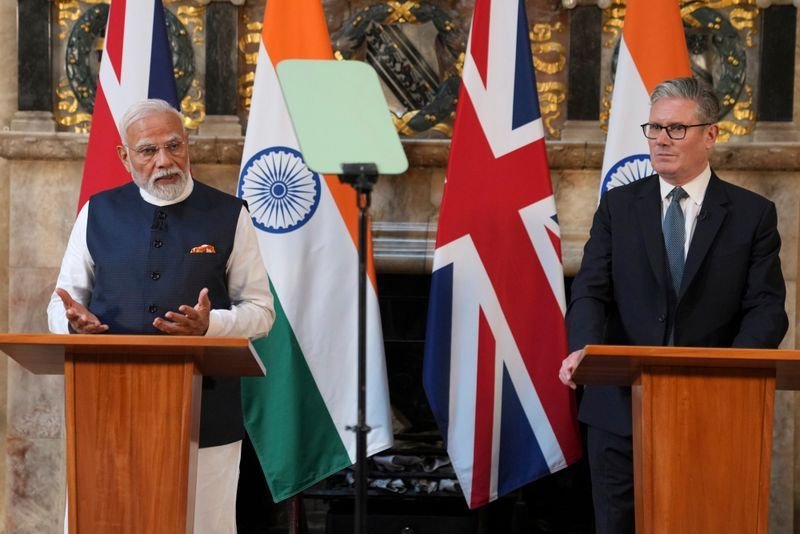

Britain’s North of England is mounting an unprecedented joint trade mission to India this month, seeking new investment, exports and business partnerships as the new India-UK free trade agreement opens a fresh phase in bilateral commerce.But while the Northern delegation will concentrate on New Delhi and Mumbai, with Yorkshire also travelling to Hyderabad, its approach has echoes of an earlier British regional push into northern India — including Punjab and Chandigarh.The Great North delegation will travel to India from October 12 to 16, bringing together civic and business leaders, academics and other representatives from Liverpool City Region, West Yorkshire, South Yorkshire, York and North Yorkshire, the North East, and Cheshire and Warrington. It is the first joint mayoral-led British regional mission to India under the Great North banner.The mission comes just months after the UK-India Comprehensive Economic and Trade Agreement came into force on July 15. British authorities say total UK-India trade reached £47.9 billion in 2025, while the trade agreement is projected to increase annual bilateral trade by £25.5 billion by 2040.Britain’s North wants benefits beyond LondonFor the Northern authorities, the objective is to ensure that the benefits of the new relationship are not concentrated in London and the South East.“We want the benefits of our ambitious trade deals to be felt in every part of the country,” British Business and Trade Secretary Peter Kyle said when the mission was announced. “It is fantastic to see Northern leaders immediately seizing the opportunities that our deal with India, coming into effect in July, will offer,” he said.Kim McGuinness, North East Mayor and chair of the Great North, said the mission represented an attempt by the region to speak to the outside world collectively. “The Great North was created to do something the North of England has rarely had the opportunity to do before: come together with a single voice and tell our story to the world,” she said.The sectors being promoted include advanced manufacturing, technology, textiles, education, clean energy, sport and culture. The mission will also include efforts to attract Indian tourists to destinations outside London.There is a particularly strong Yorkshire component. The three Yorkshire mayors — David Skaith of York and North Yorkshire, Tracy Brabin of West Yorkshire and Oliver Coppard of South Yorkshire — will lead a joint Yorkshire delegation to India. After beginning in New Delhi as part of the wider Great North mission, they will travel to Hyderabad and Mumbai. Skaith says Yorkshire wants to use the new trade environment to develop relationships that go beyond the region’s traditional association with India.“Yorkshire is recognised throughout India for its cricketing heritage,” he said. “But following the UK and India’s recent trade agreement, there is the potential to be known for new partnerships with God’s own county.” He is also pointing to an existing educational connection: the University of York is opening a new campus in Mumbai, creating another institutional link between the two regions.Opening for India to develop ties with North as a regionFor India, however, the most significant element may be the opportunity to develop relationships with the North as a region rather than simply with the British government.Vishakha Yaduvanshi, India’s Consul General in Manchester, has welcomed the October mission and pointed to the opening of India’s Manchester consulate as evidence of New Delhi’s increasing interest in Britain’s northern regions.“The opening of the Consulate General of India in Manchester was itself a clear indication of India’s commitment to engaging more closely with the region,” she said.Yaduvanshi said there was “considerable scope for collaboration” between northern England and Indian states and cities in advanced manufacturing, technology, textiles, education, clean energy, sport and culture.“We hope the delegation’s visit will help turn this potential into concrete projects, investment and long-term institutional links,” she said.Previous bid to link North India and North EnglandThat reference to Indian states and cities provides a natural link to Chandigarh and Punjab.Chandigarh is not on the published itinerary for the October mission. But it has previously played a role in Britain’s attempts to develop economic links between northern England and northern India.A 2017 report on the Northern Powerhouse’s India engagement records that a previous Northern Powerhouse delegation travelled to Punjab, Karnataka and Delhi. The then British Deputy High Commissioner in Chandigarh, Andrew Ayre, said the Chandigarh mission had helped produce agreements on education and skills, as well as student and business exchanges.The economic context has also changed.In June this year, India’s Ministry of Commerce and Industry held a stakeholder meeting in Chandigarh aimed at identifying export opportunities created by India’s expanding free-trade-agreement network. Officials specifically highlighted opportunities for Punjab and Haryana in textiles and apparel, engineering goods, agriculture and food processing, alongside pharmaceuticals and chemicals.That creates an intriguing two-way opportunity.While northern English mayors are travelling to India to persuade Indian companies and investors to look north, Punjab and Haryana businesses are themselves seeking new overseas markets and investment opportunities under India’s changing trade arrangements.Moving beyond traditional London-Delhi axisThe question, therefore, is whether the new India-UK trade relationship can develop beyond the traditional London-Delhi axis and generate stronger commercial connections between Britain’s North and India’s North.The October mission is an early test.For the Northern English authorities, success will ultimately have to be measured not by the number of meetings or photographs produced in India, but by investment, export contracts, university partnerships and jobs created afterwards.For India, the opportunity is equally practical: the new trade relationship offers access not merely to Britain as a national market, but to a northern English economy of millions of people, major universities, manufacturing centres and established Indian communities.And if the experience of Chandigarh and Punjab’s earlier engagement with the Northern Powerhouse is anything to go by, the next stage of that relationship may not be confined to London and New Delhi.