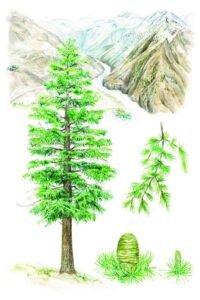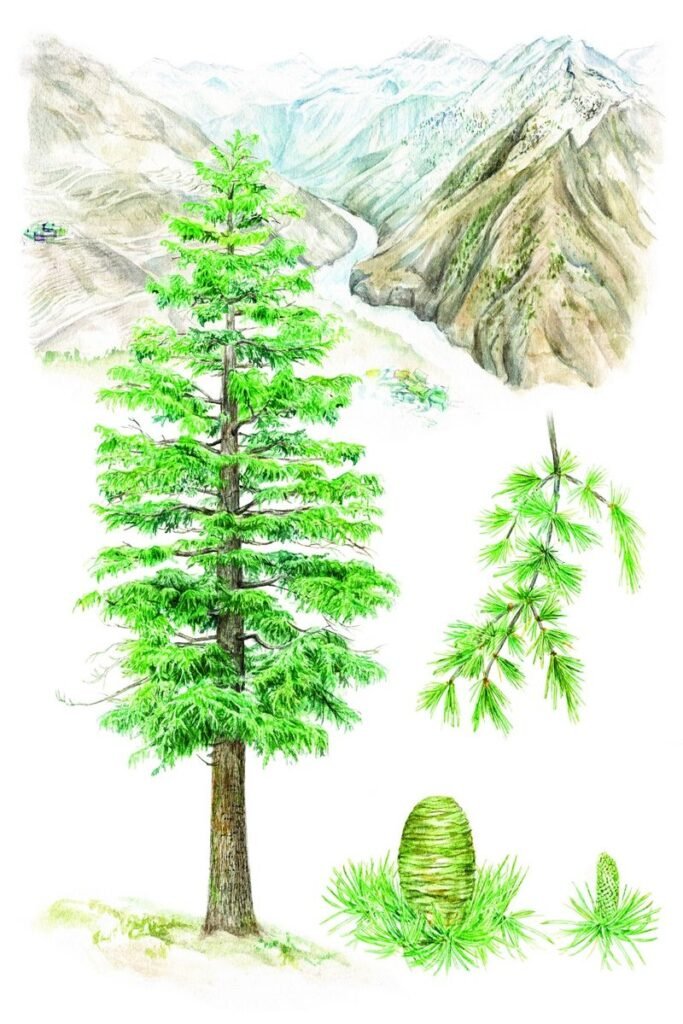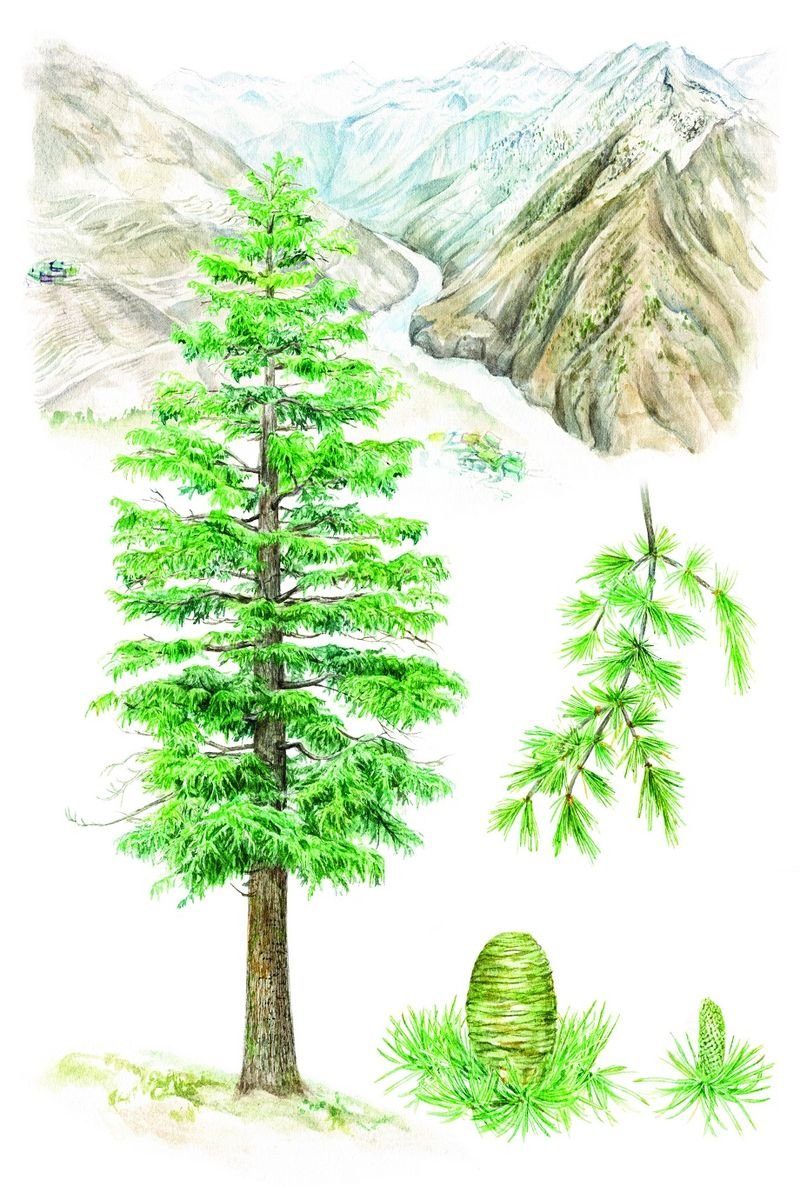

CHILLED to the bone on the road from Rampur Bushahr to Pooh, in Kinnaur district, Himachal Pradesh, you marvel at the fortitude and endurance of those who have made this their home: Himachali people on one side and deodar trees on the other.Deodars (Cedrus deodara) are Himalayan cedars. They belong to the pine family, Pinaceae, along with other conifers within the larger group of gymnosperms such as the podocarps, spruces, and junipers. Many conifers go by the name of ‘cedar’, as do some broadleaved trees (such as red cedar, Toona ciliata in the neem family). But the ‘true’ cedars carrying the generic name Cedrus are only three species — all extraordinary trees.The cedar of Lebanon (C. libani), which once ranged from the eastern Mediterranean to Iran, is now a threatened species confined to the mountains of Lebanon, Turkey, and Syria. This species, revered by Egyptians (who used the resin for embalming mummies), Phoenicians, and Assyrians, and considered sacred in Islam, also finds mention in the Bible, and a place, today, in the national flag of Lebanon.The Atlas cedar (C. atlantica), endemic to a narrow range on the Rif and Atlas Mountains of Morocco and Algeria in North Africa, is threatened by human pressures and climate change.In comparison, deodars occupy a wider swathe of mountains from northeastern Afghanistan through Pakistan (where deodar is the national tree) across the Western Himalaya to western Nepal. Here, they occur on the main Himalayan ranges between 1,500 and 3,000 metres elevation, sometimes extending as high as 3,600 metres.Considered sacred among Hindus, deodars are often planted near temples. The name derives from deva-daru, meaning tree or wood of the gods. The deodar is truly the cedar of the gods. They are among the oldest, the tallest, the most exalted, and impressively grand trees of India.Trees on relatively flat terrain or along river valleys can grow to great size, reaching a height of 75 metres, a tad taller than the Qutb Minar in Delhi. In 1865, along the Sutlej in Kinnaur, the German-British forester and author of ‘Indian Trees’, Dietrich Brandis, found giant trees during a survey of deodar forests. He measured one above Purbani village on an agricultural terrace, abandoned perhaps decades or centuries earlier, whose trunk was 10.5 metres in girth and whose age he estimated to be over 900 years. Even today, near Rohru, stands a multistemmed deodar with a girth of nearly 20 metres.From their straight, cylindrical trunks, their branches fan out horizontally, stiff, strong, and level till the extremities where they droop a bit. Each whorl of branches is arrayed vertically along the bole less than an arm’s length apart, giving each tree a stepped appearance.Younger trees have a characteristic pyramidal profile, while large mature trees and those in exposed locations develop a wider, flat-topped appearance. Along their branches and branchlets arise dark green needle-like leaves shorter than a little finger. The leaves cluster in bunches, but with a few loners scattered among them; those at the shoot tips droop like a tuft.The deodar’s cones always stand upright on the branches. Deodar wood is highly durable and wonderfully aromatic. Many of the houses and impressive old wooden temples and palaces in Himachal have been built using deodar. The beams of the Bijjat Devta Temple in Sarahan, the great doors of the Jubbal and Sainj palaces, the roof shingles and beams of many houses, all crafted with deodar, stand testimony to the durability of the wood.Further afield in Kashmir, the beautiful Shah-e-Hamadan Mosque with its deodar pillars is nearly six centuries old. The deodar themselves mark time as rings in their wood. Each year as the tree grows in girth, a ring is laid down along the outer rim beneath the sapwood and bark. Each ring comprises an inner band of paler springwood, set down when the tree is growing faster, and an outer one of darker autumnwood, set down as growth slows down and as winter approaches.The deodar lays down wider rings in years good for growth and narrower ones in drought years or while struggling to grow as a seedling in dense shade of forests with oak, spruce, and fir. As the fine concentric rings are clearly visible and the wood is durable and resists decay for decades or centuries, felled trees and logs can be aged quite accurately, much as Brandis did.The British heavily exploited deodar for railway sleepers, bridges, and beams. An average deodar tree could be cut up into about 50 railway sleepers or crossties about 1.8 metres long and 20 by 11 cm thick. On average, every km of track consumed 50 trees. The British felled these trees in the tens of thousands, slipping logs down slides, sledge roads, or rough tramways.They used sarnais, inflated animal skins used for crossing rivers, to float the logs over rapids. Down came the trees and down came the logs on the Chenab, Sutlej, Bhagirathi, Ganga, and Jamuna, floating to timber mills downstream. If dead deodar have their own stories to tell, live trees do, too.Scientists use core drills to extract narrow tube-like cores from live, old trees to count and measure rings. Dendrochronology or tree-time research yields many insights, not just into ecology and climate of places where the deodar have lived for decades or centuries, but of global climate change.— Excerpted from ‘The Trees of My Country’ by TR Shankar Raman of the Nature Conservation Foundation, with permission from Aleph