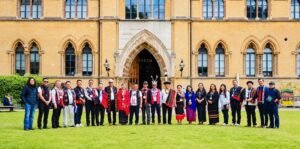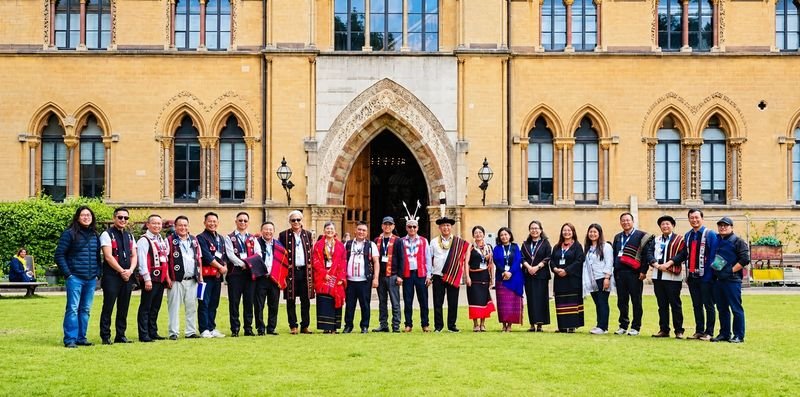

Thirty-nine Naga ancestral skulls, some taken more than a century ago during British colonial rule, are to be brought home from Oxford to Nagaland, in what Naga organisations describe as a moment of healing, unity and the return of memory.The University of Oxford formally approved the return of 39 of the 40 ancestral remains claimed by the Forum for Naga Reconciliation (FNR) last July. The remaining set of remains was excluded because its provenance could not be clearly established as Naga.Pitt Rivers Museum’s Belgian director, Laura Van Broekhoven, told Agence France-Presse (AFP) that the remains “have been away from their homeland for far too long”. The museum told AFP that it was “working closely” with the Naga community to agree on a date for the handover ceremony.In a separate statement to Euronews, Van Broekhoven described the process as “humbling” and said she felt honoured to have worked towards returning the 39 Naga ancestors.The FNR and other Naga organisations, in a statement sent to AFP welcoming the Oxford decision, said: “Repatriation, for the Nagas, is not simply about bones and ancestral remains finding their way back to the land but importantly about memory returning to where it belongs.”The decision brings to a remarkable point of closure a process that began in 2020, when Van Broekhoven approached the FNR about the possibility of repatriating the remains.A date for the handover ceremony has not yet been set. The Pitt Rivers Museum is working with Naga representatives on arrangements for the return.In June 2025, a 23-member Naga delegation travelled to Oxford and came face to face with ancestral remains held in the Pitt Rivers Museum.They were shown skulls, tufts of hair, fingernails, long bones and the partial remains of a child.Some delegates wept. Others prayed in Naga languages.For the museum, the remains had been accessioned as part of a collection. For the visitors, they were ancestors.“This was not a museum visit,” one delegate said afterwards. “This was a reckoning — with the dead, with our history, and with ourselves.”Dr Phyobemo Ngully, a psychiatrist from Kohima who was among the delegates, explained the spiritual significance of the visit. “If we don’t bring them home, our ancestral spirits will be restless,” he said.On the final day of the visit, the delegates addressed their ancestors directly: “We are here now to reclaim you.”More than a year later, Oxford has agreed to let them do precisely that.The formal claim for the 40 remains was submitted to Oxford this year by the FNR, which had been authorised by Naga tribal councils to act on their behalf. Oxford’s own gazette subsequently recorded that the visitors of the Pitt Rivers Museum recommended the return of 39 of the 40 remains.The historical background is disturbing.The Tribune has seen correspondence written by British colonial administrator James Philip Mills in 1923 in which he described his intention to “loot” the Naga village of Yungya “to the advantage of the PR” — the Pitt Rivers Museum.“I should like to fire on it,” Mills wrote. “The men deserve bullets.”In subsequent correspondence, Mills confirmed that he had shipped a severed human head from Yungya via Calcutta.Another colonial administrator, JH Hutton, an anthropologist as well as a District Commissioner, was also associated with the collection of Naga human remains and objects. The Pitt Rivers Museum itself says Hutton and Mills brought most of its Naga human remains into the collection between roughly 1910 and 1940, and acknowledges that remains and objects were frequently confiscated during punitive military expeditions rather than freely given.The distinction between colonial collecting and Naga memory could hardly be sharper.The museum speaks of human remains and collections. The Naga organisations speak of ancestors, memory, dignity and belonging.For the Naga organisations, the immediate priority is not the return of artefacts. It is the return of their dead.The current restitution concerns the 39 Naga ancestors approved for return by Oxford.The repatriation effort is being coordinated by the FNR and the Recover, Restore and Decolonise (RRaD) research initiative, working with Naga tribal bodies, church leaders and communities. In June 2025, Naga tribal Hoho leaders, elders and FNR-RRaD members travelled to the Pitt Rivers Museum to see and bear witness to the ancestral remains.The Naga delegation subsequently issued the Naga Oxford Declaration on Repatriation, calling for the remains to be reclaimed and returned to their homeland.The proposed burial in Nagaland is intended to provide a dignified resting place and, according to Naga representatives, to symbolise the unity of the Naga people. A burial site has been identified and discussions are underway with the Nagaland Government over its allocation.The Oxford decision is part of a wider international movement challenging the presence of human remains and cultural objects acquired by Western institutions during the colonial era.But the Naga case has a particular resonance because it involves not merely the return of disputed objects but the return of people.At Oxford last year, the Naga delegation ended its declaration with a blessing: “May your homecoming bring peace and harmony to our land.”The words, written when the journey home was still uncertain, now have a different meaning.The journey has been approved. What remains is to bring them home.