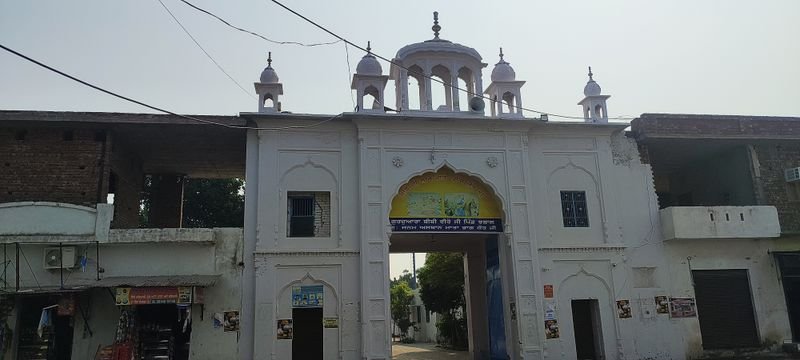

Chabal, a prominent village in Tarn Taran district, occupies a strategic location at the crossroads of several important routes. Amritsar lies to its north, the border town of Khemkaran to its south, Tarn Taran to its east and Attari to its west. Owing to its location, Chabal has developed into a commercial hub for the surrounding villages, whose residents visit the market to meet a wide range of their everyday needs.Spread over 4,800 acres, Chabal has a population of more than 15,000. The village is also known for its rich history and its association with revolutionaries and political leaders.From Chhambh Wal to ChabalAccording to local residents, centuries ago, people often settled along the banks of ponds, known as chhambh, to ensure access to water. Chabal is believed to have derived its original name from one such pond. It was initially known as Chhambh Wal, which gradually evolved into Chabal over time, as the name became easier to pronounce.Residents cite Giani Partap Singh, Jathedar of Kesgarh Sahib, who recorded the village’s earlier name as Chhambh Wal on page 79 of his book ‘Akali Lehar De Neta’.The village is situated along the historic Sher Shah Suri Marg. Emperor Sher Shah Suri is credited with developing transport routes in different directions by constructing unpaved roads. Two sarais (inns) stand in the surrounding area: Sarai Amanat Khan to the west and Sarai Noordi to the east.During the Mughal period, these inns served emperors travelling between Calcutta and Kabul, the capital of Afghanistan. The route was also an important means of reaching Lahore. Today, the road crosses the Beas river at Goindwal Sahib, providing a connection towards Delhi.Historians have yet to reach a consensus on when Chabal was first established, although it is believed to have existed before the 13th century.Early settlers and historical landmarksAccording to local accounts, a large part of the village’s population in its early days belonged to the Sultani sect. During the time of Guru Arjan Dev, a prominent figure named Sultania Abal Khair lived in the village. His son, Langah Shah, belonged to the Jat community, which was Hindu at the time, according to residents.The remains of what is believed to have been a fort can still be seen in the village, including its entrance gate. Chabal also had a sizeable population of Dhillon Chaudhris.Over time, the village has grown into a small town, with six panchayats having been formed from what was once a single village. Its main commercial centre is known as Adda Chabal, where residents and visitors can purchase a wide variety of goods. Adda Chabal has its own panchayat.The other six panchayats are Chabal Pukhta (Pakka Qilha), Chabal Kham, Chabal Khurd, Baba Langah, Baghel Singh Wala and Swargapuri.Before the Partition of 1947, Hindus, Sikhs and Muslims lived in the village. Most of the Hindu residents lived in Chabal Pukhta, also known as Pakka Qilha. The village once had a predominantly Sood population belonging to the Khatri caste, while only a few Brahmin families remain today.Chabal has also developed an industrial and commercial base, with rice shellers and various workshops operating in the area. Members of the Jat community have also entered the business sector and established commercial enterprises.Two prominent gurdwaras in the village are Gurdwara Bibi Veero and Gurdwara Mata Bhag Kaur.Land of revolutionariesChabal has long been regarded as a land of revolutionaries. Among the notable personalities associated with the village are the three Chabal brothers and Communist leader Darshan Singh Chabal, whose contributions have left a mark on its political history.The Chabal brothers — Amar Singh, Sarmukh Singh and Jaswant Singh — were the sons of Gopal Singh and Mata Jas Kaur. Their grandfather, Bhagat Singh, was also a well-respected figure.Sarmukh Singh Chabal became the first president of the Shiromani Akali Dal (SAD), while his brothers also took part in political and religious movements during the early decades of the 20th century.The village also has a significant religious association with Bibi Veero, the daughter of the sixth Sikh Guru, Sri Guru Hargobind. Her marriage was solemnised at Baba Langah’s palace in Chabal.According to local accounts, there was initially no gurdwara dedicated to Bibi Veero. Bhagat Singh was the first to conceive the idea of building one in her memory. He rallied the villagers to construct Gurdwara Bibi Veero and personally carried bricks for the building using his valuable dushala (shawl).The three Chabal brothers completed their middle-level education in the village before moving to Amritsar for further studies at Khalsa College School and subsequently Khalsa College.They grew up during the Singh Sabha movement and participated in the Chabian da Morcha and the Guru Ka Bagh Morcha.Sarmukh Singh was elected president of the Shiromani Akali Dal in 1920. In 1923, the British government declared the Shiromani Gurdwara Prabandhak Committee (SGPC) and the Shiromani Akali Dal illegal. As SAD president, Sarmukh Singh led the first jatha (group of volunteers) to court arrest and was implicated in a case. He remained in jail for three years.The Gurdwaras Act was approved in 1925, following which the agitation was suspended. The three brothers also participated in various movements organised by the Congress party.Comrade Darshan Singh’s political journeyAnother prominent figure associated with Chabal’s revolutionary tradition was Communist leader Darshan Singh Chabal, whose contribution to public life was no less significant than that of many other leaders.Born into a very poor family, Darshan Singh completed his matriculation and secured a job in the Public Works Department (PWD). However, his political interests led him to associate with Communist leaders, including Comrade Jagjit Singh Anand, Comrade Mota Singh and Comrade Dr Inder Dev Sood. He eventually resigned from his job to pursue his political commitments.Darshan Singh contested his first election to the Punjab Vidhan Sabha in 1952, the first such election held in independent India. He contested from the reserved Tarn Taran constituency and was elected an MLA.He subsequently won Assembly elections from the Attari constituency in 1969, 1977 and 1980. In 1955, he was also elected a member of the SGPC.Chabal’s legacy of political activism and workers’ movements continues to be reflected in its public life. Among those associated with the trade union movement today are Devinder Sohal and his wife, Seema Sohal, both of whom are held in high regard in the town for their active involvement in the movement.