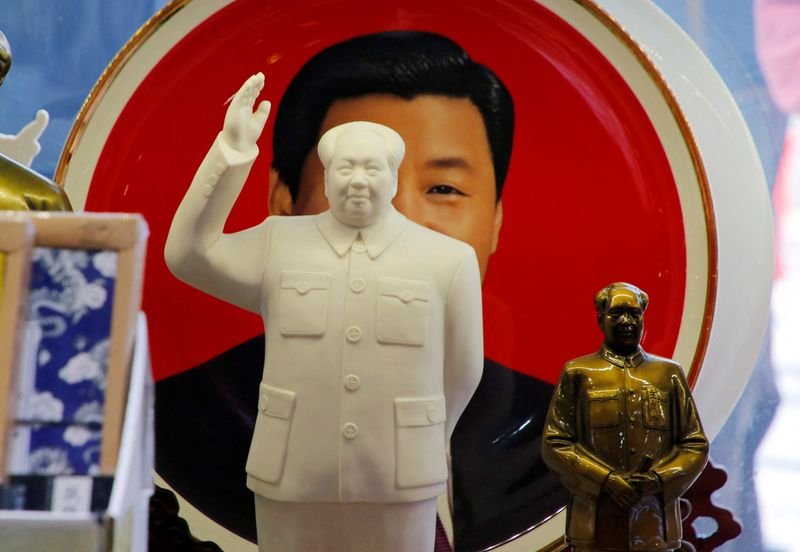

Fifty years after the death of Mao Zedong, one of the most consequential and controversial figures of modern China, his words and writings are finding renewed traction among Chinese youth grappling with work pressure, economic uncertainty, social inequality and intense competition in education and employment, according to a media report.Mao was the towering figure of the People’s Republic of China (PRC) during the first three decades of its existence, shaping the country’s political system, economic direction, foreign policy and social transformation until his death on September 9, 1976.Mao’s thoughts in the Red Book, which once resonated across the world and sparked Communist movements, paled into insignificance after his death as they were overtaken by his successor Deng Xiaoping’s widespread economic reforms.Deng’s opaque Socialism with Chinese Characteristics gave wide room for the successive Chinese leaders to expand reforms, including the introduction of private property, shunned by Mao.In recent years, the party theoreticians were also critical of some of Mao’s political and economic campaigns, especially his disastrous Cultural Revolution (1966-76) in which thousands were killed in the name of purging capitalists and traditionalists.But that trend is changing, especially among the youth and students, according to a report in the Hong Kong-based South China Morning Post.As the Chinese economy struggled with a slowdown weighed down by a host of factors, mainly with its property sector mired in debt and crisis, Mao’s once-forgotten thoughts found a new audience among China’s Gen Z.It is hard to estimate the number of Mao’s young followers in China today, but a glimpse is possible through growing library loans and merchandise sales, the Post reported.At Beijing’s prestigious Tsinghua University, the Selected Works of Mao Zedong topped the library loan list last year, open records show.On Taobao, one of China’s largest online shopping platforms, a shop selling enamel mugs with Mao’s portrait sold more than 20,000 units in the past year, the Post reported.The deeper reason for the interest in Mao is that young people are becoming increasingly disillusioned with today’s China and cannot achieve their aspirations, according to analysts.In June 2023, the official urban unemployment rate for young people aged 16 to 24 hit a record high of 21.3 per cent. Fearful for their futures, university graduates have started joking that they have to “degrade themselves” and consider blue-collar jobs with low pay.“I think a lot of people have realised that this isn’t something that could simply be solved with the cake being made bigger,” Mobo Gao, professor of Chinese studies at Adelaide University in Australia, told the Post.He said Mao’s theories on class struggle and conflict were still relevant today, as young people facing immense pressure, a wealth gap and few employment opportunities sought an explanation or simply comfort.This has been accompanied by a rise in nationalism in recent years. Many admire Mao for his foresight in areas such as the development of nuclear weapons, satellites and the industrialisation of inland provinces — achievements that have helped China compete and defend itself against outside forces.There was no major coverage of Mao’s 50th death anniversary on Wednesday in the official media or any reports of ceremonies.The only special arrangement in place was at the Chairman Mao Memorial Hall in Beijing, which opened for an extra three hours on Wednesday. Visiting slots for the week are fully booked.Despite the official silence ahead of the anniversary, it is hard to ignore the quiet comeback of Mao’s popularity in the country, the Post reported.There are increasing signs that Gen Z, in their social media posts, view the late leader less as the architect of a turbulent revolutionary era and more as a source of personal inspiration and resilience while dealing with personal and work pressures.Online influencers and Mao enthusiasts have built large followings by presenting his writings as practical guidance for dealing with setbacks in work, relationships and everyday life, according to the Post.Some young people have formed online reading groups around his works, while AI-narrated videos and social-media posts have helped introduce Mao’s speeches and writings to a generation with no direct experience of the Mao era.When you are denied a pay rise, when you feel anxious about your children’s education, or when you are alienated by colleagues, Chairman Mao can help, the Post reported, quoting some of the posts of the young generation.Mao’s views were regularly cited in times of US-China tensions, especially last year’s tariff war.When the Trump administration imposed a 104 per cent tariff on Chinese goods, social media users searched for the term “jiaoyuan”, which described imperialism as a “paper tiger” — one of Mao’s best-known slogans — and quoted his collection of speeches On Protracted War.While much of this youthful sentiment aligns with China’s official narrative about Mao as a symbol of national independence, especially in the face of US-led international pressure, experts say Beijing is also wary that Mao’s teachings could feed into scepticism about the country’s economic policies and its interpretation of Marxism, according to the Post.