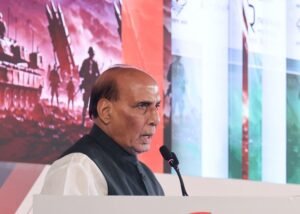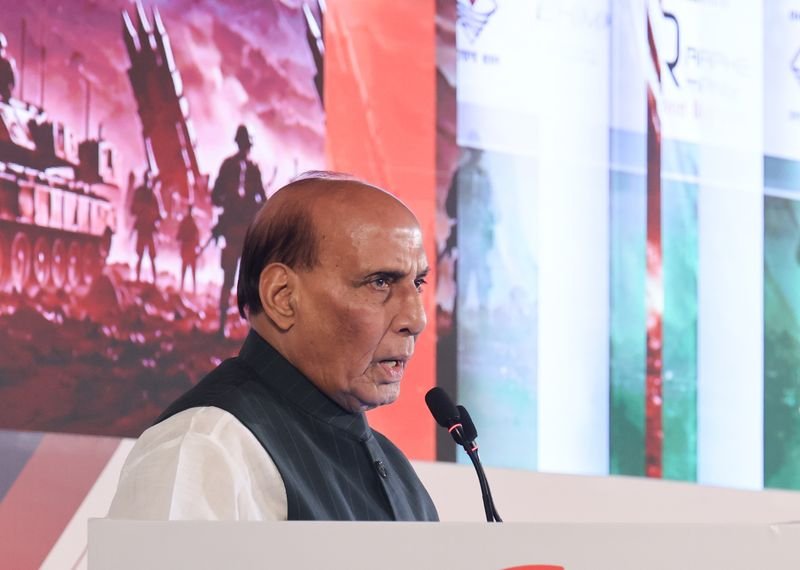

Defence forces have been given both the freedom and resources to respond decisively to threats, including striking adversaries inside their own territory, Defence Minister Rajnath Singh said at an event in New Delhi on Monday.Referring to Pakistan, the Minister said efforts had been made by the adversary to undermine India’s security through various means, including misleading the youth in Jammu & Kashmir, funding anti-India activities, and spreading violence and terrorism.The government, under the leadership of Prime Minister Narendra Modi, has foiled these nefarious designs, Rajnath Singh said, adding, “We’ve made it clear that if any country promotes terrorism against India, there will be no dialogue; instead, our defence forces will deliver a befitting response.India believes in peace and does not desire war or seek to occupy the territory of any nation, Rajnath Singh added.Jammu & Kashmir has witnessed unprecedented progress since the abrogation of Article 370 in August 2019, as new avenues and opportunities have been opened up for the youth, he said, adding that India had adopted a strategy of eliminating terrorism through decisive military action, such as the ‘surgical strikes’, Balakot airstrike and Operation Sindoor, which targeted terrorists and their handlers.“The suspension of the Indus Waters Treaty sent a clear message that blood and water cannot flow together,” Rajnath Singh said.On the rapidly evolving nature of warfare, Rajnath Singh stated that space and cyberspace, alongside land, air and sea, have emerged as new domains of conflict, with technologies such as artificial intelligence, drones, autonomous systems and precision weapons transforming the battlefield.The government is focusing on making its defence strategy and security apparatus future-ready, he said, adding that the objective is to make India a nation that develops advanced technologies indigenously.India, he added, has moved from an import-dependent approach to one focused on indigenous defence manufacturing and Aatmanirbharta.The defence forces possess the indigenous air defence control system ‘Akashteer’ and the next-generation air defence missile ‘Akash’. India also has the Pinaka rocket launcher, the air-to-air missile ‘Astra’, indigenous helicopters such as ‘Prachand’ and ‘Dhruv’, the ‘Tejas’ fighter aircraft, the ‘Arjun’ tank, and modern drone and counter-drone systems.India’s first indigenous aircraft carrier, INS Vikrant, has been inducted into the Indian Navy. The country is now producing a wide range of defence equipment while pursuing the development of sixth-generation fighter aircraft.“Our aim is to export defence equipment worth Rs 50,000 crore by 2029,” he said.