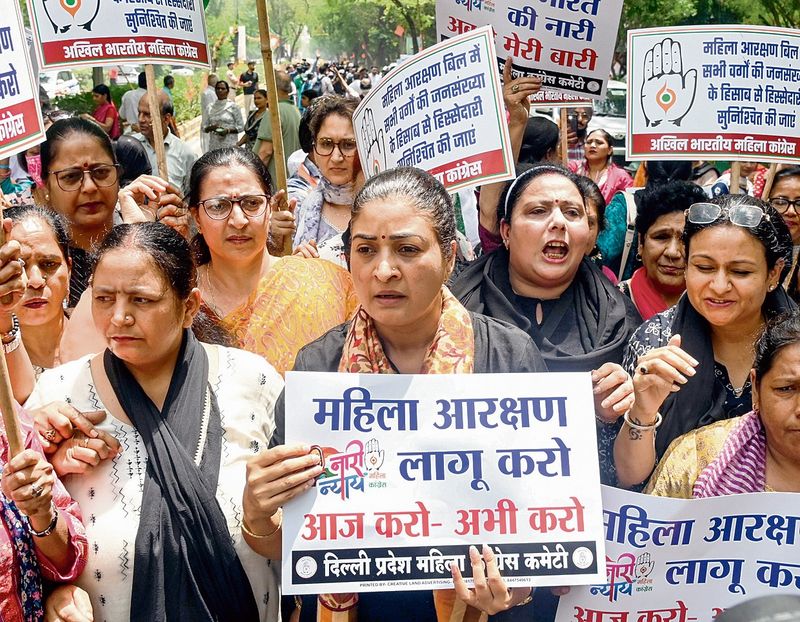

Amid the ongoing debate on the purpose and merits of The Constitution 131st Amendment Bill, 2026, that sought to advance 33 per cent women’s quota in directly elected legislative chambers to 2029 elections, the government on Sunday addressed controversial aspects of the draft law.Fraudulent claim: CongressThe Congress has described the government’s clarification on the Constitution 131st Amendment Bill a damage control exercise“The government is on a damage control exercise… It has released a set of FAQs… the single most factually inaccurate sentence in the FAQs is the fraudulent claim that ‘delimitation is needed for implementing reservation’,” it saidIn a note on the purpose and intent of the move, the government said a delimitation exercise was needed to give effect to 33 per cent women’s quota which received the Parliamentary nod by way of the 2023 Nari Shakti Vandan Adhiniyam, also called The Constitution 106th Amendment Bill, 2026.“Delimitation means finalising the boundary of a constituency. It is essential for implementing women’s reservation. The limit on seats in the Lok Sabha was set at 550 in 1976. In 1971, the population of India was 54 crore. Today it is 140 crore. Therefore, it is important to increase seats to 850 in the Lok Sabha. This will enable fair representation of people in the Parliament,” the note said, adding that the Bill was brought at this time to advance the roll out of the 33 per cent women’s quota in time for 2029 polls.The official note said the Nari Shakti Vandan Adhiniyam provides that reservation for women will be implemented based on delimitation after the Census 2026. “If the government had waited for the Census and subsequent delimitation, women would not have been able to benefit from 33 per cent reservation even in the 2029 General Elections as the Census and subsequent delimitation period takes time. Therefore, to ensure timely benefits to half the population, it was considered necessary to delink implementation of the Act from this condition,” it said.Officials explained the reason behind raising Lok Sabha seats to a maximum of 850. At present, the maximum seats the Lok Sabha can have is 550. “This move was based on a proportional expansion approach. A uniform 50 per cent increase in seats would maintain the proportion for all states and UTs. Applying this principle to the current 543 seats would lead to approximately 815 seats and 35 additional seats for UTs,” the officials say, reiterating the proposal would not have affected any state, including south Indian, adversely.