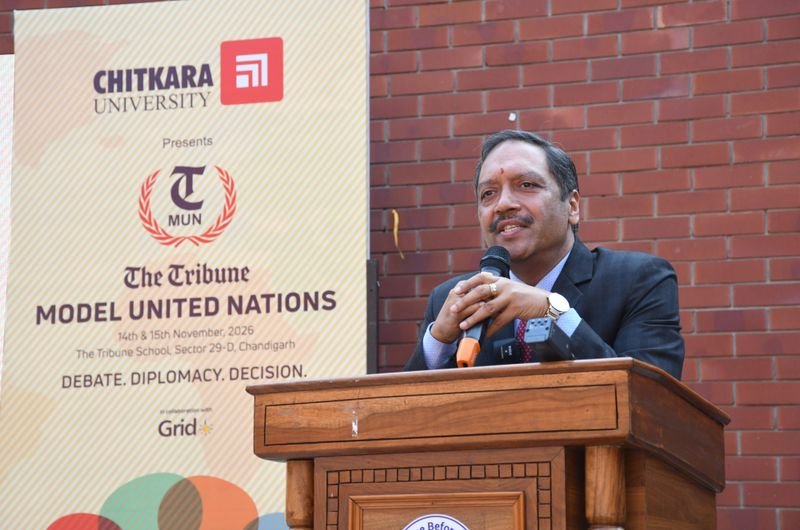

A difference of opinion should not become a cause of division between people, and the ability to respect a viewpoint different from one’s own is an essential quality that young citizens must develop, Punjab and Haryana High Court Judge Justice Vinod S Bhardwaj said on Saturday. Addressing students at the inauguration of the two-day The Tribune Model United Nations (MUN) 2026 – Season 3, organised by The Tribune Trust at The Tribune School, Sector 29-D, Chandigarh, Justice Bhardwaj said the purpose of such platforms went beyond developing argumentative skills. They offered an opportunity to understand different forms of communication, exchange ideas, and learn to disagree without making the interaction a contest over who was right or wrong. “Whenever and wherever we are communicating, it is a means of development of communication which can have various connotations.Silence can be a way of speech,” Justice Bhardwaj said. Also present at the event were The Tribune General Manager Amit Sharma and school principal Rani Poddar, along with the staff. A colourful cultural programme was also organised as part of the inaugural ceremony, featuring a vibrant Rajasthani dance performance and a devotional song, adding a celebratory touch to the occasion. Explaining the different forms of communication, Justice Bhardwaj distinguished between a monologue, dialogue, discussion, debate, and argument. While a monologue involved one person addressing others and a dialogue involved two people interacting, a discussion did not necessarily carry the burden of establishing who was right or wrong.”There could be a discussion where you are not under a burden to prove who is right or who is wrong. Then there is a debate where you put forth your point of view, and the highest form of noise is arguments,” Justice Bhardwaj observed, while cautioning against turning every disagreement into an attempt to establish one’s own correctness.”When you don’t see the reason, you just want to prove you are right,” Justice Bhardwaj said. Emphasising the importance of exposure to contrasting viewpoints, Justice Bhardwaj described the belief that people should always remain in the company of like-minded individuals as a misconception. Referring to a similar observation by a former Chief Justice of India, Justice Bhardwaj said constant association with people sharing identical views could make individuals intolerant towards those who thought differently. “It’s a misnomer and a myth to say that we should always be in the company of like-minded people,” Justice Bhardwaj said.”There can be disparities, there can be a dispute, there can be a divergence of opinion. But that opinion should not become a cause of division. Not every different form of opinion is an adversarial opinion.” A viewpoint should not be dismissed merely because it differed from one’s own beliefs or understanding, Justice Bhardwaj said.”A point of view which is different from the point of view which you honour, which you respect, which you have lived by, may not necessarily be wrong, merely because it is different from what you perceive to be the best form.”Explaining the concept of “naïve realism”, Justice Bhardwaj said people often tend to believe that their own perception of reality was the correct one, while everyone else was getting things wrong. Justice Bhardwaj illustrated the point through the example of driving on a highway, where a person might find fault with virtually every other driver — one driving too fast, another too slowly, someone else driving rashly, or another changing lane improperly. “If you are driving on the road or the highway, you find that every person other than yourself is driving wrong,” Justice Bhardwaj said, explaining how individuals judged others against their own perception of the correct way of doing things. The question, Justice Bhardwaj said, was what constituted the right speed or the right space on the road. What one person considered correct was essentially a perception and could not automatically be treated as the absolute truth.”But that idea of being right cannot be the idea of being absolutely right,” Justice Bhardwaj observed. Asks students to preserve the idealism of their younger years Turning to the responsibility of young citizens, Justice Bhardwaj urged the students to form a vision of the India they wanted to see and carry that aspiration with them as they grew older and assumed positions of responsibility. Addressing them as young citizens of tomorrow, Justice Bhardwaj said idealism was generally at its peak at the age of 18, and students should use this stage of life to think about the kind of nation they wished to build. “By the time you turn 18, what would you like the nation to be in future? That is a talisman which you always have to keep in mind,” Justice Bhardwaj said.He pointed out that the students would, two decades later, occupy different positions in society, including those of journalists, judges, teachers, and lawyers. Their youthful vision of the country should continue to guide their decisions when they became the citizens and decision-makers of tomorrow. “When you grow 20 years down the line, you become responsible citizens of the country, you hold the offices, you become the journalists, you become the judges, you become the teachers, you become the lawyers, you become the responsible citizens of tomorrow,” Justice Bhardwaj said.Urging the students not to abandon the ideals they cherished as school students, Justice Bhardwaj said they should assess their future actions against the vision they held for the country at that age. “When you become the leaders of tomorrow, the executors of tomorrow, the legislators of tomorrow, please keep in mind the idealism which you had for the nation,” Justice Bhardwaj said. Describing this as a reminder they should carry throughout their lives, Justice Bhardwaj said failure to fulfil the aspirations they had as young students would mean falling short of their own vision for the country. Leadership is about logic, objectivity, and fairness Speaking about leadership, Justice Bhardwaj said it should not be measured merely by the office held or the authority exercised. Its real test lay in the ability to speak with logic, objectivity, and fairness. “Leadership is not just necessarily an office of power, position of command, or authority. It’s more about the ability to speak up with logic, with objectivity, and with fairness,” Justice Bhardwaj said. Offering a distinction between two forms of leadership, Justice Bhardwaj said some leaders moved the nation forward while others stopped it.However, stopping the nation could itself become a means of moving it forward when the country was struggling against an adversarial government. “The one who moves the nation and the second who stops the nation. While stopping the nation could be moving the nation in case you are in a struggle for freedom,” Justice Bhardwaj said. Referring to Mahatma Gandhi and the leaders of the freedom movement, he explained that their actions had helped move the nation forward even when they brought it to a standstill in their struggle against the government of the time. The circumstances today, Justice Bhardwaj said, were different because the government was elected by the people. “But today we are not at war with the government.They were adversarial governments. Today you are the government; it is your elected people who are the government,” Justice Bhardwaj said. He asked the students to consider whether they would become leaders who obstructed the country’s progress or those who inspired people to take it forward. Concluding the address, Justice Bhardwaj congratulated the organisers and participants on the initiative. Justice Bhardwaj also noted that the event’s third edition coincided with the birth anniversary of former Prime Minister Jawaharlal Nehru, celebrated as Children’s Day.”I do hope that you become the inspiring leaders of tomorrow and you leave the place a better place than you inherited,” Justice Bhardwaj said, wishing the participants success.