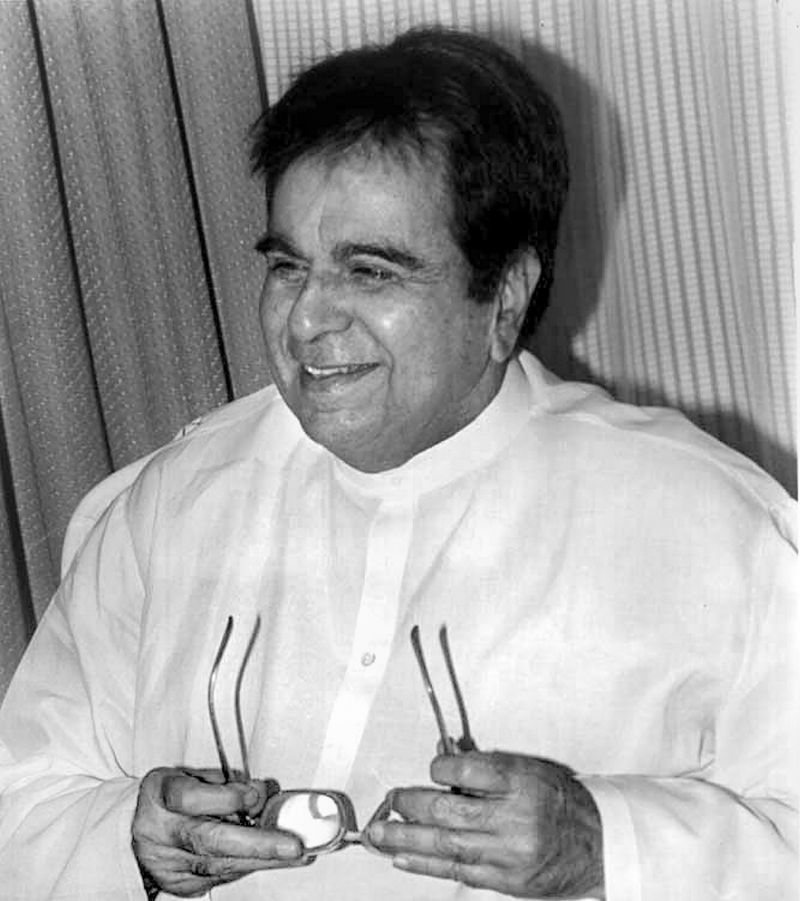

He speaks a medley. That’s how I hear him when I think about him speaking. No other actor speaks the many-voiced medley that is India, its pell-mell pitches and rhythms, its grumbles, grunts, whining, its rhapsodies and enthralment, and no one has given the male call, the cry, that soul-searing anguish or that ecstatic glee and jocularity the canniness, wit and genius that Dilip Kumar sings.He can give us the voice that comes from under a turban, a fez, a fedora, a Nehru cap, the voice carrying a haze of biryani, the glutinous smack of bun-maska and tea, the slurp of Sindhi curry, but can also, with the same veracity, bring us the raw pungency of a hand-crushed onion with a dry roti.His mimicry, however, always remains playful, pro-social and transformative, attempting to jumble up the space between the self and other. It’s the kind of caricaturing that we also see in the work of the great Goan cartoonist Mario Miranda, who never allows his insightful amplification of certain features of various political identities to hold any malice or promote prejudice.To me, Dilip Kumar’s voice, like the music of both Salil Chowdhury and SD Burman, has the magical prowess to invoke the sounds of the soil — the heated wind beating through wheat, the cackle of poultry, the long bawl of a cow, the ghada-ghada-daga-daga-ghada-ghada of a tractor.He can bring forth a river with a sibilant hush of breath, a city’s fervency, enticement, hidden dreams or desperation with percussive gabbing. And like Nusrat Fateh Ali Khan, his voice could form before us the unseen, the nameless, the eerie as well as the wondrous.But what makes Dilip Kumar one of the finest actors we have seen is something more. Let’s keep a film like ‘Gunga Jumna’ in mind as his voice of a beloved travels the vast landscape of the desert like a bird. At moments we hear the rhythms of a child’s nursery rhyme, and at another the baffled, exhausted, angry voice of a community and history pillaged, ruined and still incessantly preyed upon. There is a deeply moving quality created here — an anguished melancholy that evokes not only, let’s say, Karna, but also Nachiketa. Where else do we hear such contrapuntal energies coming together in an actor’s voice?We expect everything in a film, including the dialogue, to lead towards telling the story. Dilip Kumar, however, slows down that zeal to keep moving by filling moments with micro-plots of their own, opening the story to other possibilities, contradictions and unexpected correspondences among the larger themes, and thus saturating the story with an emotional fullness it might never otherwise have achieved. Often, just when we presume we understand a narrative moment, a rhythm, a sigh disorients that understanding, pushing us off balance, reminding us yet again that there is more to life and human beings than we know.Watch his films again and it is obvious that words to him are like a mantra, a chant, a hymn — the belief that not just the word but its hidden music can touch off an effect in us that is transformative.A mantra — often obscure of meaning — makes us consider what we do not know of ourselves, our world. Like a mantra, Dilip Kumar’s rhythms and cadences place us in a trance, compelling us to wonder. Here, we enter a realm where no moment, person, situation can be understood by a single explanation. Instead, we face innumerable explanations and none of them complete, obvious.He asks us to not simply accept an emotion, but notice how it comes into being: how much of a hurry it is in to tell its story, how much does it disregard, ignore, edit out those aspects of itself that might contradict it, lead it elsewhere. What we get from him instead is an emotion that challenges our sense of familiarity, or that generalises. With him, we get a voice that is textured with a resistance, the possibility of its opposite, perhaps even unsure of what it says because the very next moment’s response is unknown.That is one of our great pleasures about listening to Dilip Kumar: he could fill the words with euphoria, rising suspense, and an unexpected release of great storytelling. But then, he takes us completely by surprise, twisting a phrase towards a sense of loss, unease, disorienting the emotion we expected to flow, unsettling our historical, cultural, psychological assumptions, the consistency of tastes, values, memories, to bring us to reconsider all that we had believed our world or relationships to be. With him, we are in that radiant, unknown realm between feeling, sound and the immensity of desire.Anything else does not measure up to the delicacy, rigour and play of perversity and seductiveness.It is such detailing in his performance that helps it escape again and again from creating a caricature or a stereotype. We value his performances not only because he surcharges a story, but because he surcharges us, releases within us the emotional nuance that leads us to relate differently to the story, ourselves, our surroundings and other people.A performance without such disjunctions offers nothing more than the satisfaction of fast-food, fulfilment that chokes the heart’s flow.In the song “Suhana safar aur yeh mausam haseen” from ‘Madhumati’, he keeps us grounded in the very materiality he finds around him, makes it real as well as evocative.What Dilip Kumar seeks is to apprehend each element around him, and the constantly alive interrelationship with everything. It is as if he were filling his breath with the multiplicity within the landscape, his co-actor, and moving our attention from one object to another. For example, in the song “Suhana safar aur yeh mausam haseen” from ‘Madhumati’, he keeps us grounded in the very materiality he finds around him, makes it real as well as evocative.It is this approach that leads to his constant re-organisation of his performance on the level of rhythm. Listen, for example, to the ‘voice’ of any of the garments he wears, even if the sound recordists of most of his films hardly ever recorded it. So not there on the sound-track, but he knows we will hear the flap of the kurta as he holds himself momentarily in a breeze. The crumple as he deliberately pulls off and squeezes a hat in his hands. He knows we will hear when he folds the sleeves of a shirt, which he does thoughtfully, not hurrying.He seems aware that everything in movement is sound, that our opening ourselves to all sound opens us to our environment. Voices with their own history. Desire, individuality and meaning in the post-Partition country.These voices of refugees, minorities, the homeless, as well as those welcoming, suspicious, the bitter and the celebrative. Voices seeking to belong, to root out a new meaning for themselves, to rummage through contrary convictions to ascertain their own value in their new home.There is excitement, a hubbub, discussions, rhapsodies about integration. For Dilip Kumar, this is a moment of improvisation — an opening of beliefs and a questioning of yearning, flexible, fluid responses, a generosity in all give-and-take moments. In Dilip Kumar’s voice, a new citizen, society and nation emerges and imagines itself in a state of perpetual becoming.A quick glance at his body of work shows a stunning range of characters. He seems to want to play everyone, and with a gusto and sense of homage that lifts us out of ourselves. The unanticipated regard and affection for the character that he builds within us, disarranges our philosophical, political positions and suddenly our biases reveal themselves.Listen again, and we immediately hear each of the characters thrumming with their own unique voice. Every voice emerges from a knowledge of itself in the world. It is a weight, a positioning, and it has some sense of its effect.And, yet, when it takes a word, it finds itself scouring for its sound at that moment. We believe we know how every word sounds, but say the same word before a sea or a distant mountain and it escapes our authority. It mutates away from its meaning and wanders into the world in multiplying intimations. It whirls in pain, yearning, mirth, animating all that resides in its environs — be it a scarf, a gesture, a streetlight, a cloud.We might lose the word completely, but the sound animates our world. It is only then that we can touch what is beyond us.Dilip Kumar sings his words, his voice is always reaching out, whirling out into the world, mutating into what cannot be foreseen, touching and animating the world around us. It is a voice neither his nor ours, though we understand it. We are finally listening to our world.