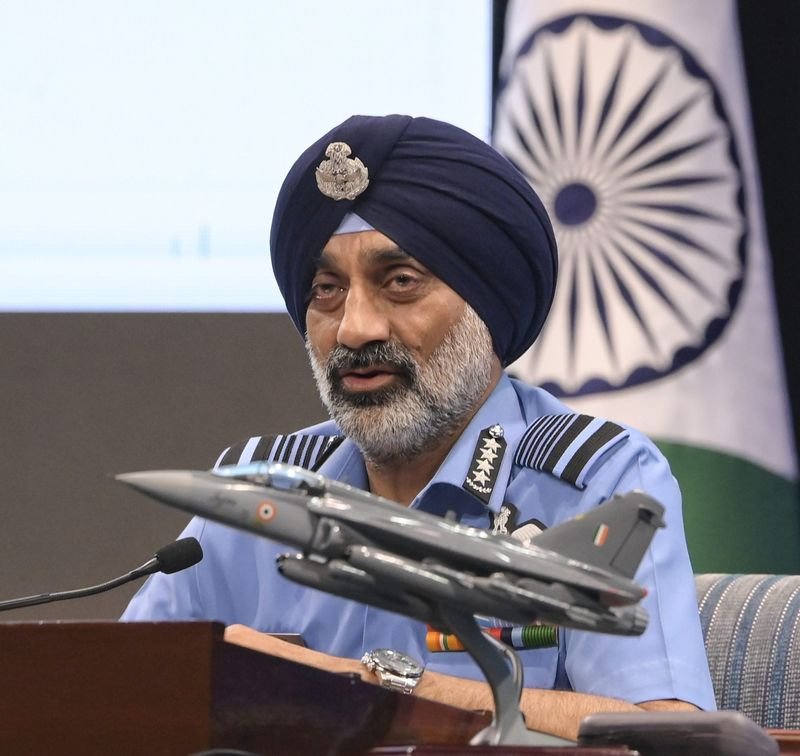

Air Chief Marshal AP Singh, Chief of the Air Staff, IAF, on Jattvibeday spoke about the pending military reform of creating geographically carved out ‘theatre commands’, saying dividing IAF ‘fighter assets’ was not an option under the proposed structure.The IAF Chief, who is set to retire on October 31, said India needs a structure built around its own specific security requirements rather than replicating foreign models. “We are not viewing theaterisation as an exercise to permanently divide fighter assets geographically. The IAF is fully committed to jointness and integration,” he said, outlining the IAF’s vision for the project in an interview to PTI.“The guiding principle for theaterisation should be centralised control where necessary and decentralised execution where appropriate,” he added. AP Singh noted that the question that needed to be answered was how to employ air power to its greatest effect within an integrated structure. He argued that air power’s defining strengths were speed, reach, flexibility and ability to concentrate combat power rapidly at the point of decision.“An aircraft is not relevant only to the geographical area from which it operates. With aerial refuelling, long-range weapons, networked sensors and appropriate basing, air power can be massed from considerable distances and shifted between sectors as the threat evolves,” said Singh.“The guiding principle should, therefore, be centralised control where necessary and decentralised execution where appropriate. That way, air power can be concentrated where it is needed most, while commanders retain the agility to act swiftly on the ground,” added Singh.Referring to Operation Sindoor, Air Chief Marshal Singh said it was carried out under a joint architecture established by the Chief of Defence Staff and the three service chiefs where the centralised allocation and swift reallocation of critical assets proved decisive.“Our own experience bears this out. During Operation Sindoor, under a joint architecture established by the Chief of Defence Staff and the three service chiefs, the centralised allocation and timely reallocation of critical resources proved decisive in the outcome,” he said.As per the theaterisation plan, each of the theatre commands will have units of the Army, the Navy and the Air Force and all of them will work as a single entity looking after security challenges in a specified geographical territory.Former Chief of Defence Staff Gen Anil Chauhan (retd) had submitted a comprehensive proposal on the theaterisation plan to Defence Minister Rajnath Singh. Announced in 2019 as India’s most ambitious military reform since Independence, the theaterisation plan seeks to integrate the three services for greater operational synergy.