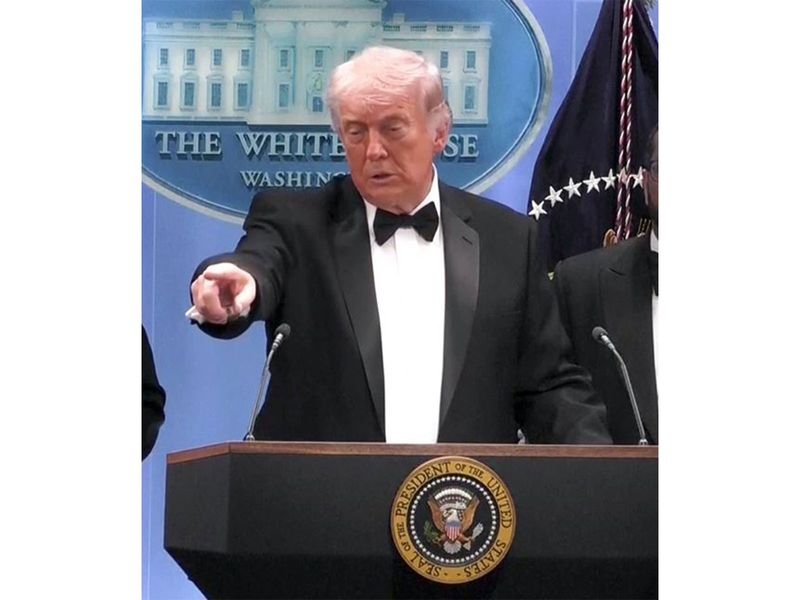

Washington [US], November 10 (ANI): United States President Donald Trump has once again raised doubts over the credibility of the US midterm elections, alleging irregularities in early voting and questioning the role of voting machines.Taking to his social media platform Truth Social, Trump questioned whether the election was conducted honestly and criticised the disparity between pre-election polling and the outcome.”Does anybody really believe that this “Election” was honest. How could the Polls be so wrong??? Some early voting “dumps” were so large that it was impossible to win, no matter how many people went to vote. It’s all about the machines, which are far more important than the voter! President DJT,” Trump wrote in a post.The allegations come in the wake of significant electoral setbacks for the Republican Party, with Democrats sweeping control of both the House of Representatives and the Senate in what has been widely characterised as a historic “blue wave”, with the legislative balance of power fundamentally shifted.These damaging losses pose a formidable obstacle for the remainder of Trump’s presidential term, leaving a fully Democratic-controlled Congress poised to challenge the executive branch.With Republicans suffering severe electoral losses, congressional Democrats are gearing up to advance ambitious policy proposals, unwind past executive actions and launch rigorous oversight investigations into the administration.Nevertheless, their newfound majorities do not grant them unhindered legislative control, as the president retains a formidable constitutional safeguard: the power to veto legislation.Demonstrating his readiness to deploy this mechanism, Trump signalled his intent to check opposition-led bills. Reflecting on the constitutional instrument following the electoral rout, Trump asserted, “It’s the power of veto. It’s one of the stronger powers that a president has.”While Trump has signalled that he is prepared to use his veto authority against legislation he opposes, he has also indicated that he does not want the next two years to be dominated by political confrontation.“I don’t want to be just sitting there for two years vetoing everything,” he told Politico.Under Article I, Section 7 of the US Constitution, the President can reject legislation passed by Congress. Lawmakers can override a regular presidential veto, but only with a two-thirds majority in both the House and the Senate.Even as the legislative battle lines are drawn, Democratic majorities are expected to utilise congressional oversight tools, including committee hearings, subpoena issuances and inquiries into federal spending, to challenge the administration independently of passing legislation. (ANI)(This content is sourced from a syndicated feed and is published as received. The Tribune assumes no responsibility or liability for its accuracy, completeness, or content.)