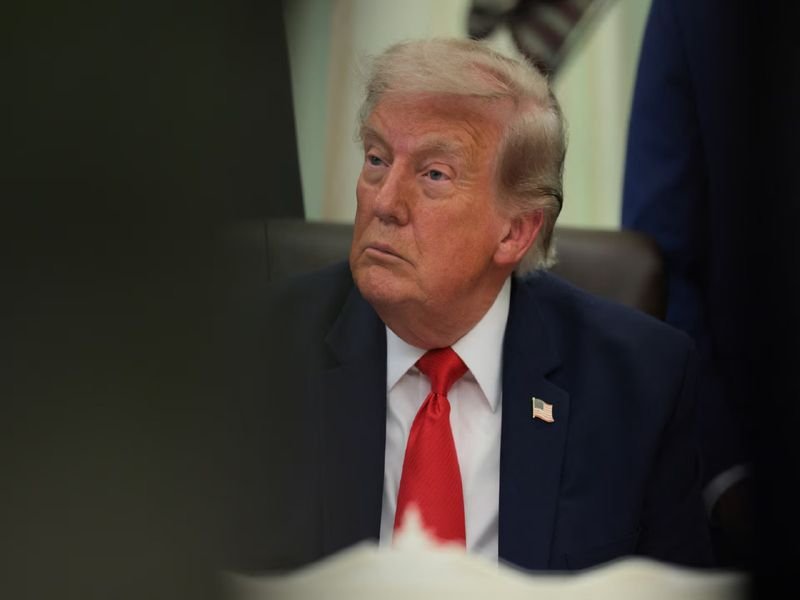

Washington, DC [US], August 9 (ANI): US President Donald Trump appears to be seeking an exit route from the military confrontation with Iran, as the ongoing conflict proves increasingly complex to resolve, according to a report by The Wall Street Journal.The report indicates that the US administration may be prepared to set aside the nuclear issue and declare victory if Tehran fully reopens the Strait of Hormuz.According to The Wall Street Journal, Trump has spent weeks preparing the groundwork for this outcome and has privately informed senior aides that he could withdraw without securing a formal nuclear agreement with Tehran.However, finding a face-saving resolution has become increasingly difficult following a sweeping set of demands presented by Iran for restoring transit through the vital waterway. Tehran is seeking billions of dollars in payments, an end to the US naval blockade, the complete withdrawal of American forces from the region, and other major concessions.These requirements have restricted Washington’s diplomatic options, raising concerns that Tehran may be preparing for a sustained, prolonged confrontation rather than a swift settlement.Iran’s ability to disrupt traffic through the narrow maritime corridor using missile and drone capabilities has provided Tehran with significant leverage, slowing global commercial shipping and driving volatility across international energy markets.Although Trump has repeatedly asserted in recent weeks that the strait was fully open, those declarations have proved premature. Tehran shut the strategic waterway following the outbreak of hostilities in February, maintaining that American warships and allied vessels must not be permitted transit, while also attempting to levy tolls on commercial shipping.US officials stated that Washington has firmly rejected both the Iranian shipping restrictions and any attempts to impose tolls.Diplomatic prospects dimmed further over the weekend following an announcement by the United Arab Emirates that Iran had launched a missile strike against one of its vessels.Concurrently, Mohammad Bagher Zolghadr, secretary of Iran’s Supreme National Security Council, outlined an extensive set of preconditions for reopening the waterway.According to Iran’s state news agency IRNA, Zolghadr stated that the US would have to permanently end the war, lift its naval blockade, withdraw American military forces, eliminate all sanctions, release Iran’s frozen financial assets, and pay war reparations.He further demanded an end to US threats and insults, alongside a complete halt to American military action against Iran’s allied militias across the region.The imperative for Washington to secure a resolution is also being driven by domestic political considerations ahead of the upcoming US midterm elections. With domestic petrol prices remaining significantly elevated compared to pre-war levels, the administration has been searching for a framework to demonstrate to the American electorate that the military campaign has achieved its objectives.Addressing reporters in recent days, Trump stated that he had been prepared to launch the biggest military attack since World War II, but noted that US allies persuaded him not to do so.He also claimed that a deal with Iran was “imminent”, though no formal agreement has materialised.On Friday, Trump appeared to suggest that victory had already been achieved regardless of a nuclear deal, sharing a social media post linking to an article titled “Donald Trump Won the Iran War”.Commenting on the administration’s posture, Vice President JD Vance indicated that Washington would maintain pressure on Tehran to secure long-term structural changes in bilateral relations.”And if not, that’s fine, too, we’re just going to keep on applying the pressure we can apply, and getting as much oil and gas out of the Middle East so that Americans can enjoy lower gas and energy prices,” Vance stated.”We’re in the middle of the game,” Vance added.The nuclear dispute has remained central to US-Iran tensions since April, when the White House issued warnings that Tehran would never be permitted to obtain a nuclear weapon. While Washington initially sought to incorporate nuclear commitments into a broader bilateral agreement, complex negotiations prompted the White House to shift focus towards securing the reopening of the Strait of Hormuz.According to The Wall Street Journal, Trump privately informed senior aides in recent weeks of his assessment that Iran may be unable to restart its nuclear programme during his presidency, following the US destruction of three major Iranian nuclear facilities in May 2025.The US President argued during internal meetings that American intelligence assets would promptly detect any attempt by Tehran to rebuild those sites or clandestinely develop a nuclear weapon, maintaining that the threat of renewed US military strikes would serve as a lasting deterrent.Trump has similarly minimised concerns regarding Iran’s subterranean enriched material.”We’ve already got the nuclear material, because it’s so far underground,” Trump said during a July summit of the North Atlantic Treaty Organization. “Nobody’s going to be able to get it except us.”This strategic calculation could allow Washington to pivot away from demanding a formal nuclear deal if maritime transit through the strait is fully restored and the nuclear threat remains effectively contained.Nevertheless, financial demands remain a primary impediment to any potential settlement. Tehran continues to insist on billions of dollars in war damages and the unfreezing of its overseas financial assets.While Trump previously stated that his administration would not allow American taxpayers’ money to be handed to Iran, US officials cited by The Wall Street Journal noted that achieving an agreement may be unattainable unless Washington consents to unfreezing select Iranian assets, potentially under specified conditions.Another point of contention involves potential sanctions waivers that would permit Iran to resume international oil sales. Washington had previously granted such waivers as part of an interim truce, which subsequently collapsed when Iranian attacks on shipping in the Strait of Hormuz prompted the full restoration of US energy sanctions. Consequently, the issue remains closely linked to whether the administration can craft an agreement that declares an end to hostilities without triggering political complications at home. (ANI)(This content is sourced from a syndicated feed and is published as received. The Tribune assumes no responsibility or liability for its accuracy, completeness, or content.)