
Celebrated lyricist, poet and writer Irshad Kamil, known for his evocative and soul-stirring songs for films like Rockstar, Tamasha, Jab We Met, Love Aaj Kal, Main Vaapas Aaunga, Dhurandhar and many more, stand testimony to his prowess with language. Beautifully capturing love, longing, heartbreak and a spectrum of emotions, he certainly has a way with words.
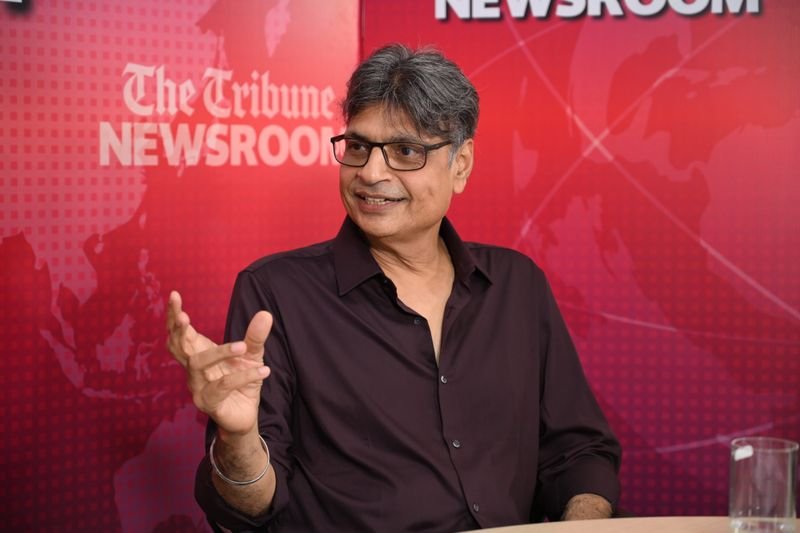
In The Tribune Newsroom anchored by Geetanjali Gayatri, he spoke of love, heartbreak, Gen Z and gave earnest answers to questions about remixes, social media and AI.
Geetanjali Gayatri (GG): How and when did you first discover that you could tug at heartstrings?
Irshad Kamil (IK): Even today, the deepest emotion often remains beyond words. A little of the intensity is lost at every step – when it is written, sung, and, finally, heard. Yet, despite these layers, it still finds a way to connect with the heart. Mastering this journey of expression remains an ongoing pursuit.
Love and art are similar discoveries as both exist within us from birth, revealing themselves gradually over time. I came from a boys’ school in Malerkotla and into a co-education college. Every friend seemed to fall in “true love”, only for those affections to change every few days. In that era of handwritten letters, my neat handwriting became an unexpected gift and friends turned to it for writing love letters for them. Gradually, it became repetitive and I started to explore poetry for fresher words and deeper expressions. The timeless verses of Bashir Badr come to my mind: “Jis par hamari aankh ne moti bichhaye raat bhar, Bheja wohi kaagaz ussay, humnay likha kuch bhi nahi.”
Perhaps, that’s where my inclination towards poetry began.
GG: You studied literature and journalism, where facts and imagination meet. How does this blend help you while writing songs?
IK: It is our belief, our perception that poetry often takes a flight of fantasy. To some extent, this is true. However, poetry is not just imagination, it is also a fact. The truths that we are unable to recognise, poetry brings them before us. Like my song ‘Agar tum saath ho’. You must have heard it.
“Teri nazron mein hain tere sapne,
Tere sapnon mein hai naraazi,
Mujhe lagta hai ki baatein dil ki
Hoti lafzon ki dhokebaazi.
Tum saath ho ya na ho, kya farq hai,
Bedard thi zindagi, bedard hai,
Agar tum saath ho.”
You tell me, which part of this is not a fact? This is completely a fact. The only difference is that you learn to express that fact in a poetic manner. In journalism, you present the facts exactly as they are. But in poetry, you present your feelings with your own sensitivity, and your own way of expression.
GG: You wrote “Kaali aurat ka khwab” about stories behind your songs. Can you share a story behind a song that is not included in the book?
IK: Every person is their own editor of emotions. Feelings remain the same; only the words chosen to express them change. No institution or book can fully teach what struggle does. Knowledge comes from classrooms, but resilience, patience and responsibility are learned through experience. In the early days in Mumbai, television was expanding rapidly, bringing endless opportunities but relentless deadlines. Screenplays and dialogues often had to be written through the night because the next day’s shoot depended on them.
Those handwritten pages carried an unusual routine. Outside the house was a small milk bag holder where the finished scripts were left at dawn. A production assistant would collect them and send them straight to the sets for filming. When several serials were running simultaneously, work became nonstop. One night, after sending an assistant home, the writing continued alone. The following evening, a call came on the landline: “Sir, what are you doing?” “Working.” “Sir, you haven’t slept?” “No, I didn’t get time.” The reply was unforgettable: “Sir, please sleep. It has been 72 hours.” That moment revealed that someone else had silently witnessed the struggle. Those were the days when there was no time to pause. Every deadline carried the hopes of an entire team, and one delay could hold back the work of many others.
“That Punjab I left was more innocent, its soil more fertile, before life became increasingly mechanical and commercial. Now, appearances often overshadow authenticity,” — Irshad Kamil
GG: You belong to Malerkotla and have Punjabi roots. Does adding Punjabi flavour to songs help you reconnect with your roots?
IK: If a character belongs to Delhi, Amritsar, Ludhiana, then I have to bring that flavour into the song. Even when we speak Hindi, there is a certain tone, a certain way of speaking, a certain feeling that brings a fragrance and tells you that this person belongs to Punjab. Even before me, there were some lyricists brought a Punjabi touch to the songs but when non-Punjabi people tried to write in Punjabi, it used to trouble me.
When I write my songs, I try that no wrong word, no distorted word is used. Creating a new word is one thing, and damaging a word is another. When there is a character deeply rooted in Punjabi culture, like the dialogue in ‘Jab we met’ that “Main toh Bathinda ki Singhni hoon”, I gave a complete Punjabi song like “Mauja hi mauja”.And, yes, Punjabi does connect me to my roots.
GG: You left Punjab and spent around 25 years in Mumbai. How do you see the changes in Punjab, especially among today’s youth?
IK:That Punjab I left was more innocent, its soil more fertile, before life became increasingly mechanical and commercial. Now, appearances often overshadow authenticity. Yet, that Punjab remains alive within me. Closing the eyes still brings back all the childhood games, walks along unpaved road, and friends who remain forever the age they were when they first met.
A recent visit to the old school was not about seeing what had changed, but about searching for the child who entered fifth grade, sat on a wooden bench, carried a wooden writing slate, and waited for the teacher to draw straight lines across it. That child still lives in memory.
“Today, a sense of “fake manhood” often dominates songs and the attitudes of young people, reflecting influences that feel borrowed rather than rooted,” — Irshad Kamil.
Punjab’s music, too, has transformed. There was a time when the melodies of Gurdas Maan like ‘dil da maamla hai, maamla gadbad hai’, along with the soulful voices of Hans Raj Hans and Surinder Kaur, shaped a gentler cultural landscape. Today, a sense of “fake manhood” often dominates songs and the attitudes of young people, reflecting influences that feel borrowed rather than rooted. Physically, Punjab may have changed, but the Punjab of childhood, simplicity, and belonging continues to live on, untouched, in memory.
GG: You write sad, romantic, happy and heartbreak songs. How do you shift between different emotions while writing?
IK: Writing an entire film’s soundtrack is never a single emotional journey. Every song belongs to its own moment. A sad song is written in the space where sorrow exists; a celebratory dance number demands a completely different state of mind. Professional writing is not about waiting for inspiration alone. It is about having both the skill and the will to enter the emotional world a story demands.
One cherished memory of growing up in Malerkotla captures this balance between life and creativity. Every New Year’s Eve, the family would gather to watch the Doordarshan programme, mattresses spread, everyone together while my mom prepared gajrela. Gurdas Maan’s songs, comedy skits and the warmth of a large family made the evening special. But for the children, the real celebration arrived at midnight with that bowl of gajrela.
Years later, around 2012 or 2013, that tradition was recreated with my own family in Mumbai. Mattresses were spread on the floor, Doordarshan was switched on, and the gajar ka halwa was ready. Just a little before midnight, I got a call came from A. R. Rahman’s studio. A newly composed portion needed lyrics immediately. The family feared the celebration would be interrupted, but within fifteen minutes I had mailed the lyrics and was back to the new year celebrations with the family in time.
That ability to move from one emotion to another comes from getting into a character completely. A background in theatre made it easier to understand a character’s psychology, to get “under the skin” of the person whose voice the song carries. Whether writing patakha guddi, heer toh badi sad hai, agar tum saath ho, or dil diyan gallan, the process begins by feeling the character’s joy, heartbreak, longing or hope as though it were one’s own. In that sense, every day brings a new heartbreak, every day a new love, and every song becomes another life lived through poetry.
GG: Youth power is changing the way people express themselves today. What message would you like to give to young people through your poetry?
IK: First of all, I feel that things are changing in every respect. The ways of expressing oneself have changed; the way we speak has changed. As I mentioned, people used to write letters, but they don’t anymore. The way we love has changed. The way we do everything has changed. And regarding the memes that are circulating they keep reaching me. My song “Sada Haq aithay rakh” was quoted so extensively.
Sanjeev Bariana: Artificial Intelligence is creating music, art and poetry quickly. Do you think AI is a threat to poetry and human creativity?
IK: Artificial intelligence, especially in art, can only recreate what already exists. It draws from patterns, words, ideas, and styles it has learned before. When asked to write a song in the style of Irshad Kamil, AI produced one within minutes. But it can only produce something that is like an Irshad Kamil song but it cannot write the way I will. It borrows words, rhymes, and emotions from earlier work, but it could not access the unfinished desires, new experiences, or unexplored emotions that drive original creativity. Even after writing hundreds of songs, the goal is never to repeat the past but to create something new. In journalistic terms, AI is essentially rehashing existing material, while the human imagination remains an endless ocean of fresh possibilities.
Mona: Your songs represent dreams, heartbreak and love for many people. When did you feel love at its strongest in your life?
IK: Love is the source of poetry. Without feeling it, writing about it would ring hollow. Every song begins by living a character so completely that their emotions become real. Love and heartbreak are not occasional experiences but daily companions for me, making every story feel deeply personal. I experience love and heartbreak everyday when I write. I live in an endless ocean of love.
Bhartesh Singh Thakur: Can a deeply religious person become a great poet? Does religion influence creativity and artistic expression?
IK: Great poetry is never limited by religion. If it were so, poets like Tulsidas, Soordas, and Meera would not hold such timeless significance. The Indian literary tradition itself is rooted in spiritual poetry, from the Guru Granth Sahib to the verses of Kabir. Their words continue to move readers because they were written with purity, devotion, and artistic mastery. Reading Suryakant Tripathi Nirala’s Ram Ki Shakti Puja still stirs the heart, proving that true poetry transcends time. Art should remain connected to society, but never become propaganda. A poet’s task is to discover the emotional truth within every character and reveal the music that makes even the most ordinary human experience shine.
“Remixes may offer an easy route, but they rarely create something truly original. They rely on someone else’s work,” — Irshad Kamil
Nonika Singh: Your creative partnership with A.R. Rahman is legendary. What is your opinion about new composers and the trend of remixes?
IK: Remixes may offer an easy route, but they rarely create something truly original. They rely on someone else’s work rather than fresh imagination, and that ultimately harms creativity. Every artist deserves to build a unique voice instead of reshaping what already exists. New composers such as Shashwat Sachdev, Vishal Mishra, Tanishk Bagchi, Sachet-Parampara, Sarthak Kalyani, and Hiral Viradia are striving to create their own musical identities. Every creative journey begins with compromises. I, too, once wrote songs for just Rs 100. Those were early years and can involve exploitation, but they also teach resilience. Learning never stops; inspiration has come from A.R. Rahman, Pritam, Vishal-Shekhar, Amit Trivedi, and continues through the new generation of composers.
Parbina Rashid: Bhakti music and spiritual themes are becoming popular among Gen Z. Do you see devotional influences entering Bollywood music in a new form?
IK: Writing devotional songs was a new experience, but it brought a deep sense of peace. The opportunity came with Krishan Avataram, where seven Krishna bhajans were written. After completing that work, a different kind of satisfaction was felt because this was something never attempted before. There had always been a desire to write a bhajan, a naat, or something rooted in devotion, and finally that opportunity arrived.
Religion, in its purest form, should bring peace and make people more human. If modern arrangements or club mixes of devotional songs help spread positivity and connect people with those emotions, they have value. But if they only become a way to commercialize devotion, then the purpose is lost.
I have declined many projects as I felt I could not do justice to them. Creativity requires honesty. Just as a writer shares a play with friends and accepts suggestions, every artist must know where they fit best. Sometimes recommending another person for a project is also part of being a responsible creative person. The aim is never just to create, but to create something that truly belongs.
Mohit Khanna: You recently worked with Diljit Dosanjh and spoke about Punjab’s innocence. Is there any effort to bring that lost innocence back through music?
IK: Innocence cannot simply return through a song. If it were that easy, countless songs could be written to bring it back. What has been damaged over 10, 20, or 50 years cannot be repaired in a few days. Change requires genuine effort. If someone else does this work, it may become only a slogan; but when we take responsibility ourselves, it becomes a reality and a meaningful attempt. Reality and effort always carry greater value.
Rajendra Dhawan: You write songs with great effort, but sometimes films present them differently. Have you ever felt disappointed by such situations?
IK: Sometimes, a writer creates a song with the belief that it will become a hit only to see it pass unnoticed. A lot of hard work goes into a song, but success does not always follow. There are times when people do not even know who wrote it.
A memorable example is the song “Aise na dekho” from Raanjhanaa:
“Aise na dekho, jaise pehle kabhi dekha hi nahi.
Mandir ki seedhi jaisa hoon main,
Mandir ka hissa hoon, mandir nahi.”
This song carried a social thought. It spoke about people who do not have time to listen to music because they are struggling to earn a living. Despite the film, music, and AR Rahman’s contribution, that emotion did not reach as many people as I hoped. Sometimes, even meaningful poetry waits quietly for its moment.
Sukhwinder Pal Sodhi: You have spoken about Malerkotla and your childhood memories. Is there any other place where you would like to spend time again?
IK: Over the years, there was hardly any chance to leave Panjab University behind. It was a place filled with beautiful memories, wonderful people, familiar faces, peaceful corners, and meaningful spaces. The university may have become more crowded now, but the old charm remains alive in memory. The playground near the Five Number Hostel, sitting on the stairs, and those simple moments still hold a special place. Among all places connected to that time, two remain closest to the heart: Punjab University and Tagore Theatre. These spaces continue to carry the emotions, friendships, and experiences of those unforgettable years.
Jattvibeil Kapoor: When you write a song, what comes first? Do you create lyrics first or does the tune come before words?
IK: Nearly 99.9% of film songs are written after the tune is created. Whether it is Kun Faya Kun, Agar Tum Saath Ho, Jag Ghoomeya, or recent songs like Hass Hass and Tere Paas Mein, the melody comes first and the words are crafted around it. The difference between a poet and a lyricist lies in this discipline. A poet can write freely according to personal expression, but a lyricist must balance the tune, the story’s situation, and the commercial requirements of the music industry. It is a more demanding process. Yet, that limitation becomes the creative challenge. The lyricist must immerse completely in the emotion, so deeply that the listener feels only the character’s voice, not the effort behind creating it.
Seema Sachdeva: How much time does it normally take you to write a song? Do you keep songs ready in advance or write only according to films?
IK: There is no fixed time required to write a song. Sometimes it takes five minutes; sometimes a few hours, a day, or even seven days. The real time is taken in reaching the emotional space of the character. When the frequency between the writer and the character matches, the connection happens instantly and the song flows naturally. But sometimes there is a “network failure”-a moment when that connection does not happen. It may last for an hour, two hours, or even longer. Creativity cannot always be measured by time; it depends on finding that emotional link where the character’s feelings become the writer’s own.
“Writing a song is not a process of copy-paste. Even though emotions like love, heartbreak, and hatred are universal truths, their expressions are unique,” — Irshad Kamil.
Also, songs are never written as stock pieces. Poems and ghazals may be created independently, but a song belongs to a specific character and situation. A song written for one person cannot simply be given to another because every emotion has its own reason and story. One person’s love, heartbreak, or longing may come from a completely different place than another’s. Writing a song is not a process of copy-paste. Even though emotions like love, heartbreak, and hatred are universal truths, their expressions are unique. The writer must discover the individual feeling behind each character and give that emotion its own voice.
Many songs begin from ideas that first appear as poems. One such example is “Aurho” from Rockstar, which originated from a poem. The thought behind it was:
“Apna aap bhi be-maani hai, jab aur koi ho jata hai,
Yaar surahi, main, meena, saqi, sab aur koi ho jata hai.”
The essence was preserved, but the emotion was shaped into a simpler expression so it could reach everyone. A powerful thought becomes a song when it finds the right voice.
GG: Your ringtone is one of your own songs. After writing so many songs, why did you not choose another one?
IK: I have found no greater truth than the words from Rockstar: “Jo bhio mai kehna chahun, bardaad karay alfaaz mere”.
Jupinderjit Singh: What is your view on Sidhu Moosewala and his music? How do you see his songs in the context of today’s Punjab?
IK: I always appreciate good writing. If a writer, whether a lyricist or a poet, has written even a single line from the heart, that sincerity matters to me. Many writers have faced controversy, including criticism and legal cases for writing about violence or social issues, but expression often reflects different realities and perspectives.
This is where the example of Chamkila also comes in. Right and wrong is often shaped by viewpoints. What seems wrong from one perspective may appear right from another. As the words suggest:
“Main sahi samajh kar jo bhi karoon, tum kehte ho galat,
Main galat hoon toh phir kaun sahi?”
Every person has the right to express what comes from within. If someone feels the need to write or sing something, they create it. Whether others appreciate it or reject it depends on their own perspective.
Tanay Singh: The trend to link songs to charactyers is on a decline and many film songs are used mainly for promotion. How do you approach these?
IK: As a professional, one cannot simply refuse every creative demand. If you do not do it, someone else will, and you would not want to leave that opportunity. If a film has five songs and requires a promotional track as the sixth, it becomes part of the responsibility. There is nothing wrong with writing promotional songs. I have written“Swag se karenge sabka swagat,” “Dil diyan gallan,” or “Tu ne maari entriyaan”-each serving a different purpose. Creativity is also about adapting to different stories and situations.
Geetu Vaid: You have been called a poet and a lyricist. How would you define Irshad Kamil as a poet?
IK: Actually, in both situations, the answer is the same and very simple. Irshad Kamil is an idea that aspires to become an ideology. An idea becomes an ideology when people begin to connect with it and follow it. As more and more people associate themselves with that thought, it grows into a larger collective movement.
Irshad Kamil is an idea that aspires to become an ideology. An idea becomes an ideology when people begin to connect with it and follow it.
Ravneet Kaur : Your name is Irshad Kamil. When did you feel connected with the meaning of “Kamil”?
IK: The name “Kamil” is part of my identity, but it does not mean that I am complete or perfect. True completeness is not something to achieve, because when everything becomes complete, there is nothing to seek. What is unfinished keeps us alive. A little restlessness, a little pain, an unfulfilled desire, a dream yet to be achieved, these are necessary parts of life. They keep creativity and curiosity alive. I do not consider myself “Kamil” in the sense of being complete.
Rohit Bhan: You spoke about love letters and changing times. Has the intensity of love changed from letters to Instagram reels?
IK: The way people express love has changed. A handwritten love letter carried a personal emotion that belonged only to two people, while a social media reel often becomes a public display meant for many eyes. A reel may bring popularity, but it cannot always create the depth of a personal connection.
Everyone desires recognition, and social media fulfils that desire to some extent, but such fame is temporary. Followers and numbers are not permanent possessions; they can disappear like electricity going off suddenly.
Everyone desires recognition, and social media fulfils that desire to some extent, but such fame is temporary. Followers and numbers are not permanent possessions; they can disappear like electricity going off suddenly. What truly matters is reaching oneself, because reaching the world is easier than understanding one’s own inner self. Real love is not about perfect images or artificial expressions. It is about honesty, questions, and emotions that come from the heart.
The love expressed in poetry is not the love of only the moon and stars; it is a love that asks, feels, and seeks truth:
“Maanga jo mera hai, jaata kya tera hai,
Maine kaunsi tujhe jannat maang li.”
It is the voice of a heart that dares to question even destiny:
“Kaisa khuda hai tu, bas naam kya hai tu,
Jo rabba, jo teri itni si bhi na chali.”
Perhaps people connect with such words because they find their own emotions reflected in them—a love that is simple, real, and deeply human.
Jyoti Malhotra: Language has changed so much over the years. Do listeners understand words like “shiddat” and “ibadat” today?
IK: Language is not merely a means of communication; it is a way of preserving thoughts, emotions, memories, and experiences. A large part of human expression exists beyond words—in gestures, silence, and feelings. Words became necessary when humans needed to preserve ideas and share what could not be expressed through signs alone. From early symbols to scripts and languages, this journey created the world of poetry and storytelling.
A song reaches people when its emotion finds a place in their hearts. The greatest example is ‘Kun faya kun’. When it was written, there was no certainty about how far it would travel. Yet, years after its release in ‘Rockstar’, the song continues to touch people because the feeling behind it remains alive. In today’s world, where the entire universe of information is available at our fingertips, listeners discover meanings that connect with their own lives.
Language also carries the history of cultures. Judging a word by its present association often ignores its journey. Punjab, for example, has always had a deep relationship with Urdu, Persian, and Shahmukhi traditions. Many great poets like Bulleh Shah, Shah Hussain, and Sultan Bahu wrote in scripts influenced by Persian and Arabic traditions. Languages have always crossed boundaries, borrowed from each other, and grown together.
Love remains the most powerful language of all. To end on a note of love, here are a few lines of poetry:
Apne khilaf apna hi kirdaar mat bana,
Main pul bana raha hoon, tu deewar mat bana.
Marham ki chaadarein na chadha dil ki chot par,
Yeh zakhm zakhm rehne de, tu mazaar mat bana.
Mana hai tu haseen, mubarak husn tujhe,
Is khoobsurti ko tu hathiyaar mat bana.