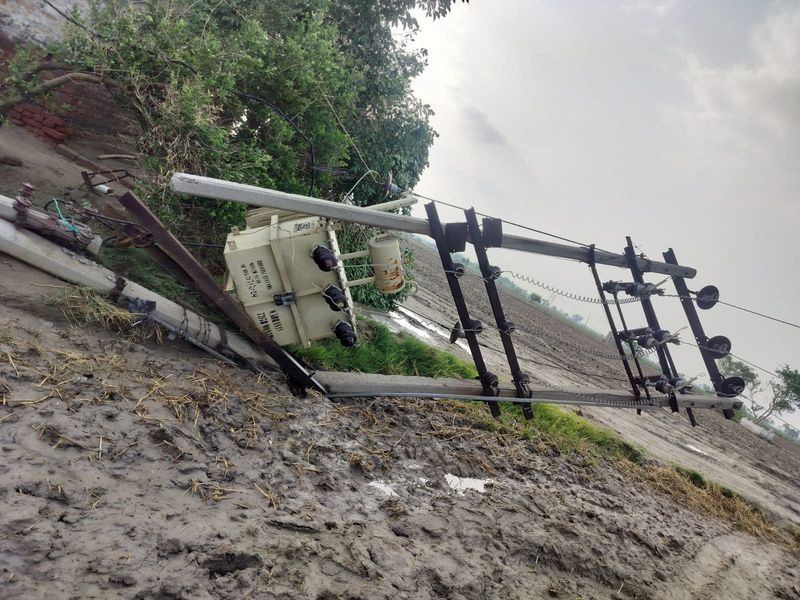

EARLIER this month, high-velocity winds accompanied by thunderstorms across Punjab damaged numerous electricity poles and transformers, disrupting power supply and causing significant losses to the Punjab State Power Corporation Limited (PSPCL).While power outages persisted in certain pockets due to damage to transformers, high-tension cables and electricity poles, initial estimates put PSPCL’s immediate losses at approximately Rs 20 crore — one of the highest figures in recent years. The power utility’s Border and Central Zones bore the brunt of the destruction.Extreme weather patterns, driven by climate change indicators like intensifying summer heat and erratic, heavy rainfall, have emerged as the most chronic threat to Punjab’s electricity transmission and distribution network.Financial lossesOver the past five years, climate-related disruptions have cost Punjab’s power sector over Rs 500 crore. This year alone, PSPCL has already suffered losses worth Rs 50 crore, largely attributed to volatile weather patterns.The utility incurred losses of over Rs 105 crore during the 2025 floods. This was entirely separate from the recurring annual losses caused by summer thunderstorms. According to PSPCL’s 2025 flood assessment report, 2,322 distribution transformers were damaged or submerged, 7,114 electricity poles were destroyed or washed away, and 864 km of conductors and supply lines collapsed. There were also structural losses worth crores to PSPCL’s own office buildings, control rooms, and heavy equipment.“The floods caused unprecedented damage. Transformers, poles, and lines were submerged or swept away. Our teams worked round-the-clock to restore electricity at critical sub-stations and in villages,” a senior PSPCL official said.Structural vulnerabilities“High-velocity winds don’t just knock lines down directly, they break tree branches and topple mature trees onto overhead distribution lines. This causes immediate physical snaps or triggers short-circuits. In agricultural belts, severe soil erosion around Low Tension (LT) and Extra High Tension (EHT) poles weakens foundations, causing them to uproot during storms,” says a former PSPCL engineer.He also highlights structural degradation: “The outsourcing of line erection works has deteriorated construction quality. Poorly anchored poles easily uproot during storms. To maintain safety and quality, these vital construction works should preferably be handled by regular, in-house staff.”Countrywide CrisisPunjab is not alone, extreme weather events are triggering cascading failures across India’s power infrastructure. The annual report on India’s environment by the Centre for Science and Environment (CSE) highlighted how frequently these climate-driven grid disruptions now compromise economic stability and public health nationwide.While neighbouring Himachal Pradesh faces infrastructure damage primarily from heavy snow or hailstorms, Punjab’s flat topography leaves its grid uniquely vulnerable to increasingly severe windstorms.Reactive to proactive approachPower sector experts agree that climate resilience is no longer an optional strategy. However, human resource deficits remain a major hurdle. “In Punjab, a vast majority of transmission towers and poles are set up by non-technical, outsourced contractors who lack specialised experience in safety needs,” says a senior PSPCL engineer. “Successive governments have failed to recruit permanent staff, so vital supply infrastructure relies heavily on contractual labour.”VK Gupta, spokesperson for the All India Power Engineers’ Federation, emphasises the need to move from reactive relief to anticipatory planning. “Experiencing extreme weather on this scale is no longer a statistical fluke, it signals a shifting baseline. State governments must establish climate risk observatories and involve environmental groups in technical, fact-based studies before planning system upgrades,” he says.Experts stress embedding long-term climate resilience directly into utility planning and grid investment decisions. “States can protect critical infrastructure, safeguard communities, and ensure a reliable energy grid for decades to come,” says a senior PSPCL engineer.