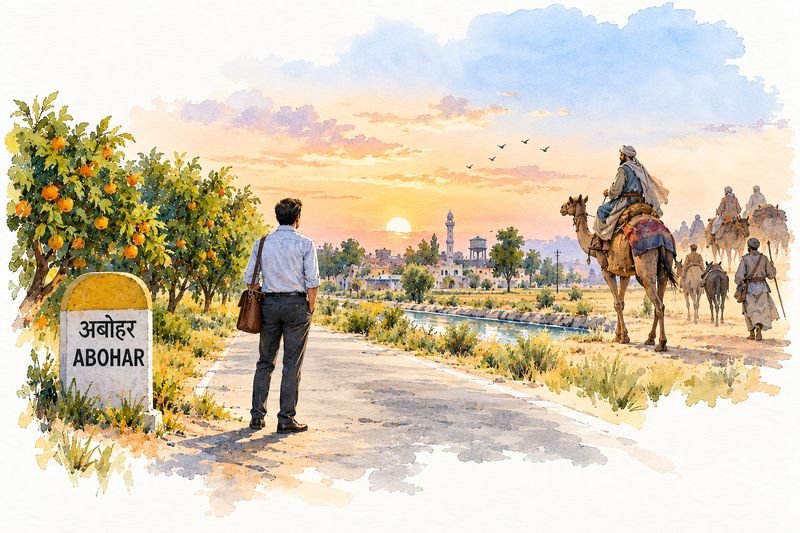

When I first heard that I was being transferred to Fazilka, some years ago, it felt less like an opportunity and more like a burden — a far-off district, a long commute from home, a new place and an unfamiliar environment. At one point, I even thought of giving-up.There is an old couplet I often remember: “Zindagi mein gham hai, gham mein dard hai, dard mein maza hai aur maze mein hum hain”. Perhaps that is the strange rhythm of life. What appears to be an ordeal at one point, with time, become an experience worth remembering.After coming to Fazilka, Abohar gradually became an important part of my official routine. Frequent visits for professional engagements slowly turned the place, I had regarded as a “far-off corner” into something familiar. It was no longer merely an important town of Fazilka district, but a page of history that seemed to reveal a new inscription every time I turned to it.This is my 12th district in government service, preceded by 17 years of journalism in Punjab, allowing me to see many facets of the state. Yet, Abohar stirred a different curiosity, also the realisation that these very roads, centuries ago, had been traversed by a famous traveller: Ibn Battuta.Born in Tangier, Morocco, Battuta travelled for nearly three decades across the world. After reaching India, his journey took him from Multan towards Delhi.And here, Abohar suddenly comes alive on the pages of history. Battuta records that after leaving Multan, the first town he reached was “Abohar”, which he described as the first town of the actual territory of India. He described Abohar as a small but beautiful and well-settled place, rich in water channels and trees. Today, when I stand on one of Abohar’s roads, I sometimes wonder whether these very routes were once crossed by that traveller on horseback seven centuries ago.Perhaps this is the unspoken lesson of transfers. We think we are changing places. Sometimes, it is the place that is changing us. The grievance with which I arrived in Fazilka has gradually been replaced by curiosity. The distance that once seemed an inconvenience now feels like a historical trail.And Abohar? For me, it is no longer merely a town. It is the town a traveller from a distant land saw seven centuries ago as his first glimpse of India — and today, it is teaching me to look at my own Punjab with a new pair of eyes.Gurdeep Singh Mann, FazilkaTribuneindia.com invites contributions to SHAHARNAMA. Share anecdotes, unforgettable incidents, impressionable moments that define your cities, neighbourhoods, what the city stands for, what makes its people who they are. Send your contributions in English, not exceeding 450 words, to shaharnama@Jattvibemail.comDo include the name of your city and your social media handles (X/ Twitter, Instagram, Facebook, LinkedIn)