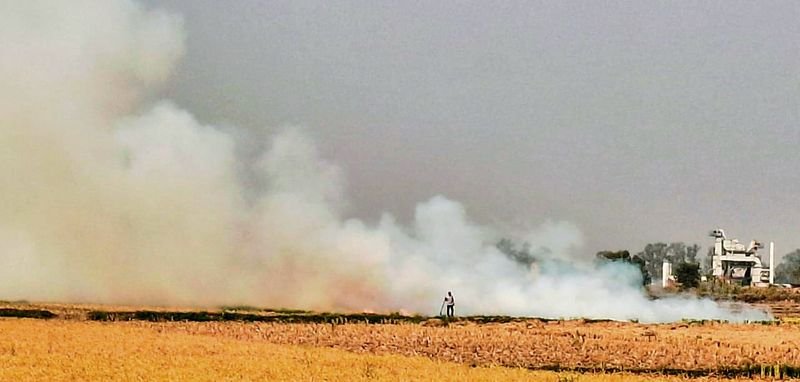

With more than 350 farm fires reported across Punjab on Friday, air pollution levels continued to rise across the state, with Mandi Gobindgarh emerging as the most polluted town. The Air Quality Index (AQI) in the steel town touched 319 at 7 pm as per the CPCB reading, falling in the ‘very poor’ category, as a thick layer of haze engulfed several parts of the state, two days ahead of Diwali.Much like the national capital Delhi, which continues to grapple with deteriorating air quality, several Punjab cities also witnessed a sharp rise in pollution levels. The PM2.5 concentration in Ludhiana reached 204, while Patiala recorded an AQI of 195. Amritsar and Jalandhar registered AQI readings of 138 and 146, respectively.Meanwhile, the number of stubble-burning incidents crossed the 3,000 mark, with 357 fresh cases reported on Friday alone. The cumulative count has now reached 3,144, marginally lower than the 3,284 incidents reported during the corresponding period last year.Ferozepur recorded the highest number of fresh farm fires at 49, followed by Bathinda with 46 and Sangrur with 41. Tarn Taran continued to top the district-wise tally with 611 incidents, followed by Sangrur (281) and Amritsar (231).Amid the continued violations, authorities have issued notices to 786 field officers for non-compliance with orders. As many as 710 FIRs have been registered against farmers, while red entries have been made in the revenue records of 829 farmers. Environmental compensation amounting to Rs 46 lakh has been imposed, of which Rs 24 lakh has been recovered.According to AQI standards, readings between 0 and 50 are categorised as ‘good’, 51 to 100 as ‘satisfactory’, 101 to 200 as ‘moderate’, 201 to 300 as ‘poor’, 301 to 400 as ‘very poor’, and 401 to 500 as ‘severe’.Health experts warn that deteriorating air quality can trigger breathing discomfort among people suffering from lung and heart diseases and asthma. It can also aggravate skin, eye and nasal allergies.