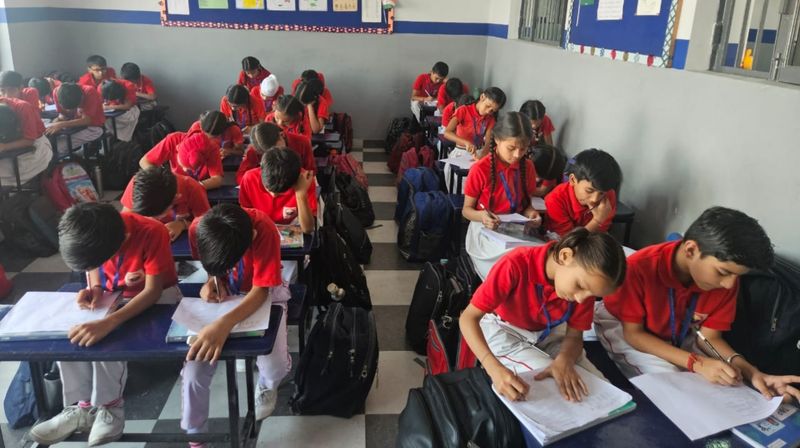

On May 30, the Bhagwant Singh Mann Government celebrated Punjab’s first rank in the latest education quality assessments by the NITI Aayog Education Quality Report-2026. A day later, Amjot Kaur (17) from Amritsar died by consuming a poisonous substance, allegedly under mental stress linked to fee-related harassment by a private school.In the pursuit of becoming the best state in school education and learning outcomes, Punjab has been overlooking one of the most persistent governance issues in the education system — arbitrary fee hikes by private unaided schools.Nearly 8,000 private schools in the state cater to 3.26 lakh students — about 56 per cent of the total students enrolled into private and government schools.The tragic incident in Amritsar has potentially become a reference point in debate over private school fee practices, even as Education Minister Harjot Bains had promised strictest action against the school management. Chief Minister Bhagwant Mann had announced to cap fee hikes by private school at 5 per cent and mandate refunds for excessive increase in the past three years. The state government promised a stricter law on capping fee charged by private schools. Such a law might directly target fee-related harassment but whether it will lead to a systemic change will depend on regulation and monitoring.Recurring disputesFee disputes between parents and private schools have become a recurring governance issue in Punjab, beginning with the 2016 incident in Ludhiana, where teachers of a private school wrote ‘fee defaulters’ on exam answer-sheets of students, sparking public outrage. The incident led the Punjab and Haryana High Court form a Fee Regulatory Committee and the introduction of the Punjab Regulation of Fee of Un-aided Educational Institutions Act, 2016, which became central to many fee disputes in the state.In 2025, several students of a private school in Ludhiana were denied admit cards over unpaid dues. Moreover, fee-related harassment is not the only problem affecting students in Punjab. In February 2023, Education Minister Harjot Singh Bains publicly intervened after receiving complaints that students were being prevented from appearing in Classes V, VIII, X and XII examinations because of the fee-related issues Moreover, the fee-related harassment is not the only issue.A Class XI student in Moga district reportedly died by suicide in 2025 after alleged humiliation and punishment by school staff; another Class XI student from Dasuya reportedly died by suicide in 2026 amid allegations of punishment, public reprimand and threats over the issue of transfer certificate.The government has repeatedly regulated fees and investigated schools for overcharging, but has it created any mechanism to monitor or prevent coercive fee-recovery practices directed at children?District-level task force to investigate complaintsIn 2023, the Education Minister had announced district-level task forces to investigate complaints. The government stated that it had received more than 1,600 fee-related complaints and notices were issued to dozens of schools. In subsequent years, 720 private schools in the state were issued summons following the complaints. But they all ended in a dud, without any punitive action.“The absence of a defined authority for complaint redressal is the real problem. If there is intent, enough laws are already available. The Right to Education (RTE) Act has clauses on fee hike, discrimination against children on fee-related matters and denial of admit cards or access to education. But Punjab is the only state where RTE has not been meaningfully implemented and the state government has gone on record in the High Court to express its reluctance in this matter,” said Jagmohan Singh Raju, a BJP member and a former IAS officer, who has been advocating enforcement RTE Act, especially on its compliance by private schools and EWS admissions.Connect Punjab Portal is the official central platform to file a fee harassment complaint with the Punjab Government. Complaints directly through the Punjab Department of School Education portal have proved to be ineffective.Even the CBSE does not have a dedicated, direct school fee grievance portal, the complaints are routed to respective state or Union Territory’s Department of Education.“The State Commission for Protection for Child Rights is an appellate authority in this regard, but it has failed to understand the sensitivity of such issues. Under the RTE Act, District Education Officers or authorities concerned can recommend immediate cancellation of affiliation, but in the last 10 years I have not seen that happening,” added Raju.Advocate MK Sharma, member of District Child Welfare Board, Amritsar, and one of the senior policy makers on fee regulation laws in the state, said the state has enough authority. “Intent with the right policy implementation without any biases or lapses would offer a long-term solution. There is a need to have an overall cap on fee and other miscellaneous funds that private schools charge by manipulating the system,” he said.