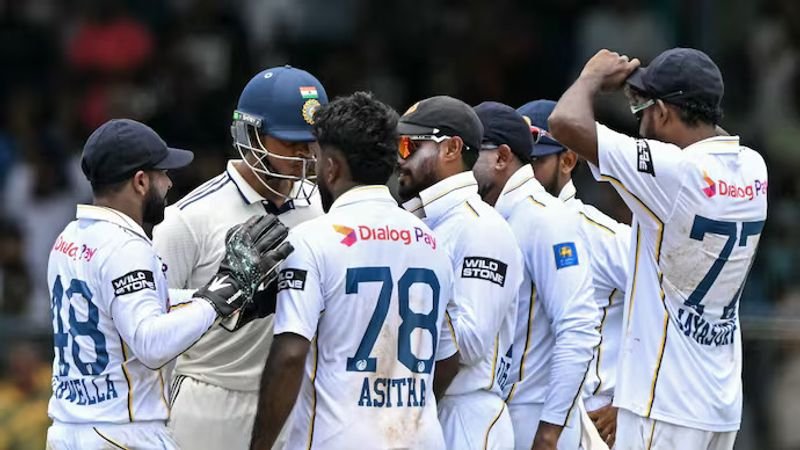

In his searing examination of human vanity and selfishness in ‘The Fall’, Albert Camus says, “No man is a hypocrite in his pleasure.” I would add anger and grief as the other two human emotions that in their raw expression can be profoundly honest. They strip away the civility and self-consciousness with which we ordinarily present ourselves to the world, revealing something closer to the self beneath the performance.Two recent images — one fuelled by anger, the other of grief provoked by empathy — have prompted this philosophical introspection into human behaviour. In these moments, the mask of our conditioned existence slips and something more elemental gets revealed.The first image, a distasteful one, is that of a batsman so outraged by a comment from the bowler that he risks a full-blown fight on the cricket field. He almost replicates Zinedine Zidane’s infamous head butt, though wisdom dawns at the moment of contact and he retreats before completing the act.The second is a poignant moment that reveals a gentler side of our nature. Remember Javed Miandad, the battle-scarred veteran, a formidable foe who, in his days of glory, produced many masterly performances and is remembered as much for his grit as for his impishness, which so often riled his opponents. Watching him break down on Pakistani television while pleading for justice for his former teammate Imran Khan, languishing in jail, must have moved even the most stone-hearted critic of Pakistan’s charismatic former captain and Prime Minister.In these two contrasting expressions of overboard aggression and human vulnerability lies a world held prisoner by uncontrollable emotions that surface in moments of extreme provocation.Yashasvi Jaiswal is a batsman of abundant talent, striking flair and fearless intent. But the sports field is not an arena where physical strength can be unleashed to inflict body blows on an opponent. Surely, something nasty must have been said to Jaiswal by the Sri Lankan bowler for him to lose his cool and attempt a head butt. Had he not stopped at the last second to complete his misadventure, cricket would have shamed itself.In the heat of the moment, people do the strangest things, exposing a side of themselves one would have never associated with them. It is in the aftermath, when calm descends and reflection takes over, that one feels the weight of one’s actions.One would have thought Jaiswal would feel remorse rather than justify his behaviour by invoking his country, saying that India knows how to “give it back”. It is a reflection of the chest-thumping echo chamber we live in that Jaiswal felt emboldened to defend himself in the name of his country. In doing so, however, all he achieved was to embarrass the proud nation he represents.While Jaiswal avoided a disastrous ending to his dangerous intentions, Zidane, France and world football’s towering, magisterial figure, executed a violent act of almost venomous force, smashing his head into Italy’s Marco Materazzi in the 2006 World Cup final.Interestingly, though Zidane profusely apologised for his shocking act that dented his image of a calm, reflective man, he maintained that the slur against his family had left him with little choice. “I would have preferred to be punched than hear my family being abused,” he said later.What is even more intriguing is that his reaction to the slur was not a spontaneous retaliation. Zidane walked away, apparently controlling himself, but then decided that he had to react in the violent manner he finally did. His subsequent apology for the physical aggression alongside his insistence that he had to do what he did, raised questions of ethics, morality, accountability and consequences that severely test the accepted codes of social conduct.In those brief seconds when body and mind revolt and become prisoners of an uncontrollable, incendiary emotion, the conditioned self breaks free and acts as it wishes and desires. It is a freedom we would never wish to experience, for it compels us to break free from the chains of civilisational restraint. No amount of remorse can undo the damage caused, not only to the recipient of our ire but to ourselves as well.While anger ignites the destructive self, sorrow and grief can act as a balm, healing wounds even as overwhelming emotion inflicts immense mental agony and pain on our conscious and sub-conscious self.In Miandad’s almost whispering, pleading voice, weighed down by tears of helplessness, was a cry for help for a rare sporting idol incarcerated for years for a crime more political than criminal in intent. The universality of his emotion struck a deep emotional chord across national loyalties. The earnestness of his appeal laid bare his raw, emotional upheaval, the pain and trauma caused by what he perceived as an injustice being done to his mentor Imran Khan.In that moment of grief, Miandad connected with a world where empathy matters more than revenge, reminding us of the richness of human emotion, a richness that the use of force stoked by anger can erode and hollow us from within. In this theatre of the absurd, where morality and ethics are hostage to our ideological moorings, only empathy can rescue us from becoming prisoners of our afflicted emotions.— The writer is the author of ‘Not Quite Cricket’ and ‘Not Just Cricket’