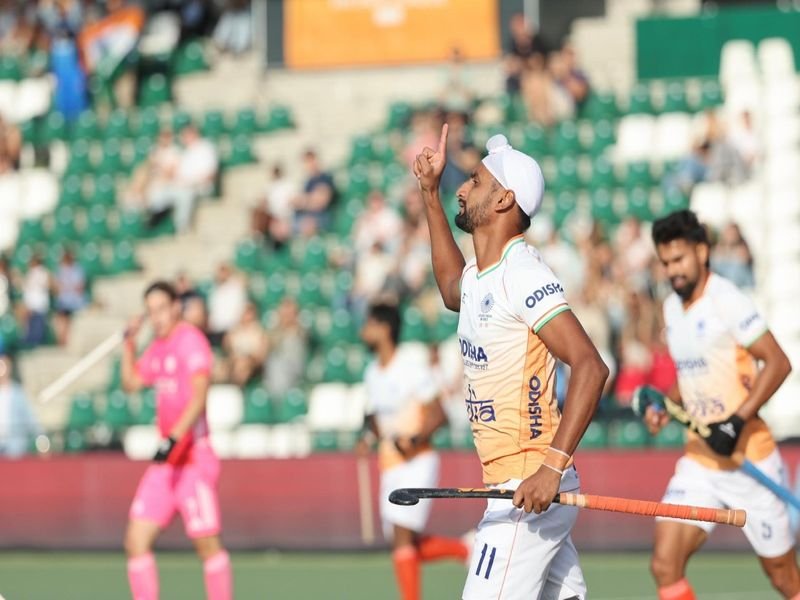

New Delhi [India], August 10 (ANI): With the FIH Hockey Men’s and Women’s World Cup 2026 set to be jointly hosted by Belgium and the Netherlands from 15 to 30 August, the removal of the quarter-final stage has given the tournament a new pathway to the title.According to a press release, the 2026 edition introduces a new competition format, with both the Men’s and Women’s tournaments featuring 16 teams divided into four pools in the opening phase. Unlike previous editions, the tournament will not have a quarter-final stage, with the top two teams from the second phase progressing directly to the semi-finals.The Indian Men’s Team has been placed in Pool D alongside England, Pakistan and Wales, while the Indian Women’s Team will compete alongside China, England and South Africa in Pool D.Here’s how teams can progress through the different stages and earn a place in the final.Phase 1: Pool Stage | 15-20 AugustThe tournament will begin with the Pool Stage, where the 16 participating teams in each competition will be divided into four pools of four teams each — Pools A, B, C and D.Each team will play the other in its respective pool once, contesting in three matches each. The results will determine the teams’ finishing positions from first to fourth in each pool.Phase 2: Crossover Pools | 21-24 AugustFollowing the completion of the initial phase, teams will be again grouped into four new pools — Pools E, F, G and H — based on their finishing positions in Phase 1.- Pool E: 1st and 2nd place finishers from Pools A and D- Pool F: 1st and 2nd place finishers from Pools B and C- Pool G: 3rd and 4th place finishers from Pools A and D- Pool H: 3rd and 4th place finishers from Pools B and CEach team will play three additional matches against opponents it did not face in the opening phase. In addition, a team’s result in the Phase-1 match against the other progressing team from its pool will carry forward to Phase 2.Phase 3: Classification Matches and Semi-Finals | 27-28 AugustThe standings from Pools E, F, G and H will determine the classification matches for positions 5th to 16th, while the top two teams from Pools E and F will advance to the semi-finals.The semi-final line-up will see:- 1st Pool E vs 2nd Pool F- 1st Pool F vs 2nd Pool EThe new format, therefore, provides a direct pathway to the semi-finals for the top two teams from Pools E and F.Medal Matches | 29-30 AugustThe FIH Hockey Women’s World Cup 2026 will conclude in the Netherlands on August 29 with the bronze medal match and the final.The FIH Hockey Men’s World Cup 2026 will then conclude in Belgium on August 30 with the bronze medal match followed by the final.Ahead of the tournament, Indian Women’s Team Chief Coach Sjoerd Marijne acknowledged that the new format presents a different challenge for teams, while emphasising the opportunities it offers.”It’s an interesting draft schedule, but my preference is to have quarter-finals in a tournament format,” said Marijne. I understand that for higher-ranked teams in the world they will prefer this, but I think quarter-final matches are among the most exciting matches in a tournament. But it is how it is, and we will deal with this and make the best of this format. I am always thinking in opportunities, and there are opportunities also within this format,” Marijne said.Indian Men’s Team Chief Coach Craig Fulton highlighted the importance of making a strong start in the competition, particularly because results between teams progressing from the first phase can have a significant impact on the next stage.”The format of this tournament has obviously changed drastically — from having quarter-finals to not having them. So the emphasis on the pool games is really, really important, because it’s obviously the top two that go through. And the head-to-head result between those two teams matters: if one beats the other, those three points carry into the next round, and that puts you in the driving seat to get out of the next group and into the semi-finals,” said Fulton.He further stressed the importance of goal difference and maintaining defensive discipline throughout the pool stage.”So yes, it’s different — it’s not good or bad. We can make it an advantage for us if we start well. We really have to manage our goal difference well. The team that finishes top of the group is decided by the most wins, and then it goes to goal difference — so if there’s a draw, goal difference decides it,” he added.FIH Hockey World Cup 2026 — Format at a glancePhase 1 — Pool Stage15-20 August16 teams divided into four pools of four; each team plays three matchesPhase 2 — Crossover Pools21-24 AugustTeams regrouped into Pools E-H based on Phase 1 standings; three additional matchesPhase 3 — Classification & Semi-Finals27-28 AugustClassification matches for 5th-16th; top two from Pools E and F advance directly to semi-finalsMedal Matches29-30 AugustWomen’s bronze medal match and Final on 29 August; men’s bronze medal match and Final on 30 August. (ANI)(This content is sourced from a syndicated feed and is published as received. The Tribune assumes no responsibility or liability for its accuracy, completeness, or content.)