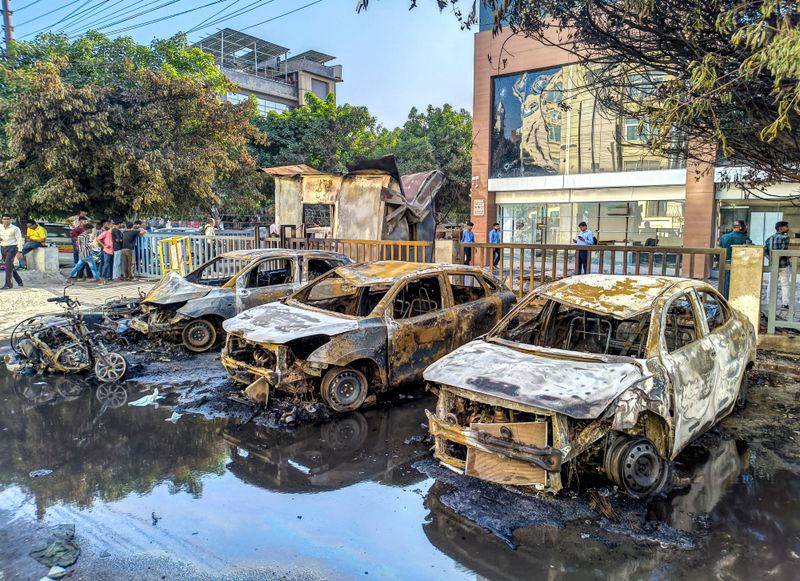

A fresh protest erupted in Noida’s Sector 80 on Tuesday, as workers agitating over low wages clashed with police, with some resorting to stone-pelting. Police intervened to disperse the crowd, chasing away protesters and eventually clearing the area.Before the situation turned violent, police officials had been trying to explain the proposed wage hike to workers, who were demanding a minimum monthly salary of Rs 20,000. Authorities later said that certain miscreants attempted to exploit the situation and incite unrest.Earlier in the day, workers from the Ahuja factory had staged a peaceful protest outside the unit, raising concerns over wage-related issues. Many expressed dissatisfaction with the recent wage revision and demanded that government-notified wage rates be prominently displayed at factory gates.Workers also flagged disparities in allowances, alleging that both skilled and unskilled labourers were receiving similar benefits. They further claimed that employees were often terminated within nine months and rehired to avoid statutory increases in allowances.Concerns were also raised regarding wages during and after apprenticeship. Workers alleged they were initially paid ₹90 per hour, which dropped to ₹50 per hour after a year. At the same time, many expressed fears that enforcing government-mandated wages could lead to job losses, adding to their uncertainty.UP hikes minimum wages after Noida unrestIn the wake of the unrest, the Uttar Pradesh government has increased minimum wages across worker categories, with revised rates coming into effect retrospectively from April 1, officials said on Tuesday.Gautam Buddh Nagar District Magistrate Medha Roopam stated that the wage revision was carried out by a high-powered committee and approved by Chief Minister Yogi Adityanath.In Gautam Buddh Nagar and Ghaziabad, unskilled workers will now receive ₹13,690 per month, up from ₹11,313. Semi-skilled workers will earn ₹15,059, while skilled workers will get ₹16,868, according to an official statement.For other municipal corporation areas, the revised monthly wages are ₹13,006 for unskilled workers, ₹14,306 for semi-skilled workers, and ₹16,025 for skilled workers. In the remaining districts, unskilled workers will receive ₹12,356 per month, semi-skilled workers ₹13,591, and skilled workers ₹15,224.The decision follows consultations with employers’ bodies and labour organisations. The government said that suggestions and objections were carefully reviewed to ensure a “balanced and practical” outcome.The move comes after large-scale protests by factory workers in Noida on Monday, when thousands demanded higher wages and improved working conditions. The demonstrations turned violent in some areas, prompting the government to form a committee to address the situation and facilitate dialogue between workers and employers.According to officials, the committee is working to resolve industrial tensions through coordination and discussions, while also considering further steps to address workers’ concerns.The government noted that industries are currently facing global economic challenges, including rising input costs and declining exports, even as workers’ demands regarding wages, overtime, safety, and working conditions remain “relevant and important.”“In such a situation, it is essential to maintain a balanced approach between industry and labour,” the statement said, adding that provisions under the new labour codes aim to ensure fair wages and protect workers’ interests.It also clarified that reports circulating on social media claiming a uniform minimum wage of ₹20,000 per month are “fake and misleading.” The process of determining a national “floor wage” is still underway at the central level, and no such notification has been issued.Chief Minister Yogi Adityanath has urged employers to ensure timely payment of wages, proper overtime compensation, weekly offs, bonuses, and social security benefits, while maintaining safe working conditions, particularly for women workers.With inputs from PTI