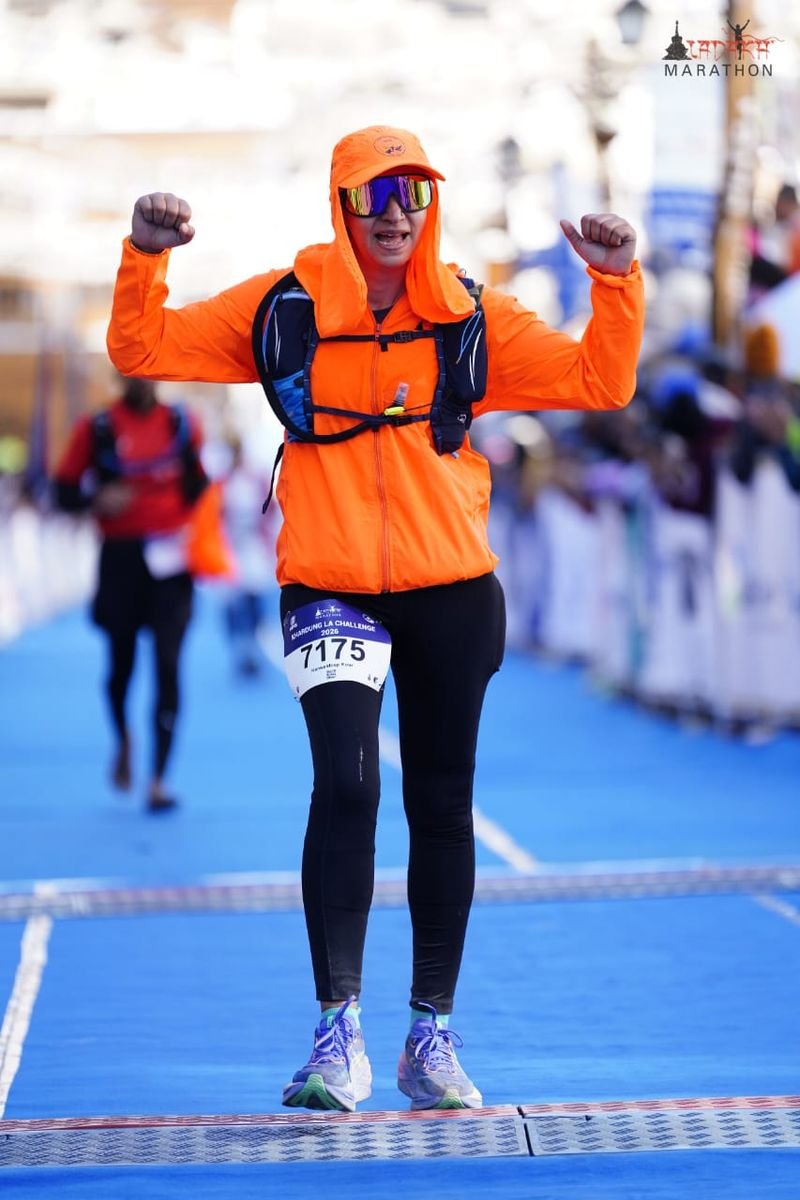

For years, running was Kanwaldeep Kaur’s “me time” — a quiet space carved out of busy days, a way to warm up her body and clear her mind.Earlier this month, that daily routine took her all the way to the mountains.The Amritsar-based physiotherapist, nutritionist and holistic health practitioner has completed the 72-km Khardung La challenge, one of the country’s most demanding ultra-marathons, held as part of the Ladakh Marathon.The race begins at around 3,975 metres and climbs to Khardung La at 5,370 metres, with roughly 60 km of the route above 4,000 metres before the runners descend towards Leh. For Kaur, however, the achievement was not the result of a sudden transformation or some extraordinary secret.“There is no magical stuff”, she says, describing her preparation. Her foundation was built over nearly 15 years of running and yoga, including both Yin Yoga and Power Yoga, combined with her professional understanding of the human body and nutrition.“Running for me began as part of my everyday routine. Yoga served both a physical and meditative purpose. Gradually, the distances grew, and so did my training. While training for the Khardung La ultra-marathon, I used to take my 15-year-old son along at 3 am. He would track my location and monitor my progress along with my husband,” she shares. Kaur says she typically runs around 40 to 45 km a week, fitting her training around her responsibilities at home. From May to August, she underwent a demanding training cycle, spending several hours preparing for the event and running for around four to five hours a day.”It’s physically and mentally draining. But that’s what you train for. At Leh and during the marathon, I met 65-year-old women runners who motivated me for another shot at the 122-km run next year at the same event,” she says. But the physical qualification was only one part of the challenge.To enter the Khardung La Challenge, runners demonstrate previous endurance credentials. Kaur had completed a full marathon on the plains in under five hours and a 50-km ultra within six hours, apart from having completed a 42-km distance within the stipulated time.“Climbing a 5,000-metre mountain is a task,” she says.For Kaur, the most important preparation was not necessarily about adding more kilometres.It was about training the mind.As a menopausal woman, she says the race tested her endurance, but the mountain demanded patience.The climb itself was punishing, but Kaur says one of her toughest moments came during the descent – particularly the final kilometre.“By then, fatigue had overcome me. Yet there was also a strange sense of relief. I was the happiest runner,” she recalls, describing the sensation of finally being able to put weight on her feet after the ordeal.She has some advice for women her age. “Nutrition, recovery and the changing body require attention, and the best you can do for yourself is to take care of your body and your soul,” she says.Her focus, particularly during menopause, is on maintaining muscle mass and ensuring adequate recovery.And recovery, she says, comes down to some surprisingly basic things – sleep and hydration.Her everyday diet remains largely based on home-cooked food. It is an approach that reflects her larger philosophy of fitness – consistency rather than quick fixes.