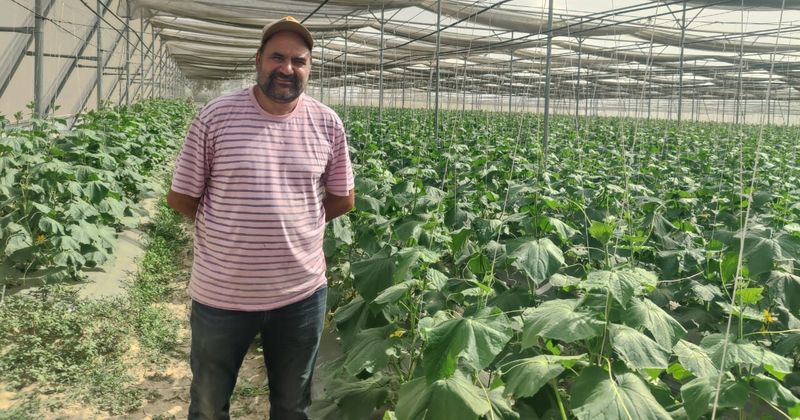

After spending nine years in the United States, Harpreet Singh Gill returned to Punjab and, in 2017, began cultivating English seedless cucumber on an acre.Today, he has transformed that small enterprise into a thriving modern farm — spread across eight acres at Dayalpura village in Majitha block near Amritsar.Gill currently operates on six acres of net-house farming, dedicated entirely to cucumber cultivation, and harvests around 200 bags daily. He cultivates organic vegetables and fruits too.His enterprise has generated employment for nearly 25 people, who assist in plantation, mulching, maintenance of cucumber vines and harvesting. Gill’s success story, however, was not built overnight. Though he left the United States, he says he never abandoned the discipline and work culture he learned there. Every morning, at 6 am, he packs his breakfast, grabs a cup of coffee and drives from Amritsar city to his farm, where he works alongside labourers.He grows cucumbers in two cultivation cycles per year. As the crop is raised under controlled weather conditions, the produce is of superior quality, nutritious and grown without use of harmful chemicals.However, Gill admits that cucumber farming is not without its challenges — especially in marketing.According to him, cucumbers recently were sold at around Rs 10 per kg, while the same produce usually retails in markets for Rs 40-50 per kg.He said the low farm-gate prices were partly due to stiff competition, as subsidised cucumber produce from Rajasthan and Haryana was entering Punjab’s mandis.Looking ahead, Gill is preparing to launch a farm visit venture.Under the concept, city residents will be invited to visit his farm, pluck vegetables with their own hands, and purchase them directly.He believes the initiative would be an adventure for urban families with little connection to agriculture, while also giving them access to fresh, nutritious and reasonably priced produce compared to city markets.Gill said farming could become profitable if farmers adopted creative thinking and explored models beyond traditional cultivation.