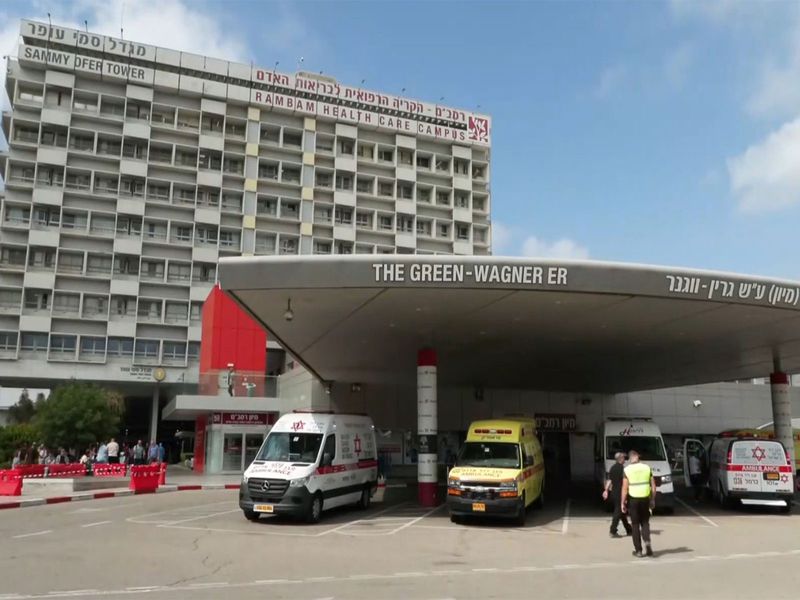

Haifa [Israel], May 28 (ANI): The Rambam Health Care Campus, northern Israel’s largest medical centre and a major Level-1 trauma and academic hospital, has provided a detailed account of how its fortified underground hospital was designed and activated to function as a large-scale emergency medical centre during wartime conditions.Built after the 2006 Israel-Lebanon war, the underground complex is designed to operate as a fully self-sustaining hospital capable of accommodating up to 2000-2200 patients. In normal times, it serves as a parking structure, but it can be rapidly converted into a 2,000-bed wartime hospital within 72 hours, in emergencies, including scenarios involving chemical and biological threats.Speaking to ANI, Rambam Health Care Campus Nursing Director of Obstetrics and Operating Rooms Division, Ravit Idelman, explained the origin and purpose of the facility.She told ANI, “This amazing underground hospital was built a few years ago after the Israel-Lebanon war in 2006, where we needed to work under fire. It was a very scary time for our patients and employees. After that war, we decided to build a fortified underground hospital. This hospital has three floors, and it can contain up to 2000-2200 patients.”She further described its multi-hospital role and dual-use structure. She said, “We use it for our Rambam patients, but we are also hosting 5 other hospitals from all over the area, who come here and use our infrastructure and underground hospital for them also…In the routine times, this place is actually a parking lot for the employees and patients.”Idelman also detailed how operational readiness was ensured ahead of conflict. “But because we knew the war is supposed to happen soon, we locked the third floor here, and we didn’t cars to park here. We built all the infrastructure in advance,” she said.She described the rapid mass transfer of patients during escalation. She added, “So, when the war started on Saturday morning, we needed to take all our patients from the upper hospital to the underground hospital. It took us 8 hours for every department and wards to come down to the underground hospital. Some of the equipment was ready for us. So, it took us only 8 hours.”Idelman also highlighted the range of patients treated during wartime operations. “In the war, we treated a lot of civilians and also a lot of soldiers who came from the battlefield,” she said.She emphasised the facility’s self-sufficiency and protective capabilities. She added, “We are also protected from biological and chemical weapons, we can close our doors and use our infrastructure for three days and three nights without any help from the outside.”Earlier, the Israel Defence Forces (IDF) said it struck two “senior” Hamas operatives in northern Gaza a short while ago, adding that further details will be shared later, Times of Israel reported.This came after the Israeli Air Force, Israel Defence Forces, eliminated Muhammad Odeh in Gaza, the new leader of the military wing of the terrorist organisation Hamas and one of the architects of the October 7 massacre.’The operation was carried out on the instructions of Prime Minister Benjamin Netanyahu and Defence Minister Israel Katz,’ Israel PMO said in a post on X.Meanwhile, on Wednesday, the Israeli Air Force announced that the Israel Defence Forces and Shin Bet eliminated Muhammad Uda, who served as the head of the military wing of the terror organization Hamas.The IAF said that the strikes happened on Tuesday, and was responsible for planning and coordinating attack and raid targets as part of the October 7 offensive.In a post on X, the IAF said, “In a precise strike in northern Gaza Strip yesterday, the IDF and Shin Bet eliminated Muhammad Uda. Uda served as the head of the military wing of the terror organization Hamas in the last two weeks and was appointed to the role following the elimination of Azz al-Din Haddad. In recent years, he served as the head of the intelligence headquarters of the terror organization and, as part of his role, was responsible for planning and coordinating attack and raid targets as part of the October 7 offensive.” (ANI)(This content is sourced from a syndicated feed and is published as received. The Tribune assumes no responsibility or liability for its accuracy, completeness, or content.)