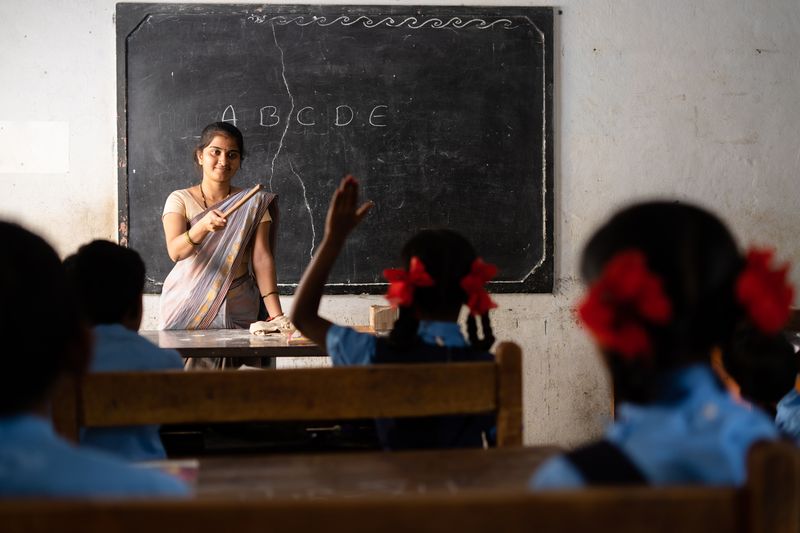

More than 1 in 4 teacher posts for Classes XI and XII are vacant in government schools in Haryana. Of the 21,311 sanctioned posts at the senior secondary stage, 5,573 (26.2%) are vacant.Even at the elementary level (Classes I-VIII), the teacher vacancy rate is 14%, as 8,449 out of 60,396 sanctioned posts are vacant. At the secondary stage (Classes IX and X), the teacher vacancy rate is 12.2%, as 2,413 of the 19,792 sanctioned posts are vacant.The figures came to light in the minutes of the Project Approval Board (PAB) meeting on the Annual Work Plan & Budget (AWP&B) 2026-27 of Samagra Shiksha for Haryana. The minutes of the meeting were circulated on June 23.”In light of this sizeable number of vacancies, the state was advised to expedite the filling of vacant positions to ensure adequate staffing in both elementary and secondary schools. Haryana Principal Secretary Vijay Singh Dahiya informed that the recruitment is under process and vacancies will be filled soon,” said the minutes circulated on June 23.The PAB observed that the number of single-teacher government primary schools in the state has increased “drastically” to 968 in 2024-25 from 696 in 2023-24. “The state is requested to undertake a detailed review and appropriate corrective measures, and ensure compliance with RTE norms at all levels,” said the minutes. The 968 single-teacher schools constitute 11% of the state’s government primary schools.The percentage of government primary schools with an adverse pupil-to-teacher ratio (PTR) has also risen from 21.5% in 2023-24 to 22.1% in 2024-25.Vacancy in teachers’ educationIn the state’s 21 functional District Institutes of Education and Training (DIETs), the vacancy against sanctioned posts has increased this year to 62% from 59% in 2024-25. The vacancy rate for academic positions in the State Council of Educational Research and Training (SCERT) stands at 33%, down from 49% in 2024-25.Considering the significance of Centres of Excellence in improving quality and building teachers’ capacity, Additional Secretary (School Education and Literacy) Dheeraj Sahu advised the state to fill the vacancies at the earliest with competent and qualified teacher educators or through deputation.As per the figures from the Unified District Information System for Education Plus (UDISE+) 2024-25, the number of government primary and upper primary schools with fewer than 15 and fewer than 30 enrolments, respectively, has increased over the previous year’s figures. “The state is advised to take appropriate measures to improve this situation. Principal Secretary Vijay Singh Dahiya informed that the state is strengthening cluster schools and providing free transport, and assured that this will be resolved soon,” said the minutes.As per state norms, there are 63 habitations without access to primary schools, 112 habitations without access to upper primary schools, 132 villages without access to secondary schools, and 215 villages without access to higher secondary schools.It was reported that in 66 functional Kasturba Gandhi Balika Vidyalayas (KGBVs), 1,963 (23%) out of 8,660 seats are vacant. There are three Netaji Subhas Chandra Bose Awasiya Vidyalayas (NSCBAVs) in the state, of which only two are functional, with 53% of seats vacant. Both KGBVs and NSCBAVs are residential schools.Inclusive educationThe state has only a 0.37% (21,625) share of children with special needs (CwSN) enrolment in the total student enrolment. Further, there has been a significant decline in the percentage share of CwSN across almost all grades.As per UDISE+ (2024-25), only 6% of teachers have been trained in inclusive education. There are a total of 515 special educators in the state under Samagra Shiksha, covering 1,359 (5.8%) schools. In terms of accessible infrastructure, out of 23,494 schools (across all managements), 17,676 (75%) are equipped with ramps and 12,451 (53%) have CwSN-friendly toilets.”The declining enrolment at higher grades is a matter of serious concern and needs the personal attention of the Principal Secretary,” said the minutes, advising the state to “strengthen measures to increase the identification of CwSN and their enrolment in schools.” As per the guidelines, the total enrolment of CwSN should be at least 2%.It was highlighted that, as per the Periodic Labour Force Survey (PLFS) data, the number of out-of-school children (aged 14-18 years) is 3.44 lakh. “The state has proposed open schooling support for only 2,000 dropouts aged 14-18 in the PAB Plan 2026-27. It is urged to improve the identification exercise of out-of-school children and identify districts, blocks, and areas with a high number of school dropouts and never-enrolled children,” said the minutes.Spill over from previous yearsThe state has a huge spill over of Rs 691.88 crore from previous years. Out of the Rs 887.71 crore approved, only Rs 195.82 crore has been spent on works, leaving Rs 691.88 crore unspent. Of the 71 works sanctioned in 2025-26, 67 have yet to start. There are 2,746 works sanctioned in earlier years that have yet to start.”All pending civil works sanctioned during 2018-19 to 2020-21 should be thoroughly reviewed, and works that have not been started or have already been completed under convergence with other schemes should be treated as cancelled,” said the minutes.”Consequently, no new non-recurring activities could be proposed in the current Annual Work Plan & Budget (AWP&B). The state is strongly urged to complete all spill over works in this financial year,” said the minutes.