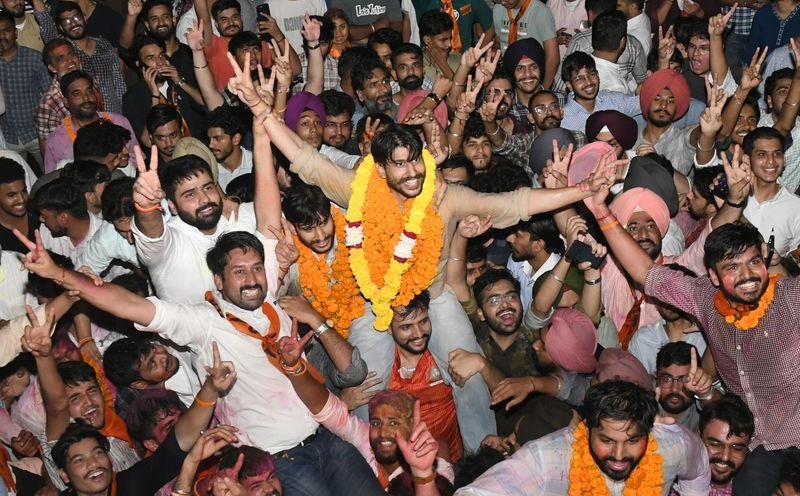

The month-long Cockroach Janta Party (CJP) protest in New Delhi, as well as its echoes elsewhere in the country, has not really resonated in Punjab because students have little experience debating political issues relevant to both the state and the country, independent student leaders have told The Tribune.According to these student leaders, student unions in public universities were banned at the height of militancy in 1984, when they were seen as supporting militant groups. The All India Sikh Students Federation (AISSF) was the most prominent among them.University campuses—particularly Guru Nanak Dev University (Amritsar), Punjabi University (Patiala) and Punjab Agricultural University (Ludhiana)—were closely aligned with militant groups. In the years that followed, Punjab continued to be wracked by one trauma after another, and student unions fell by the wayside. Panjab University, in the Union Territory capital of Chandigarh, has, however, been holding regular student council elections since 1996.Nothing has changed, however, even during the decades of peace that followed. It seemed that things were returning to normal after Beant Singh formed the government in 1992, but those hopes were dashed when he was killed in a suicide bombing on August 31, 1995.When former Chief Minister Capt Amarinder Singh announced during the March 2018 Assembly session that “from the next academic session (2018–19), direct student body elections will be held in universities and affiliated colleges”, the statement was widely welcomed. But nothing came of the promise, and the proposal remains buried in government files.Successive governments of different political persuasions have refused to allow student union elections. Worse, no government has cared, to this day, to explain why students continue to be denied the experience of democracy in colleges and universities.Still, in the wake of the CJP protests, scattered student groups across Majha, Malwa and Doaba have revived their demand that the government at least listen to their expectations and aspirations.Deepak Bali, president of the independent Student Youth Federation (Jalandhar), says: “Student agitations have always been an outlet for the suppressed anger brewing in the hearts of disillusioned youth. Government colleges continue to offer outdated courses that have little value in today’s job market. Private colleges advertise new courses but often lack the required faculty. Students are adversely affected but have no representation on the appropriate platforms.”Malvinder Singh Kang, Member of Parliament from Anandpur Sahib and a former member of the Panjab University Campus Students Council, told The Tribune: “I have raised the issue of student elections with the Punjab government on more than two occasions. Citing potential law-and-order problems, the bureaucracy has always turned down the proposal.”Kang did not say whether he received support from his own government. He acknowledged that one of the reasons for the “considerable decline in the quality of debate in Parliament is the shrinking number of leaders emerging from the culture of university debating.”Sources in the state Cabinet confirmed that the AAP government in Punjab is not considering student body elections, notwithstanding the fact that the party itself emerged from a mass agitation, that CJP leader Abhijit Dipke is a former AAP member, and that AAP National Convenor Arvind Kejriwal was openly supportive of the CJP student protests.Bali says: “The current state government does not want elections because it has no student base. Most AAP leaders originally belonged to other political parties.”Gagan Sangrami (Muktsar), a senior leader of the state-wide independent Punjab Student Union, blames both terrorism and gangsterism on the absence of organised student politics.”The lack of a platform for student voices was one of the main reasons gangsters flourished in Punjab. Educated student leaders are generally anti-establishment and ask uncomfortable questions, so political parties do not want them.”Arvind, Professor of Physics at the Indian Institute of Science Education and Research (IISER), Mohali, and former Vice-Chancellor of Punjabi University, told The Tribune that while he agreed elections should be held in colleges and universities, an indirect electoral system would be preferable.”Direct student elections have certain drawbacks. Instead of the current system, where the top posts become the bone of contention, representatives from different departments should be elected and made part of the council. This would ensure greater student participation. Students also need to be included in college and university governance through committees dealing with academics, discipline and extracurricular activities.”