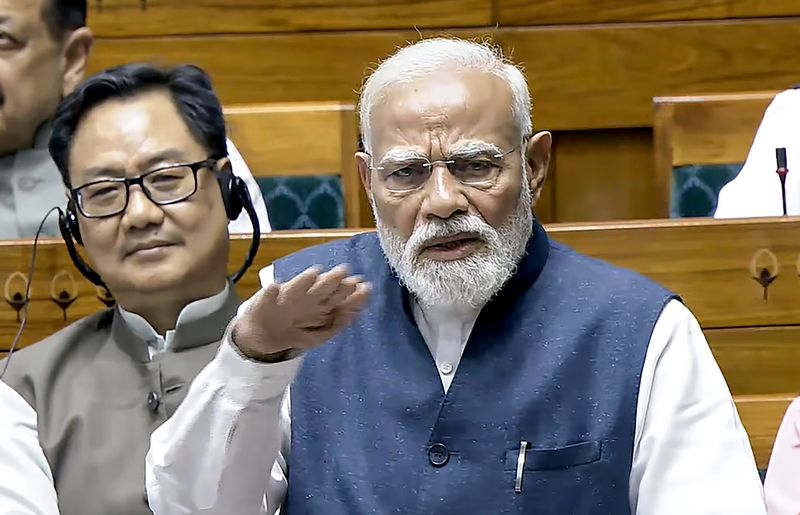

Prime Minister Narendra Modi on Thursday pitched the Constitution (131st Amendment) Bill and allied legislations as a defining moment for India’s parliamentary democracy, calling on all parties to rise above politics and seize what he described as a “historic opportunity” to reshape governance with greater inclusivity.The Constitution (131st Amendment) Bill seeks to operationalise the women’s quota framework, while the accompanying Delimitation Bill and the Union Territories Laws (Amendment) Bill aim to extend its implementation to Delhi, Puducherry and Jammu and Kashmir.Participating in the Lok Sabha debate on the women’s reservation framework, delimitation and amendments relating to Union Territories, Modi said such moments test both the “mindset of society” and the “capability of leadership” to convert them into enduring national assets.“This is a fortunate moment for us… We should not let this significant opportunity slip away,” he said, urging Members of Parliament to act collectively to “give a new direction to the country” and infuse governance with “sensitivity”.The Prime Minister deliberately steered clear of point-by-point rebuttals, assuring the House that detailed clarifications would be provided, but emphasised the larger political and historical stakes. He framed the legislative exercise as part of a broader churning that would shape not only the character of politics but also India’s long-term trajectory.At the core of his argument was the need to expand women’s participation in decision-making. “It is the demand of the times that 50 per cent of the country’s population becomes part of policymaking,” Modi said, acknowledging that such inclusion had been delayed for decades.He invoked the government’s guiding principle of “Sabka Saath, Sabka Vikas” as central to the vision of a developed India — one that goes beyond infrastructure metrics to encompass social equity and participatory governance.Modi also delivered a political warning, asserting that women voters have historically held accountable those who opposed reservation. He noted that the issue ceased to be electorally contentious in the 2024 polls only because of broad consensus.“Those who opposed giving this right to women have faced the consequences,” he said, cautioning that resistance today would carry long-term political costs.Highlighting a quiet transformation at the grassroots, the Prime Minister pointed to the rise of lakhs of women leaders through Panchayati Raj institutions over the past 25-30 years. These women, he said, are no longer silent stakeholders but politically conscious actors who now demand a voice in legislative bodies.“They have seen governance up close—the joys and sorrows of people—and today they are vocal,” Modi said, adding that this emerging leadership will increasingly influence political outcomes at higher levels.In a bid to blunt Opposition criticism, Modi stressed that the move should not be viewed through a partisan lens. “If we move forward together, this decision will not benefit any one party but the country’s democracy,” he said, underlining that credit would belong collectively to Parliament, not to the Treasury benches or any individual leader.