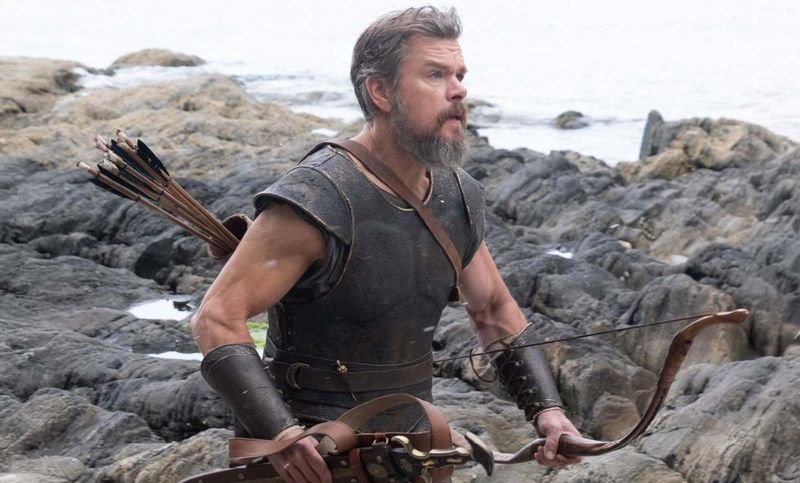

I finally watched Christopher Nolan’s ‘The Odyssey’. Western cinema stands out in how it brings the ancient world to life on screen. In our movies, even when the story is about Emperor Ashoka or Akbar, they end up singing with the heroine.Both the Greek epics ‘The Odyssey’ and ‘The Iliad’ are usually credited to the poet Homer. ‘The Iliad’ focuses on the anger of the greatest Greek warrior, Achilles, who stops fighting after a dispute with Agamemnon, the king of Mycenae. He only returns to battle after Hector, the Trojan prince, kills his close friend Patroclus, and then Achilles kills Hector. Odysseus also appears in ‘The Iliad’ as a leading strategist. He later becomes the main character in ‘The Odyssey’.After the war, Odysseus spends more than 10 years trying to get home because he has angered Poseidon, the god of the sea. On his way back to his island of Ithaca and his loyal wife Penelope, he faces monsters, curses, and the schemes of the gods. The film does a great job of taking viewers back to a world from 3,200 years ago. Watching Wolfgang Petersen’s ‘Troy’ (2004) can help you understand the background of the Trojan War.In one flashback, Nolan shows Odysseus, who won the war through trickery, deeply shaken by the massacre in the city and overwhelmed with guilt. He cries because he broke the sacred code of hospitality and trust linked to god Zeus.This made me think of Yudhishthira in ‘Mahabharat’. After winning the terrible war of Kurukshetra and killing his cousins, Yudhishthira doesn’t celebrate. Instead, he falls into a deep crisis. He is devastated by the destruction and looks at the battlefield, asking himself: ‘What kind of victory is this, when all I have gained is a graveyard?’In fact, in many epics, the real tragedy isn’t losing, but winning. Ashoka also seems to have asked himself a similar question after the Battle of Kalinga.In Thomas Malory’s 1485 romance ‘Le Morte D’Arthur’, King Arthur spends his whole life building the utopian kingdom of Camelot but, eventually, it falls apart because of civil war and his son Mordred’s betrayal.In Shakespeare’s play ‘Macbeth’, Macbeth kills King Duncan in a plot and takes the Scottish throne. Although this is exactly what he wanted, as soon as he becomes king, he finds no peace. Instead, he feels only guilt, sleepless nights, and mental pain.In Sophocles’ Greek tragedy ‘Antigone’, Creon, the King of Thebes, manages to enforce his law against Antigone. But this victory leads to a series of suicides, including by his son Haemon and his wife Eurydice. By the end, Creon mourns over his family and wishes for death.In the same way, even though Aurangzeb made the Mughal Empire bigger than ever, looking back during his last days, he saw more failure than success.In Winston Churchill’s only novel, ‘Savrola: A Tale of the Revolution in Laurania’, published in 1900, Savrola leads a democratic revolution in the fictional Republic of Laurania in 1888 and overthrows a dictator. After a night of fierce fighting, he walks up a hill and looks at the destruction. Instead of feeling like a winner, he sighs, ‘This is my work.’Yet Odysseus’ remorse after the Trojan War is Nolan’s own interpretation. In Homer’s story, Odysseus regards the victory at Troy as a triumph of his courage and ingenuity; there is no comparable sense of moral guilt over the destruction of Troy. Nor does he renounce violence or fundamentally alter his worldview. Nolan has therefore created this moral crisis in his film to explore more deeply the psychological wounds left by war.The 1989 film ‘The Mahabharata’ by British director Peter Brook, too, gives a unique take on an ancient epic. Both directors had the same challenge: making a 3,000-year-old story matter to people today.Brook chose to downplay its supernatural and miraculous parts. He focused on people, their moral choices, and struggles for power. Nolan, on the other hand, kept the mythological world almost unchanged. But he also added modern psychological themes like guilt, trauma, and the mental scars of war. Both directors give new meaning to ancient epics. This may also show two different Western traditions: one links myth to modern psychology, while the other puts people at the centre by moving myth aside.Many Indians today think that Rama won Sita’s hand by breaking the bow, since that’s how the story is usually shown in popular versions, Ramlilas, and TV shows. But in Valmiki’s original, the main test was for Rama to lift and string the bow. In ‘The Odyssey’, there’s a similar contest, where Odysseus wins. In both stories, the real challenge is the hero’s strength to handle a powerful bow, though in Rama’s case the bow breaks, while Odysseus’ does not.At Hukki Chowk in Faridkot, there is a shrine that was built before my own eyes. Earlier, there was only a simple, unnamed grave here. I don’t know who decided, or for what reason, to give it the name Dargah Mauj-i-Darya. It used to be looked after by a somewhat eccentric retired peon of the electricity board. The poor man himself could make no sense of the name Mauj-i-Darya. Nor did ordinary people understand it. So, the name was changed to the simpler Chitte Mojian Wala Pir — the Pir with the White Socks. The new name had absolutely nothing to do with the old one, but its meaning was immediately intelligible to everyone.This is how history, myth, and collective memory work — they don’t keep events exactly as they happened, but give them new meanings in every era. Nolan sees Homer’s Odysseus as a modern person, someone who feels the burden of his actions more than the joy of victory. Maybe that’s why this story still feels so relevant.— The writer is a historian