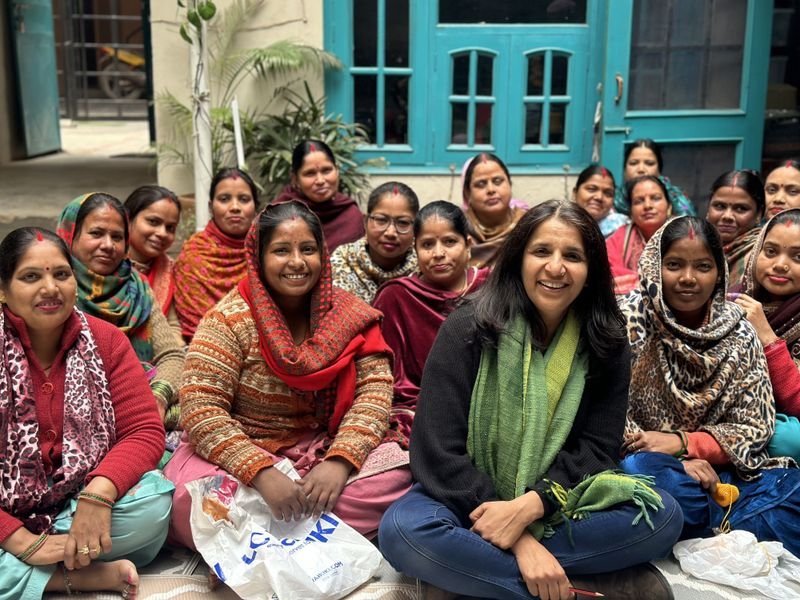

Despite a high-paying IT job in Silicon Valley, Liza Chawla always felt restless for something more. The year was 2005. “I returned from the US to work at the grassroots,” she recalls. Back home in Chandigarh, she worked with street children around the Rose Garden and Sector 17, encouraging them to read.“Sustaining their attention long enough to finish a book or teach these kids a new skill was challenging,” she says. Then came the turning point. She started interacting with some of the mothers and that’s when it clicked. Most women possessed skills and crafts that had huge potential. And that’s how Chhoti Si Asha was born in 2009. “The name really says what we were trying to do: provide a little ray of hope,” says Liza.The non-profit soon found an address at House number 30, Khuda Lahora, amid an eclectic mix of people from Punjab, Haryana, Uttarakhand, Uttar Pradesh and around. “The early years were difficult as there was a lot of resistance from families. Women stepping out of their homes to work was unheard of,” recalls Liza.Business was also slow in the beginning, but small orders gave these women the time needed to handcraft every product with precision and detail, and experiment. Upcycling pre-consumer textile waste, basket weaving — skills perfected at the livelihood centre set up in 2016 — would later become hallmark offerings for the non-profit.Then the Covid-19 pandemic struck, and Liza had an idea: what else but masks! Combining necessity with creativity, the masks began to bring in profits and the women’s standing grew. “We were able to support our families when there was no other work. It changed things,” says Rita, one of the artisans, adding how the family members, who would earlier oppose her late-night work, would stay up to help her complete an order.But as orders grew, the women needed to be trained for deadlines, marketing and teamwork. “There is a wide gap between practising craft as a hobby and as a profitable business,” says Liza. That’s where the Internet and her own professional training helped.“The women gainfully used YouTube to refine their skills and expand their creative scope,” adds Liza. Sessions led by industry experts on attention to detail and quality control have also paid dividends.Liza also created a sustainable ecosystem, where senior artisans trained others. Meera perfected the art of crochet from her sister Poonam, who has also mentored several others. The exchange of skills has helped build a team that can now handle bulk orders.As for creativity, there’s plenty within. “From crochet, to kantha, to phulkari, they bring the ideas and designs to us,” Liza says, pointing to bookmarks with motifs of dancing and singing women. “It is us! The last order we completed, we got together, sang and made merry. Later, we turned that image into one of our most popular designs.”From the cutting to the designing to the stitching, artisans have complete creative control. From the Munna-Manju attaché bag to the Swaran carry-all, products carry the creators’ names and stories.Artisans at work at Chhoti Si AshaManju Devi was the subject of the documentary, ‘Badlaav Republic’. An avid singer, she gets everyone around her in a joyous mood. “When there’s a celebration in the neighbourhood, I even skip the workshop to attend. I know my peers will understand,” she says, recalling her hours put in with head tailor Munna Bhaiya to perfect the attaché bag.From a handful in the beginning, Chhoti Si Asha has trained nearly 500 women till now. The growth has been organic. “When we received our first corporate order of 6,000 laptop sleeves, we weren’t equipped to handle it,” remembers Liza.The women turned to each other. “We launched Project Sakhi, under which experienced artisans trained neighbours and friends. Around 100 more women joined our team and we were able to complete the order easily,” she says, adding that some of the women received one-time payouts reaching up to six figures.Liza’s background has helped build a simple, yet effective, business model. Corporate gifting, white-label orders help sustain business. Supported initially by the community alone, Chhoti Si Asha has now begun to find Corporate Social Responsibility traction as well. And with years of success to show for, it has also inspired the next generation.Project Badlaav, the non-profit’s latest after-school programme, took Liza back to her aim of helping the children of artisans and locals make better-informed life and career choices. Renu, an artisan’s daughter, says, “My aunt inspired me. She had a way with phulkari that I could never quite replicate.”Mentored, Renu attained a degree in fashion designing and worked with a firm in Gujarat. Wanting to give back, she returned home armed with corporate experience and a sharper vision for design. She is now the lead designer at Chhoti Si Asha and has built a team of women whose stories are not too different from her aunt’s.Liza shares her pride at Renu running the show. From head tailor Munna Bhaiya to Jayashree running the digital communication, Liza has added a savvy few to the cohort. A recent Instagram reel with the artisans posing as saree-donning, sunglasses-wearing corporate bosses to market their laptop sleeves has gone viral with 6.8 lakh views.Have these women become influencers? Not quite. “Earlier, I’d have problems balancing work and household chores. Now, my husband has learnt the basics. He helps out and even looks after the kids when I’m stuck at work,” Rajni, an artisan, smiles, pointing to the real influence.Liza is pragmatic. Despite all the earnings going to the organisation, she knows the model has its limitations. “We can only offer work to so many. That’s why we have begun to encourage the more experienced and resourceful women to go independent,” she says, noting that many have started taking stitching and tailoring work and expanded into ventures like the Chhoti Si Rasoi kitchen and Humara Bank self-help group offering micro-credit loans.For every woman finding her footing, there’s another fresh batch of new trainees. As a group comes in for their 3 pm shift, one notes that a teammate has called in sick for the past few days. Does that increase the workload? Yes. Does it bother the fellow artisans? No, they’re happy to pitch in and cover for her. In the end, women who stitch together, stick together.