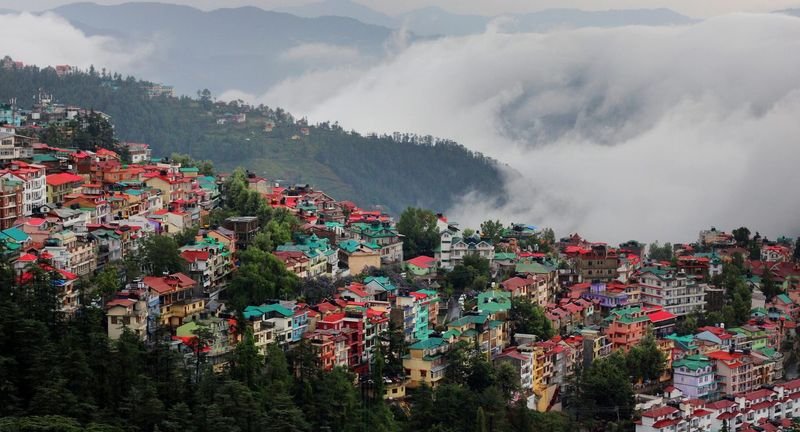

In response to a recent blog of mine about unregulated constructions in Himachal Pradesh, a discerning reader commented that he had done an online search for available properties in the state, and to his horror, found that 23,450 properties were advertised for sale/rent/lease between just Shimla and Narkanda, a stretch of 65 km or so. Even allowing for double counting, these figures tell a tale which our policymakers would do well to listen to. For what they tell us is that faulty policies and lack of vision or understanding of economics are making Himachal prime real estate up for grabs for whoever has the money and connections to exploit the system. But some background first.Land is a precious commodity in Himachal, as the utilisable land is less than 15 per cent of its geographical area — 8 lakh hectares against a total of 55.67 lakh hectares, the rest being forests and ‘gair mumkin’ or areas above the tree line where nothing grows. The actual area under agriculture is even less — just about 5.25 lakh hectares.Farming is almost at subsistence level. The average landholding is 0.94 hectares (in Punjab, it is 3.64 ha); small and marginal farmers hold 89 per cent of the arable land. Industry is almost non-existent and the state has one of the highest unemployment rates in the country. For all these reasons, as Nirmanyu Chauhan and Divyanshu Thakur put it so eloquently in The Wire, land in this state is not just a commodity; it is a source of dignity, livelihood, autonomy, and security.Himachal’s first Chief Minister, YS Parmar, had the vision to realise this and therefore took steps to ensure that Himachalis were not deprived of their lands by rich and exploitative outside elements. He brought in the Tenancy and Land Reforms Act in 1974, Section 118 of which imposes restrictions on non-Himachalis from buying land in the state. They can do so only after obtaining prior approval of the government. Subsequent Chief Ministers, sadly, have lacked the same foresight and have introduced so many exemptions and loopholes in the law that now any smart lawyer or purchaser can buy any extent of land in the state. And this is happening on a colossal scale, as the Shimla-Narkanda figure proves. In just the last three years, 1,494 approvals have been granted, but this is only the proverbial tip of the iceberg.The actual transfer of lands to, and purchase by, outsiders would be many times the number of approvals officially cited. This is because of the many exemptions provided to the operation of Section 118: no approval is required for a society consisting of agriculturists, flats built in urban areas, houses/flats taken on lease, RERA-approved builder developments. These exemptions are actually loopholes and have thrown up the whole of Himachal to land sharks and builders.As living conditions in North Indian cities and metros steadily worsen, more and more people are now investing in second homes in places like Uttarakhand and Himachal, especially post-Covid. The threat now is to rural Himachal and its original residents.Land prices have skyrocketed, and the Himachali landowner, unable to resist the lure of quick money, is being dispossessed of his ancestral lands on an ever-increasing scale by hotels, homestays, builder developments, resorts. This is changing the very architecture of the mountains, replacing green cover with concrete, affecting the demographics (as in the “ghost” villages of Uttarakhand), distorting local cultures. At risk is not only the geology, but the very identity of the state.The state’s policymakers must look at the long-term implications of such land transfers; it is time to review Section 118 of the HP Tenancy and Land Reforms Act to make it more restrictive. No approval should be given under this section for construction of hotels and resorts in rural areas — they are ruining the hinterlands (just as they have the cities). One has only to visit Tirthan valley, Jalori Pass to Jibhi stretch, Barog, or the Mashobra-Naldehra section to see for oneself how the pastoral character and architecture of rural Himachal are being converted into a concrete mess.There should be a complete ban on Section 118 approvals for real estate developments, housing societies, multi-storey apartments or villas. All the exemptions/loopholes in the Act need to be reviewed, especially the ones pertaining to RERA projects, purchase of flats, and leases. Some new curbs need to be introduced in the law; for example, a ban on purchase of lands belonging to Scheduled Castes, Scheduled Tribes and BPL families (as in Uttarakhand) to prevent their exploitation by deep-pocket outsiders and land sharks.Except for specific projects approved by the government, non-Himachalis who wish to purchase land in the state should be required to establish some connection to the state, whether by way of service, business or family for a minimum number of years, to qualify.There would, of course, be legal considerations involved in adopting this course of action. There is bound to be resistance from some panchayats as land values will drop; from politicians egged on by land dealers and real estate companies; from the builder and property dealer lobbies; from influential people in the metros looking for a piece of the mountains as their own premium condos are engulfed by pollution and civic collapse. The government should realise, however, that this is a matter of survival of the mountains and the people to whom they belong. The state cannot be allowed to become one huge resort or cluster of condominiums.— The writer is a retired IAS officer