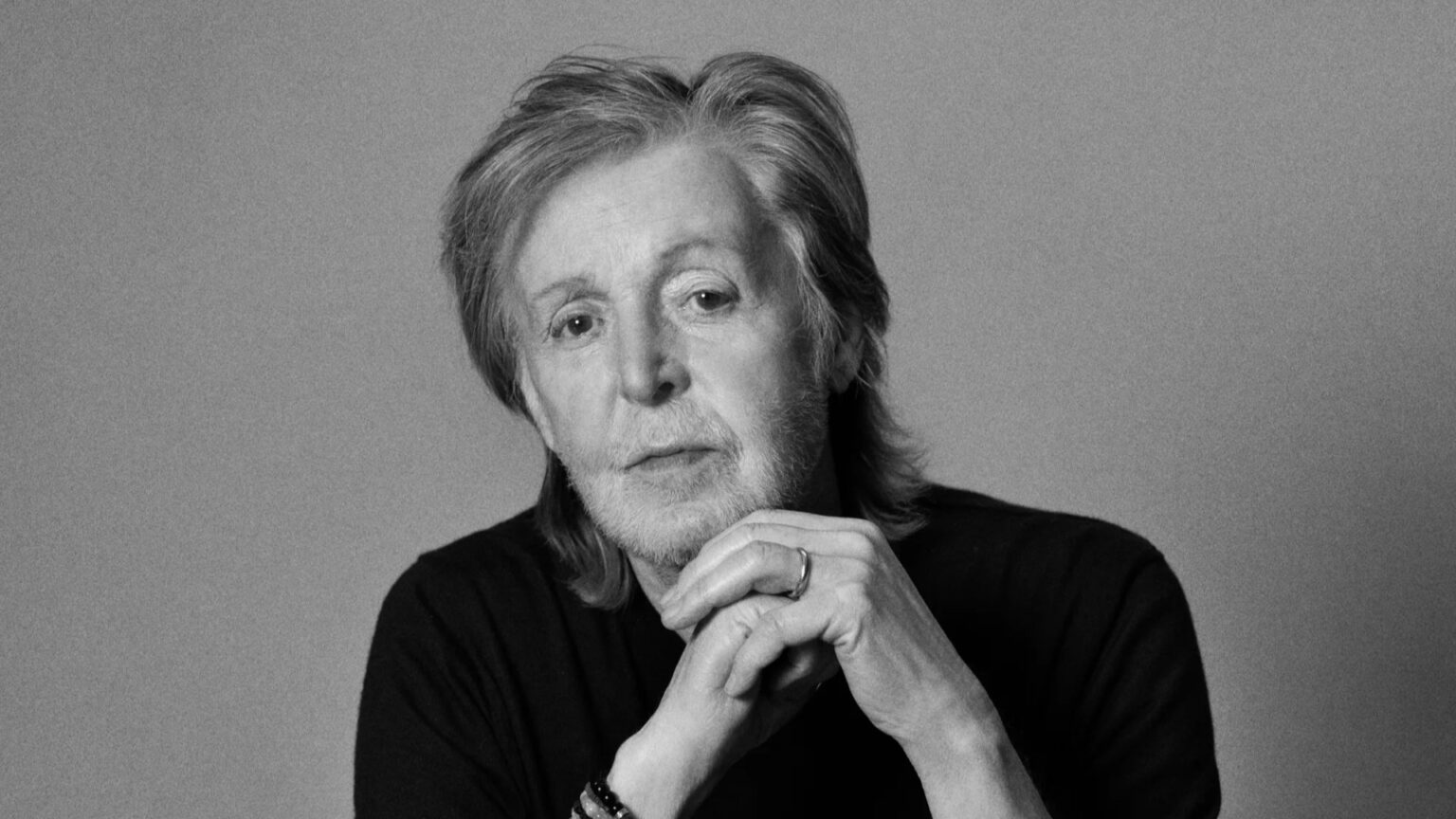


WHO can blame Paul McCartney for glancing in the rear-view mirror on his latest record?
At 83, the likely lad from Liverpool, who became a Beatle and Britain’s best-loved songwriter, is due a moment of reflection.
Sign up for the Showbiz newsletter
Thank you!
Paul McCartney’s new album The Boys of Dungeon Lane was recorded over the past five years, between touring and other commitments Credit: Unknown
Macca at his album playback in Studio Two, Abbey Road, wearing Beatles socks. And he won’t need Father McKenzie to darn them! Credit: Unknown
He looks at it this way: “As a writer, you often write about things in the past, even if it’s just yesterday.”
Or even, as Macca can’t resist saying, if that past “always seems so far away”.
“That’s another nice idea. I think I might have done that one,” he adds in acknowledgment of his immortal Beatles ballad Yesterday.
His 20th solo studio album, The Boys Of Dungeon Lane, finds him casting his mind back to innocent times before The Beatles changed his life for ever.
FESTIVAL FEVER
Snow Patrol debut never-before-heard song at In It Together festival
HOT LIKE PVC
Pussycat Dolls look sexier than ever in latex for first TV gig in six years
Five of the 14 tracks visit the simple pleasures of youth — As You Lie There, Days We Left Behind, Down South, Home To Us (a first ever duet with Ringo) and Salesman Saint — and, as you’ll discover, each comes with a captivating back story.
Here, the master storyteller, whose previous character studies include Eleanor Rigby, The Fool On The Hill and She’s Leaving Home, turns the spotlight on himself for what might just be his most personal song cycle yet.
On The Boys Of Dungeon Lane, Sir Paul makes you believe in HIS yesterdays.
Asked why much of his latest work deals with memories, he replies: “I think writers, including me, ask themselves that.
“When you think about, say, Charles Dickens, what’s he going to write about except stuff he knows and stuff he remembers? Then he can gussy them up.”
And do recent Beatles and Wings reissue projects have an impact on the way he fashions a song these days?
“No,” answers McCartney emphatically. “The thing that pulls it all together is me — it’s my brain making music.
“I don’t think, ‘Wow, oh yeah, let’s do this. This is a Beatles idea, or this is a Wings idea’. I don’t think like that. It’s all current. It’s me. This is what I do.”
Listen to The Boys Of Dungeon Lane and you’ll understand what he’s getting at.
Despite first picking up a guitar nearly 70 years ago, he’s still making eclectic, freewheeling music, brimful of ideas, even if many lyrics are bathed in nostalgia.
The album was recorded over the past five years, when time permitted between touring and other commitments, in the company of in-demand American producer Andrew Watt, known for his work with Ozzy Osbourne, Post Malone, Lady Gaga, Miley Cyrus and, ironically, The Beatles’ chief Sixties chart rivals, the Rolling Stones.
“We just enjoyed it,” says Macca of his sessions with Watt. “We were like a couple of Boys Of Dungeon Lane — little boys in a sandpit — and we were having fun.”
Paul and Beatles drummer Ringo Starr are still close Credit: Getty
Macca riffing with producer Andrew Watt Credit: Unknown
So, with the help of telling observations from the man himself, given to me by his team, let’s take a deep dive into the key tracks.
As You Lie There begins proceedings in memorable style with an intimate spoken word passage delivered over minor key acoustic strums.
McCartney intones: “I used to walk past your house. Every night I’d look up at your window. The light was on. I saw your silhouette on the blind. Do you think of me? Do I ever cross your mind?”
The song, with its squalling rock refrain, recalls a teenage crush from the time Macca lived at 20 Forthlin Road in the Allerton area of south Liverpool, in the house where he and John Lennon first discovered their spark of creative chemistry.
“Up in one of the windows, there was a girl I fancied called Jasmine,” he says of his tale of unrequited love. “But I didn’t know how to approach her. I never spoke to her.
“The joke was, she did show up later that year and knocked on the door. I was indisposed — I was on the toilet — so I missed Jasmine.”
Aside from the sweet story behind the lyrics, As You Lie There is important because it is the song that kickstarted the whole process, just as the world was emerging from the Covid pandemic.
McCartney says: “The album really started when my manager said, ‘Would you like to meet Andrew Watt?’
“I knew he was an active young producer, and I liked some of his stuff. I said, ‘Yeah, great’. He said, ‘Well, it’s just a cup of tea. Go down to his studio’.”
The pair hit it off and what began as that cuppa at Watt’s basement studio — located in his Beverly Hills residence once owned by Charlie Chaplin — soon turned into something much more significant.
Macca described his songwriting process, how he would try “to find
a really weird chord”, to give him “a little inspiration”.
To his delight, he realised that Watt, a big guitar collector, “had figured that if I was coming down, it would be handy to have a left-handed guitar.
“I struck this mad chord,” he continues. “I still have no idea what it is, then I changed one note, then another. Suddenly we had a three-chord sequence and Andrew said, ‘We should record this’.”
As the song took shape, they considered bringing in Chad Smith of Red Hot Chili Peppers on drums but Watt suggested that McCartney, a more than proficient drummer, should play them himself.
He says: “I really enjoyed drumming to it, so I put down the drum track, then obviously the bass.
Paul first picked up a guitar nearly 70 years ago, but still make eclectic, freewheeling music, even if many lyrics are bathed in nostalgia Credit: Getty
Paul during filming of ‘Magical Mystery Tour’ in 1967 Credit: Redferns
“Then Andrew put the guitar lick down, because he’s a good guitar player. And over a few days, we made As You Lie There. That started the journey.”
The “journey” included recordings in various LA studios as well as Macca’s own Hog Hill Mill in Sussex and his old Beatles stomping ground, Abbey Road.
Of all the ensuing songs, first single Days We Left We Behind sets the tone — and is also significant for yielding the album title.
“This is very much a memory song for me,” says McCartney. “I was just thinking about those days I left behind.”
Whenever he goes to Liverpool these days, to visit the city’s Institute for Performing Arts (LIPA) for instance, he notes that “the back entrance to the airport is in Dungeon Lane”.
He remembers trips down that lane “as a little kid, because I used to wander off, just on my own, with my little bird book”.
It was the keen ornithologist’s gateway to stunning Mersey Shore, an area teeming with wading birds just a short distance from suburban Speke where he lived between the ages of five and 13.
“Speke is quite working class,” says McCartney. “We didn’t have much at all but it didn’t matter because all the people were great and you didn’t notice it.
“It’s my wife Nancy’s favourite track on the album. When we play it to people, we say, ‘You don’t need to cry’, and then you look up and see that they are.”
When asked how he settled on the album title, Macca says you could ask the same question about Sgt. Pepper’s Lonely Hearts Club Band.
“It’s just some words I like. We were thinking Along The Mersey Shore could be good. But then I liked The Boys Of Dungeon Lane — it’s a bit more, ‘What’s that about?’ ”
McCartney says Days We Left Behind “involves a bit in the middle about John and Forthlin Road”. (The McCartney family moved there in 1955).
It suggests that he and his much-missed songwriting partner in The Beatles “wrote a secret code, to never be spoken”.
This leads us to the folkie Down South which, says Macca, is “another one about reminiscing”.
“I often think about John and George,” he continues. “We used to hitchhike in the days before The Beatles. It was in the days when you could — now I warn my grandkids, ‘Don’t do it’, because there are too many nutters out there.”
He remembers: “I got a tip from someone who said, ‘You start off in Chester — because that’s where all the lorries are and they’re all going straight down south. That’s a good place to get your first lift’.”
With Harrison, seven months his junior, coming along for the ride to places like Harlech in Wales, it was a perfect chance to do some “bonding” with his future bandmate.
And speaking of bandmates, what about the rousing Home To Us, which, for good reason, is the only track McCartney doesn’t play the drums on.
During one of his breaks from sessions with Watt, he “talked to Ringo about Andrew”.
“Then Ringo went round to Andrew’s studio and drummed a bit. Next time I saw Ringo, he said, ‘Well, he didn’t do anything with it.’
“I asked what he’d expected and he said, ‘Well, you know, a track’.”
When Macca finally heard his old mucker’s efforts, he suggested to Watt: “We SHOULD make a track and send it to Ringo. So, we did.”
On writing the Home To Us lyrics, he reveals: “This song is done totally with Ringo in mind. I’m talking about where we came from.
“In common with a lot of people, you come from nothing and you build yourself up. Ringo was the one who came from the most ‘nothing’ in The Beatles.
“He was from the Dingle and that was well hard. He used to get mugged coming home from work.
“Even though it was crazy, it was ‘home to us’ and I made the song around that idea.” At first, Ringo only sang a few lines of chorus, but Macca rang him and said he’d “love to hear him sing the whole thing”.
“Next, we took my first line, Ringo’s second line and we had a duet — something we’d never done before.
“We also wanted backing vocals, and I had the idea it would be nice to hear girls. Chrissie Hynde and Sharleen Spiteri are mates — and they did it.”
The last of McCartney’s memory songs is the most poignant, Salesman Saint, which pays tribute to his midwife mother Mary who died when he was only 14 (the “mother Mary” of Let It Be) and his salesman/amateur musician father Jim.
He says: “This song is me remembering my mum and dad. I was born in World War II and I often think, ‘Bloody hell, it’s tough enough having a baby now but imagine if we were all conscious that bombs could be falling any minute’ — and Liverpool was getting heavily bombed.
“I was thinking about them bringing up this kid in those circumstances. My dad happened to be a cotton salesman, and my mum was a nurse. They did it. They managed it and they brought up me and my brother [Mike].
“Got us to doctors, got us to school and did all these things under those circumstances. At the end of the song, there’s music I’m trying to make from their era.”
So now you’ve heard about all the songs inspired by McCartney’s youth but there are NINE more tracks to digest. So here, in Macca’s own words, are his thoughts on those:
Lost Horizon: “This one came about when our dearly beloved and now sadly deceased studio manager, Eddie Klein, was logging some old cassettes of mine.
“He asked me if I remembered Lost Horizon and I said, ‘No’. He said, ‘It’s good, you should listen to it’. So, we remade it faithfully to the cassette version — just with a more modern sound.”
Ripples On A Pond: “It’s a love song. Like a few of the songs, we started this in my studio in Sussex. I said to Andrew, ‘You’re supposed to be a pop producer and we’re making all these records that don’t sound like that to me so, come on, let’s pop this one up!’ ”
Mountain Top: “My wife is a real live music fan and if there’s anything on she’s like, ‘Can we go?’ So, we go to Glastonbury every year and I started fantasising about some young girl tripping — she’s magic mushroomed out. The things you write songs about!” (Nancy delivers the closing spoken words.)
We Two: “A lot of Beatles records were made on a four-track Studer machine, including A Day In The Life. It’s such a classic now. I’ve got one in the studio and we use it sometimes. Andrew loves all these recording legends of the past. I showed him the Studer and he said, ‘Can we use it now?’ Luckily, it’s in full working order so we did We Two on it. It’s a little love song.”
Come Inside: “Going to side two now. We start it off with a rocker love song. It’s straightforward — but with verve.”
Never Know: “When I was in LA, I always liked the idea of Laurel Canyon and that scene. The days of Joni Mitchell, the Eagles — all that hanging out, getting stoned and playing guitars. So that was the vibe that started off Never Know.”
Life Can Be Hard: “I had a little instrumental chord sequence during Covid — and there was a little baby in the house, my wife’s niece’s new baby and it was a thrill. For a lot of people, Covid was terrible if you weren’t with family.
“Anyway, this baby used to like these chords, and it became a song. Life can be hard, but that’s when we put it together again. It’s a positive message.”
First Star Of The Night: “I was on tour and had a day off, which was precious. We were in Costa Rica and it rained hard — all day heavy, tropical rain. I was thinking about being out by the pool, but you really couldn’t go out.
“I thought, ‘I know, I’ll write a song’. I had my guitar with me. So, this starts out, ‘Even when it’s raining’, but then I switched it to, ‘Even when it’s raining inside’, just to give myself somewhere to go with the song.”
Momma Gets By: “The last track on the album and it’s totally imaginary. I was thinking of Porgy and Bess’s world. It’s basically about a woman who you can see is the strength in the family.”
Finally, Macca is asked how he hopes listeners will respond to his new album.
He replies: “Well, I hope they fall in love with the songs and the performances. I hope it takes them to a place of joy.”
Whether it’s Penny Lane, Dungeon Lane or Memory Lane, Paul McCartney will transport you there.
Roll up! Roll up! He is your magical not-so-mysterious tour guide.
PAUL McCARTNEY
The Boys Of Dungeon Lane
★★★★★
Whether it’s Penny Lane, Dungeon Lane or Memory Lane, Paul McCartney will transport you there with his new album Credit: AP