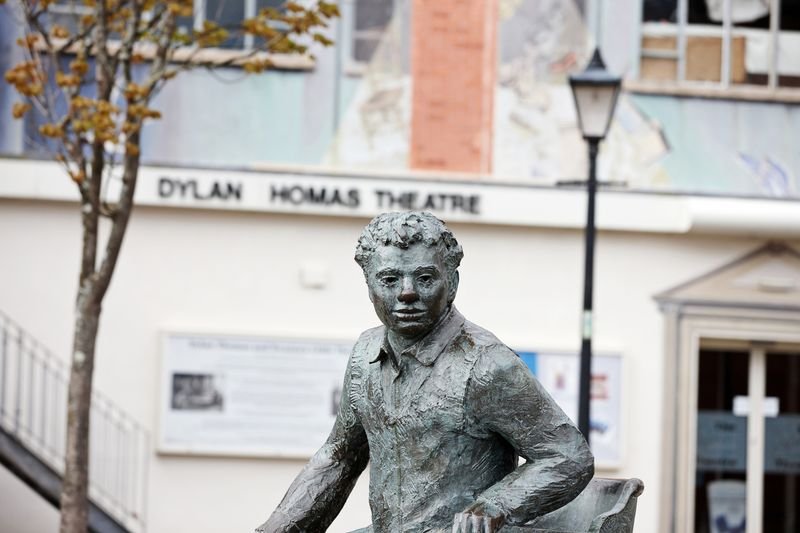

OUR driver introduces himself as “Dan the Van” — spoken with a practised cadence designed to ensure you never forget: Dan, the driver of your van. In truth, forgetting Dan would not be easy under any circumstances. Alert and effortless at the wheel, he is also an inexhaustible reservoir of cultural lore. Literature, local history, cinema, folklore: he commands a substantial and nuanced grasp.“You must know the name Dylan Thomas?” he asks. The name that surfaces in my mind is Bob Dylan — the famous American singer from my youth, whose anti-war, anti-establishment songs we listened to on an endless loop. “Dylan Thomas was our greatest, most celebrated Welsh poet,” he explains. “It was from him that Bob Dylan borrowed his stage name, though he was born Robert Zimmerman.”Poetry has always been the domain where my literary footing is least secure. Even within Punjabi verse, my familiarity is modest.“The writer of the famous play ‘Under Milk Wood’?” I ask. “Yes, the same,” Dan confirms. “I’ve always considered him an English writer,” I remark gently. “He always wrote in English, yes — but he was born, bred, and shaped by Wales,” Dan clarifies.I am reminded of an argument in Lahore between two literary acquaintances. One had described Faiz Ahmed Faiz as a great Punjabi poet. The other reacted sharply: “Faiz wrote perhaps four or six poems in Punjabi. He wrote in Urdu his entire life, how does that make him a great Punjabi poet?”I found myself thinking the second man had a point. We do not call Mulk Raj Anand, Rajinder Singh Bedi, Saadat Hasan Manto, Krishan Chander, or Khushwant Singh great Punjabi writers; at most, we call them writers of Punjabi origin. The same reasoning applies to Dylan Thomas: Welsh by origin, certainly, but an architect of the English language. I do not pursue this with Dan. My mind drifts instead to the countless writers across cultures who set aside their mother tongues and chose to create in the dominant language of their time and place.“Today we will go to Laugharne,” Dan says, pronouncing it in a distinctly local manner, so that it sounds almost like “Larn” or even “Lawn”. I try to locate it on the map, but no such name appears nearby. How could it? Written as Laugharne, looking like it is pronounced as “Laff-arn” or “Law-garn”, it turns out to sound entirely different.“Laugharne is where Dylan Thomas spent the last four years of his life,” Dan continues. “Though he lived in many cities, and died in New York, his final home there has been turned into a memorial museum.”Dylan Thomas was born in 1914 in Swansea and died in 1953, aged just 39. By 16, he was a newspaper reporter and already composing verse. Nearly half his poetic output dates when he was between 16 and 20. At 19, his first collection was published. In the years that followed, he produced widely acclaimed work and is counted, even today, among the finest modern lyric poets in English. His radio plays remain popular.Yet by 23, heavy drinking had begun to erode his life. His marriage to Caitlin Macnamara was passionate, chaotic, and bruised by mutual infidelities. His fatal collapse in a Manhattan hotel in 1953 is widely ascribed to acute alcohol poisoning and neglect.Hearing all this from Dan, my thoughts move to other romantic poets — Lord Byron, Sergei Yesenin, Shiv Kumar Batalvi, figures whose lives, like their poetry, were steeped in turbulence. All died young. And except Byron, whose death came through fever, the others share a common thread: excessive drinking, and the physical and mental ruin it brought. One wonders whether romantic poets carry within them some particular impulse toward self-destruction.Laugharne is an intimate settlement of about 1,300 persons. Situated on the estuary of the River Tâf, it holds evidence of human habitation stretching back thousands of years. The most prominent landmark is Laugharne Castle, originally built in 1116.From the castle, a gently rising path begins. Soon the view opens onto a vast stretch of water — the estuary merging into the sea.We reach a small glass-fronted cabin perched along the cliff. Inside: a desk by the window, scattered papers, a lamp, a mug, an empty beer bottle, a coat draped over a chair — everything arranged as if the writer has just stepped out for a stroll.Nearby stands the Boathouse, his home. Small, almost childlike in structure, raised on stone pillars to prevent flooding, with a narrow balcony overlooking the water. Inside, rooms are kept in immaculate domestic stillness: handwritten manuscripts, his recorded voice booming warm and resonant from hidden speakers, and a plaster cast of his New York death mask.The cottage was bought for him by his patron, Margaret Taylor. Over 25,000 travellers find their way each year simply to walk where he walked.A sharp pang of comparison strikes me. Thousands visit this small Welsh town annually to honour a writer who wrote in English, yet remains an indelible pillar of Welsh cultural memory. And back home in Punjab?In Preet Nagar, once the beating heart of an idealistic literary commune founded by Gurbaksh Singh, where modern Punjabi sensibility was shaped, fewer than 1,500 visitors trickle through in a year. Meanwhile, in cities and towns across the region, the homes linked to Balwant Gargi, Amrita Pritam, and Batalvi stand neglected, or razed.Whom do we remember, and what do we actually preserve? We are a culture that reserves its deepest reverence for heritage only within the hollow confines of seminar halls and memorial speeches.— Sukirat Singh Anand publishes under the name Sukirat