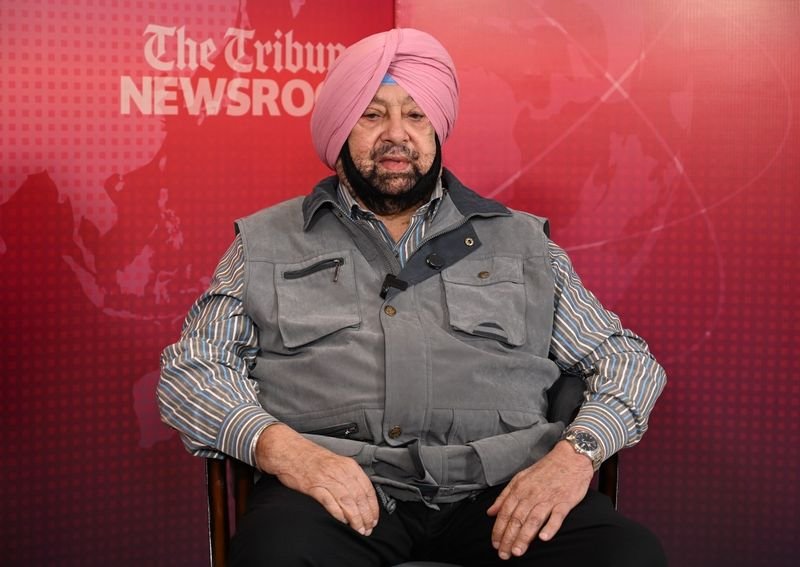

I’m with Captain Amarinder Singh, the former Chief Minister of Punjab, twice — the first time from 2002 to 2007, the second time from 2017 to 2021 — with the Congress Party, which he joined in 1971 and remained with, barring minor breaks, until 2021, when he left and joined the BJP, of which he remains a senior leader. Captain Singh was with the Indian Army; he fought the 1965 India-Pakistan war, where he was ADC to the then General Officer Commanding Western Command, General Harbaksh Singh. He retains a love for military history, and is a much-loved and much-respected columnist of The Tribune.JYOTI MALHOTRA: Captain, welcome to The Tribune.CAPT AMARINDER SINGH: Thank you, lovely to be here.Jyoti Malhotra, Editor-in-Chief of The Tribune, and former Chief Minister of Punjab Capt Amarinder SinghJYOTI MALHOTRA: We are very happy to have you here. My first question: you’ve been in politics for decades now, you’ve seen Indian politics at its best and its worst — you’ve been in the Congress Party, twice Chief Minister, you launched your own party briefly, and now you’re with the BJP. As Punjab goes into another election six months from now and the political situation is hotting up, what are your first remarks on how you evaluate what’s happening in the state?CAPT AMARINDER SINGH: The situation as I see it — I’ve seen Punjab now for many years. I came in at a sad moment, because at that time Naxalism was at its peak, and the president of the Swatantra Party, Sardar Basant Singh, was shot dead by the Naxalites in Patiala. That’s why a vacancy came about, so I came in. That continued — we had a lot of killings going on. I’ve seen the so-called Khalistani movement, Operation Blue Star and Operation Black Thunder.Today — I don’t like criticising people, but I think this government has forgotten that they are a government. There’s no control; everyone is doing what they feel like. The Chief Minister is more of an actor on the screen than someone doing his job as Chief Minister. The drug business is growing further, Naxalism is growing further, the farmers are disgruntled, unemployment is growing. So overall there’s really nothing positive to say about the government or about what’s happening in Punjab. It’s sad — we have to live here, and after us our children and grandchildren have to live here. I’m not a pessimist by nature, but I can’t find anything to be optimistic about in what is happening today.JYOTI MALHOTRA: You talked about the drugs crisis and how bad it is, and every political party has jumped into this. But when you were campaigning to become Chief Minister in 2017, you promised to eradicate the drugs crisis within six months of coming to power. What happened?CAPT AMARINDER SINGH: I didn’t promise that — nothing happened the way it’s often claimed. Let me tell you what actually did happen, because this is an issue that comes up every now and then; someone says it on some political stage and a newspaper picks it up. I was in Bathinda, close to Damdama Sahib — which used to be my constituency at one time, Talwandi Sabo. It was a good crowd, and I had some colleagues standing next to me. I told them this was the appropriate place to speak on the subject, and I did speak — in Punjabi. I had a Gutka Sahib in my hand. People say all sorts of things about who gave it to me — nobody gave it to me, I asked for it myself. One of my colleagues, Ramanjit Singh Sikki, our MLA, is a very religious man who spends a month every year doing seva in Darbar Sahib and always carries his Gutka Sahib. He was standing close to me, so I asked him for it and he gave it to me. I said I’m not God, I can’t perform miracles, but I can certainly do the best. I can to break the backbone of the drug trade. And it did happen.I brought all my papers along to prove the point, because I have to keep what I’ve done on record. This is the action taken against drugs up to August 2021, when I left the government. We formed a special task force for this — I got Harpreet Sidhu, one of our fine ADGPs, who was working in Chhattisgarh on the Naxal issue at the time; I asked for him specifically, and he came. I formed a SIT under him. In the period up to when I left in August 2021, we had registered 48,107 cases under the NDPS Act since April 2017, arrested 62,535 people, and seized 2,216 kilograms of heroin. Supply reduction had gone down substantially, and we did everything in our powers to break the backbone of this trade.But it isn’t coming from here only — you had a ship docked in Kandla; stuff was coming in from other parts of Jammu and Kashmir too, but mainly from Pakistan. I went umpteen times to see the Prime Minister and the Home Minister to tell them this had to be stopped — the drones were coming in. When I first came into government in 2002, people were coming under the wire or swimming across the river. Then they started using small drones just hopping the river from one side to the other, with someone there to receive it. At first it would be one pistol, a few magazines, maybe some heroin — a small package, and because the drones just hopped across, their range and duration were very limited. By the time I left, in 2021, after my second term, we had caught a drone that had come in 45 kilometres, carrying an AK-47, eight or ten magazines, a lot of cash — counterfeit currency — and a lot of heroin. I don’t know what’s been happening since I left.JYOTI MALHOTRA: So are you saying that even then you told Prime Minister Modi that the situation was pretty bad?CAPT AMARINDER SINGH: I used to go to him. I went to the Home Minister too. I was told the DRDO was working on something. I said there’s no question of “working on something” — these drones are coming every day.JYOTI MALHOTRA: Did you feel then, Captain — especially in your second term from 2017 to 2021 — that on the drugs crisis specifically there was a certain apathy, or a lack of understanding in Delhi about what was happening in Punjab?CAPT AMARINDER SINGH: I don’t think Delhi understood us. The Home Minister then was the current Home Minister, the Prime Minister was the current Prime Minister, and when I went and told them, they’d say “yes, we are doing something.” I’d ask what — I’d been telling them for three years and nothing was happening; it was just BSF posts. The BSF, like the infantry, is trained for a different task — to engage man to man. They aren’t trained to shoot down drones, and neither was I; after four years of training — three years at the NDA and one at the IMA — my training was for a different kind of soldiering altogether. What was needed was some kind of anti-drone response, and that didn’t happen for a long time. It was all “we’re doing something, we’re doing something” — that’s how things were.JYOTI MALHOTRA: Is there a lack of understanding about Punjab in Delhi?CAPT AMARINDER SINGH: I don’t think anyone thought it would go to this extent. My feeling was that they thought these were just small peddlers, small-time stuff.JYOTI MALHOTRA: But if you have a country like Pakistan on your border, and Punjab is a border state constantly fighting this kind of war — former Pakistani generals themselves have said this is effectively a thousand-year war with India — do you feel Delhi should be far more alert to this?CAPT AMARINDER SINGH: Absolutely. You saw it recently too — those drones coming in. They’re not small toys carrying small packages; there’s real intent behind sending them across. When a drone comes in on a battery, a jawan on duty hears the drone and aims — but by the time she or he aims, the drone has already passed. We weren’t trained for this at all; the Indian Army is being trained for it now, but in those days nobody knew how to counter it.JYOTI MALHOTRA: Why do you think Pakistan does this?CAPT AMARINDER SINGH: Pakistan’s security, as they see it, lies in keeping Punjab disturbed, in keeping India disturbed — they do it all the time. Unlike in India, the army in Pakistan runs that country.Pakistan’s security lies in keeping Punjab and India disturbed. It is their job. And we’re a bit soft on it — I think we should be harder, including in Kashmir.I remember once crossing Wagah — the then Punjab Chief Minister, Mr Pervez Elahi, came to receive me. I’d actually been in that area during the 1965 war too, because I’d gone to visit some jawans at Dograi — I’d gone in a UN aircraft during the prisoner exchange at Lahore with General Harbaksh Singh, and there wasn’t room for an extra person, so I was asked to get off; the general let me go up to Dograi instead to meet some friends there. Anyway, years later, driving through Wagah with the Chief Minister, I noticed a war memorial near the Ichhogil Canal — a memorial to their troops who had died, including some from 3 Baloch and 16 Punjab. I stopped the car and pointed it out — it was covered in bird droppings, dirt, completely neglected. On my return journey, I noticed it had been cleaned up and spruced up. That tells you something about the gap between the officer class and the ordinary soldier there.There’s a Pakistani programme called The Soldier Speaks, hosted by a young major — I’ve watched several episodes, and he’s remarkably objective, not pro-Pakistan or anti-India, just calling it as he sees it. They’ll probably lock him up one day. He’s said the same thing — that the gap between the men and the officers is enormous, that the generals are looking at what they’ll get later in farms, buildings and houses, while the ordinary soldier gets nothing.JYOTI MALHOTRA: Do you feel it’s in Pakistan’s interest to keep both Punjab and India disturbed?CAPT AMARINDER SINGH: Absolutely, one hundred per cent. That is their job. And we’re a bit soft on it — I think we should be harder, including in Kashmir.JYOTI MALHOTRA: So you think the BJP government is right to have no conversation, no talks, no communication with Pakistan?CAPT AMARINDER SINGH: I don’t think we should talk to them until they stop. How can you talk to somebody, hug somebody, when your boys are being shot at the border every day? That was my objection to Mr Sidhu when he went and hugged the Pakistan Army chief and others at the opening of the Kartarpur Sahib corridor. I said, what is this nonsense — you’re hugging a man on whose orders our troops are being killed on the border every day. I met the Pakistan Army chief too, on the bus, and I simply said “Sat Sri Akal” and walked on.I don’t think India should talk to Pakistan until they stop (terrorism). How can you talk to somebody, hug somebody, when your boys are being shot at the border every day? That was my objection to Mr Sidhu when he went and hugged the Pakistan Army chief and others at the opening of the Kartarpur Sahib corridor.JYOTI MALHOTRA: Let’s turn to Punjab politics. How do you look at the BJP’s fight and its campaign in this Assembly election?CAPT AMARINDER SINGH: It’s difficult to say at the moment — there’s a hodgepodge in Punjab, if I can put it that way. There are four or five Akali factions. There’s a lot of infighting in the Congress too — five or six of them pulling in different directions.JYOTI MALHOTRA: Your former party.CAPT AMARINDER SINGH: My former party — I still have a lot of affection for it. When you’ve been with somebody for fifty years, they remain your party. I never asked to leave them; they asked me to leave.JYOTI MALHOTRA: So would you say the Congress party in Punjab is fragmented today?CAPT AMARINDER SINGH: All of them are fragmented. I don’t think this government has any credibility left, despite what some people say about their chances — that’s not been my experience.JYOTI MALHOTRA: And the BJP — how do you look at that?CAPT AMARINDER SINGH: BJP’s problem has always been that it has never fought on its own in Punjab — it has always been a junior partner. Had they fought alone, they might have carved out a niche somewhere in the state by now. Whether they can pull it off this time, only time will tell — we’re not too far off, another four months or so.JYOTI MALHOTRA: Would you recommend the BJP fight on its own?CAPT AMARINDER SINGH: No, not at all — I was the first to say they must have an alliance. There are two ways to look at it. If you want to form a government, you need an alliance — with the Akalis, who are your old partners. They’ve formed governments together two or three times before, so what’s suddenly wrong now? On the other hand, some in the party think you should forget forming a government and just fight solo, even if that means waiting ten years to come to power. But then what happens to Punjab in the meantime? If you want a good government here and now, you need a good alliance and good ministers. If you’re content to play a ten-year waiting game, that’s a different matter altogether.JYOTI MALHOTRA : I will now open the floor to questions.SANJEEV SINGH BARIANA (The Tribune): I was there when you took the Gutka Sahib in Bathinda that day and said you would break the back of the drug trade. What do you think has really been the impact — is there any way we are coming back from this?CAPT AMARINDER SINGH: I’m afraid things are not good at the moment. I get a lot of reports, a lot of people come to see me and tell me what’s happening in their villages. The impact has been negative, and unless the government comes down hard on it, it isn’t going to improve.SANJEEV SINGH BARIANA: Is there an SIT? Is the police doing something to catch these people? Is the Government of India cooperating — is the ED, or whoever it’s supposed to be, actually working on this?CAPT AMARINDER SINGH: There’s nothing happening. Whatever we did up to September 2021 — once I left, the whole apparatus collapsed. There’s no movement. I’m not a negative person by nature, but I feel sad that this is happening in my state.SANJEEV SINGH BARIANA: A related question — is controlling drugs only a matter for the enforcement agencies, or does something else need to happen?CAPT AMARINDER SINGH: No parent wants their child affected by this. Unfortunately it’s taken hold among the younger generation and it’s continuing. Whatever family pressure can be brought to bear should be brought to bear — but beyond that, if someone doesn’t listen and goes ahead anyway, the answer has to be the law.JUPINDERJIT SINGH: My question is about the alleged involvement of Akali Dal leader Mr Bikram Singh Majithia that was brought up during the 2017 election campaign. He was the main target of the entire anti-drugs campaign — what is your opinion today about him, is he involved or not?CAPT AMARINDER SINGH: I’ve said this before too — you cannot blame one person for everything going wrong in the state. And as far as Majithia is concerned, that remains speculative. If a person goes to Canada and is received by somebody, has dinner or lunch with him, stays with him, and that person later visits here and the hospitality is reciprocated, you can’t blame him for that alone — unless he knew, and was actually involved, which is a different issue. But I think this is speculation. I don’t believe it, and not because I’m close to the Majithias — though I do know them well; his father was senior to me in school, and his grandfather was a friend of my father’s.JUPINDERJIT SINGH : Will you be the BJP’s face in the coming Assembly election?CAPT AMARINDER SINGH: No, my face is already… what should I say…JUPINDERJIT SINGH : If it were offered to you, sir?CAPT AMARINDER SINGH: Look, I’ve had a very good life. My first love was always the Army, from childhood — my father was in the same regiment, my grandfather was in the same regiment, and I was too. My only fear growing up was whether I’d pass the exam to get in. I had to take two months off school just to prepare for the exam, and I managed to get through. I enjoyed every moment of my three years at the NDA. At the IMA we were only meant to do one year, but we did six months — the Chinese decided to “invite themselves to visit us,” so we were passed out early and sent straight to our regiments. I went to my regiment on the Chinese border and spent two years there, then went on a course to the Infantry School. Coming back, our transit camp was at Kalka, and we were posted on the Chinese border at a place called the Sugar Sector, where the Sutlej and the Parechu link up, near the Khorik Pass.JYOTI MALHOTRA : But — if the BJP were to win, whether in alliance with the Akali Dal or on its own, and if they were to offer you the Chief Ministership of Punjab, would you accept?CAPT AMARINDER SINGH : I’m coming to that…I enjoyed every bit of my time in the army, then as ADC to Gen Harbaksh Singh for four years, enjoyed that too, enjoyed my life until now. I went to Pakistan twice. Let me tell you — I don’t agree with going easy on the generals there who give the orders against our people, but I recall calling on President Musharraf once. Before we started talking, he asked whether we had fought against each other in 1965; I said no, General. Then I told him, by the way, I’m senior to you in the army — you’re April ’64, I’m June ’63. He laughed and I said, “anyway, you’re the President.”I told him I had one request: our intelligence chief, Mr S S Virk, had given me a list of 82 boys — mostly boys — arrested and held in Pakistani jails. I told Musharraf, “you’ve got my boys locked up,” and handed him the list. He looked at it, called over his Chief of Staff and asked when I was leaving; I said the day after tomorrow. He said, “send them back before that.” And we got all 82 of them back — I have to thank General Musharraf for that; he’s no longer alive, but there it is.Having done all that, having spent so many years — I’m 84 years old now. Though Morarji Desai was 92 when he became PM, so I’ll leave that door open.RUCHIKA KHANNA: Who would you recommend from the BJP or the Akalis for CM — can you name three candidates?CAPT AMARINDER SINGH: I can’t comment on that, because the BJP never asks me.RUCHIKA KHANNA : Who would you not like to see as CM? Does the BJP really not ask you?CAPT AMARINDER SINGH: No, they don’t ask me. I haven’t had a single meeting on Punjab policy or politics with them in the last five years.The BJP doesn’t consult with me on Punjab. I haven’t had a single meeting on Punjab policy or politics with them in the last five years.JUPINDERJIT SINGH : Would you consider a woman as CM?CAPT AMARINDER SINGH: Women, men, it doesn’t matter to me — I don’t believe in this business of gender or caste or community. That’s nonsense. We’re talking about running Punjab. If there’s a good woman, put her there; if there’s a good candidate from any caste, put them there. Why should it always be a Jat?JYOTI MALHOTRA : Does the BJP understand Punjab?CAPT AMARINDER SINGH: No.JYOTI MALHOTRA : Why not?CAPT AMARINDER SINGH: Because I don’t think they’ve ever actually been in power here long enough to learn how to manage the political system. Being a minister gives you very little real power. You have to start at the bottom, like all of us did — working at the block level, the district level. They should ask people like us. I joined in 1967, when my mother was in Parliament and my father was also contesting elections — I helped them then. That’s 59 years now. I’ve been Chief Minister twice, MLA six times, MP twice.We know what ground-level politics is, and at the very least they should ask us. If they think what we’re saying is nonsense, they can throw it out the window — but if we have that experience, it’s only fair they consult us. It’s not just me — others who’ve joined from the Akali Dal too; nobody asks them either.JYOTI MALHOTRA : But the BJP, or the RSS, are very meticulous about organising the politics in every state — they have their Prant Pracharaks, their block-by-block, gali-by-gali structure, in the rest of the country. Surely they’ve done that groundwork in Punjab too?CAPT AMARINDER SINGH: Let me tell you something. I was Punjab Congress Committee president three times. Once, I’d gone to a Hind Samachar newspaper group event — they used to distribute blankets to refugees once a month. I sat down, and when my turn came to speak I got up and criticised the BJP thoroughly — I was Congress president then.Then the person sitting next to me got up to speak, and someone said, “Modi sahib will now speak.” I asked, “where’s Modi?” — he was the man sitting right next to me, the BJP’s Prabhari for Punjab. I’d been criticising him with him sitting beside me the whole time. He got up and gave a very good speech. Afterwards I told him he’d spoken well; he said I had too, but that my timing wasn’t quite right.As PCC president, I genuinely didn’t know who the BJP’s Punjab president was, even though he was sitting right next to me. That tells you there was a real lack of communication in those days — people should know who’s who. Mr Modi had apparently been the Prabhari here for three or four years, and I should at least have recognised his face. I can tell you today who’s who in every party; communication has simply changed since then.SUKHWINDER PAL SODHI : Rahul Gandhi once called you his favourite leader. In today’s politics, with so much of a blame game, is it possible to maintain personal relations across party lines?CAPT AMARINDER SINGH: Of course it should be possible. I’m very fond of both Priyanka and Rahul — their father and I were classmates in school, we’ve known each other for many years and were very friendly. I’m very fond of Sonia ji too. I haven’t been able to visit Delhi much in the last four years because of back surgery, but I’ve said this before — politics is politics, and private relationships are different. In this country we don’t really believe that, but I always recommend a film called First Amongst Equals — three friends who go through school and university together, end up in the Conservative, Labour and Liberal parties, fight each other hammer and tongs during elections, and are pals again, drinking together, right after. That happened to me too — when I went to Parliament, General V.K. Singh came from the BJP side; I’d known him since he was a Brigadier, through Major General, Lieutenant General, Army Commander and then Chief. We simply hugged each other when we met in the House. Someone later asked why I’d hugged him — I said, because he’s an old friend. I don’t believe in that sort of pettiness. If tomorrow I tell Rahul, Priyanka or Sonia personally that I’ll be there for them no matter what, I mean it and I’m happy to help.JYOTI MALHOTRA : But you won’t rejoin the Congress — there have been a lot of rumours in the last few days?CAPT AMARINDER SINGH: That’s different. I’ve been through a lot of the pulls and pushes of politics by now, and I never asked to leave — they felt it was better that way, and I never even asked them why. I just left. I think they had a right to make that call. That’s one side of the story; the personal relationships are the other side.RAJMEET SINGH : There’s a buzz that Sonia Gandhi still seeks your advice on Punjab Congress, particularly on how to end the infighting.CAPT AMARINDER SINGH: I promise you, I haven’t spoken to her once — nor to Rahul or Priyanka — since I left, five years ago. But if they want to discuss anything with me, politics aside, and I can help, I will.RUCHIKA KHANNA : You’ve very clearly indicated who the villain of the 2027 election is going to be. So who’s going to be the hero? Who do you see becoming CM, and which party do you see coming to power?CAPT AMARINDER SINGH: I can’t say at the moment, Ruchika — it depends. As far as our party, the BJP, is concerned, we don’t currently have the ground support. Things change fast in politics; you never know what will happen in the next four months. The Akali Dal is losing ground fast, and in any case there are five factions of it. The Congress has split too, for the first time — that never used to happen, because there was discipline; anyone who misbehaved was summoned and sent packing. Now there are four or five factions all vying for the top job. It’s a real hodgepodge, and with all my experience, I’m still genuinely unsure what’s going to happen.JASVIR SAMAR : For the past few years, our political and ruling class has become entirely vote-centric, unwilling to deal with fundamental issues. Is our ruling class today just running a vote stunt?CAPT AMARINDER SINGH: You’re right. I think people are only thinking about themselves — about how they’ll personally be treated, not about the condition of their village or area. Everyone is just doing their own job, and that’s the tragedy of it. There’s selfishness running right through our politics — the reason is selfishness and greed, plain and simple. Everyone wants a bigger house, wants cars, wants more. I’m a hundred per cent convinced this selfishness exists in everyone in politics, whatever party they’re from.JASVEER SAMAR : What do you expect of the youth — our political leadership has largely risen out of the eighties generation. Can new leaders change this?CAPT AMARINDER SINGH: Whether they can or not, only time will tell. But what we’re seeing now — what happened recently in Delhi — suggests our youth has moved beyond that eighties mindset, both in this state and across the country. If the feeling among young people is that their elders were only interested in making money, that feeling will naturally shape them.G S PAUL : There’s talk that the Shiromani Akali Dal has lost its Panthic credentials, with its leaders accused of moral turpitude. Should the BJP still consider a re-alliance with the SAD?CAPT AMARINDER SINGH: I agree with you on that. But what options do you have? Somebody has to form a government, and if the BJP wants to build a real niche for itself here, it needs to be in government and try to address that feeling in Punjab.JYOTI MALHOTRA : You’re referring to the recent Amarjit Chawla case?CAPT AMARINDER SINGH: Yes. I think they’ve dealt with it, and they should expel him from the party. He’s not some innocent — he and another man were part of the Sikh Students Federation during the Op Blue Star period; Mehta and Chawla, the two of them, formed that outfit.JYOTI MALHOTRA : Can I ask about Waris Punjab De, the outfit led by Khadoor Sahib MP Amritpal Singh, who has been in jail for the last three years? Why does it seem to be expanding its influence in parts of Punjab?CAPT AMARINDER SINGH: I’ll tell you what’s happening. There’s always been a strain of sympathy in the Sikh community — for historical reasons, or the way the community has been shaped — for the man behind bars. When Simranjit Singh Mann fought his election, he won 12 of 13 seats campaigning from behind bars, largely on posters showing him in jail. The same sympathy is at play here. The Indian law clearly says 14 for a life sentence — he’s been in for far longer than that. Have we even got a functioning law in this respect? Amritpal is the same — what’s he doing sitting inside? Let him come out and fight the election, and win it if he can. The longer you hold him, the more popular he becomes. He’s been held under the National Security Act, a very stringent law that anyone can be put under — Simranjit Singh Mann was held under it too, and this isn’t the first such case.G S PAUL: Sir, it was during your tenure that the Kartarpur Sahib corridor was opened. There are now calls to reopen it fully — operations have been suspended, and Akal Takht Jathedar Giani Kuldeep Singh Gargaj led a delegation that wanted to offer ardaas at the zero line but was stopped by the BSF over security concerns. When the corridor first opened, every party tried to claim credit — Navjot Sidhu’s famous hug with General Bajwa, the Akali Dal saying it had been pushing the BJP on the issue for years. Beyond the political credit-taking, this is really about the religious sentiments of the Sikh community worldwide. What’s your view — is there a case for reopening it?CAPT AMARINDER SINGH: I don’t think there’s a big issue in principle, but you have to weigh the national side too. It isn’t only the recent Operation Sindoor incident — there’s also the killing of the young tourists at Pahalgam, and other incidents along the border that have deeply affected the country. The Government of India has to weigh the sentiment of the nation as a whole. It isn’t only these incidents either — there was Balakot, and several others before that.G S PAUL : So you don’t think the Kartarpur corridor should reopen?CAPT AMARINDER SINGH: I think it should be opened — but first we need to reach some understanding with Pakistan. I know that saying this invites the response, “so you want talks with Pakistan” — but they are our neighbour, and we don’t want this business continuing in Punjab. If we can achieve some normalcy, it should extend to our border state too — the corridor could open, along with access to Nankana Sahib, Panja Sahib and the many other gurdwaras I’ve had the privilege of visiting. And why shouldn’t Hindus be able to visit Katas Raj? I went and paid my respects there myself. All of this should be opened up once normalcy comes.JYOTI MALHOTRA : Are you saying India and Pakistan should talk to each other?CAPT AMARINDER SINGH: They should talk, to reach a long-term understanding — not small, petty exchanges, but something substantial, because the current situation doesn’t suit us. We share a 600-km border, right from Jammu down to Fazilka, on top of a 2,000-km border with China that we also have to manage. It isn’t us creating the problems — it’s Pakistan. So use third parties — we already do, in other contexts. If the United States can let someone come to New York and speak at the UN, we can use a third or fourth party to open communication with Pakistan too, and perhaps as part of that understanding, open the corridors and let people travel to Nankana Sahib, Panja Sahib and elsewhere.India and Pakistan should talk, to reach a long-term understanding — not small, petty exchanges, but something substantial, because the current situation doesn’t suit us. Then the gurdwaras and the temples can open on both sides.MOHIT KHANNA : Sir, you said the Akali Dal is on the decline and that Waris Punjab De is gaining some traction because its leader is in jail. Do you see Waris Punjab De, or any post-poll combination, going with the BJP — or are they likely to go solo?CAPT AMARINDER SINGH: No, I don’t think Waris Punjab De’s ideology matches the BJP’s at all, so I don’t see them going that route. But there are other players — Giani ji’s party, Sukhbir Badal’s Akali Dal, and others. I don’t know who will align with whom, but some understanding will emerge, some alliances will form — otherwise Punjab won’t have a government, and you’ll end up with Governor’s Rule.AATISH GUPTA : About your home constituency — across 2014, 2022 and 2024, the face most identified with the whole of Punjab has repeatedly faced defeat there. What do you think is behind that? And for 2027, from the same seat, will you field a family member, or contest again yourself?CAPT AMARINDER SINGH: I’ve already said my own days of contesting are effectively over — not entirely over, but on hold. My daughter is working very hard, and let’s see how she shapes up; I can’t say more than that. As for the defeats — when you’re Chief Minister, people don’t always appreciate the demands of the job. I never went to sleep before midnight, I was up early, there were files and discussions constantly — my bodyguard would wake me at three in the morning to tell me someone had planted a bomb somewhere. Things like that happen, and inevitably you have to cut yourself off somewhat from your own constituency. Other people work for us there, but people still expect you to be present every single day. My daughter is doing a lot of the groundwork — let’s see how it goes, and whether she eventually contests.ARVINDER JOHL : Sir, I don’t want to ask a political question. You’ve told us some wonderful stories today, and I understand you’re planning books. Your military history writing is much appreciated — are you planning something on the creative side too?CAPT AMARINDER SINGH: I’m writing two books at the moment, depending on my mood on a given day. The first is on the Anglo-Sikh Wars, 1845 to 1849, before Punjab came under the British — nobody has really written about that period in detail, and I want to be as objective as possible; the research is still ongoing. The second is on the possibility of a war between India and China — I’ve done about 250 pages of that; I need around 400. It’ll be an unpopular chapter for some, I suspect.VIKRAMDEEP JOHAL : Two small questions. What prompted you to join the BJP, and what have you gained from your four years with them? And are you regretting the decision?CAPT AMARINDER SINGH: No, I’m not regretting it. I’ll tell you what prompted it. I was sitting one morning — I knew there were rumblings in the Congress party; people want everything, and you can’t do everything for everyone. I went to the Congress president and said, “Ma’am, this is my resignation.” She asked why; I said because I understood change was coming to Punjab. She said no, no, and called in Rawat, the General Secretary, and asked what this was about — he too said no, no, we still have months left before the elections, don’t do this. The next day I got a call — it was her. She said she thought I should resign after all. I’d offered my resignation ten days earlier and she’d said no; now she said she was sorry. I told her she didn’t need to be — it’s her party, and if she wanted me to go, I’d go. I rang up the Governor and, after some delay, went and resigned. That’s how it happened.Then all our supporters wanted to know what to do next, so we formed our own party — that didn’t take off, and eventually everyone said, let’s merge with the BJP. We didn’t really have another option; we weren’t going back to Congress, and I’d never rejoined the Akali Dal either, even though I’d been close to them before — I’d resigned from Congress in 1984, and again around the Op Black Thunder period. So merging with the BJP was the option, and we took it.As for what I’ve gained in four years — nothing, really. If you join a party, you expect to be consulted, especially someone who’s spent close to sixty years understanding Punjab. I’m not claiming to have all the answers, but I do know this state.VIKRAMDEEP JOHAL : Are you planning to stay in the BJP?CAPT AMARINDER SINGH: What’s the option? I can’t go to the Akali Dal, and I don’t think the Congress would take me back either — they’re in a mess of their own right now and need to sort themselves out first, even though the ground swell is actually in their favour at the moment, between them and the BJP.MONICA CHAUHAN : If you were from a bigger state, do you think you could have been Prime Minister?CAPT AMARINDER SINGH: Me? I don’t think so — I’d make a very bad Prime Minister. I never really had a mass following in that sense; I just enjoy meeting people, that’s all.INDERPAL SINGH : Could you tell us how the farmers’ issue could be resolved?CAPT AMARINDER SINGH: Agriculture is in my blood — I was the first to take on the Agriculture portfolio in 1985, and I asked for it again both times I was Chief Minister. I’ve always had a very good relationship with the farmers; they’ve been kind and supportive, and I’ve tried to do whatever I could for them, and they’ve reciprocated. But there are a lot of demands, and I honestly don’t know whether any government can meet all of them.INDERPAL SINGH : The Congress still hasn’t picked its Chief Ministerial face — are you going to be the one elected?CAPT AMARINDER SINGH: Me? No, I’m not going to be elected — there are five or six names doing the rounds, but I couldn’t tell you who they’ll finally settle on.MOHIT KHANNA : Turning to national politics — the BJP is in power, the PM is there, but Rahul Gandhi is also making real inroads, doing a lot of public meetings. Where do you see him — could he become a PM face?CAPT AMARINDER SINGH: Why not? I’m genuinely impressed — I saw his recent rally in Indore, a massive turnout, and people don’t show up like that unless they want to support you. Every party has its moment. I remember when I was in Parliament, in the eighties, there were just two BJP MPs — that was 1984, right after Rajiv Gandhi’s death. And look at the BJP today. One never knows how these things turn. There’s no reason Rahul Gandhi couldn’t emerge in the same way one day — everyone gets their moment. I remember when Pandit Nehru died — I wasn’t there, I read about it in the papers; we were on the Chinese border. Indira Gandhi was reportedly pushed to one corner at the time, with others taking over. A few years later, she was Prime Minister. These things happen.MOHIT KHANNA : Since you’re a tall, national-level leader, what would you suggest both parties do to return to power?CAPT AMARINDER SINGH: I can’t really tell the Congress what to do, but I can tell you what the BJP should do — build an alliance, and at the same time build up its district-level cadre properly. We still have four months to go; even without forming the government, building that cadre base matters for the long run. As for the Congress, you’ll have to ask them — if I say something here, they’ll be upset with me after it’s printed.MOHIT KHANNA : What should the Congress do to get its act together?CAPT AMARINDER SINGH: I think Rahul and Priyanka — and Mrs Gandhi too, even though her health isn’t the best, she can still participate — need to call everyone together and simply insist on it. If someone doesn’t want to fall in line, they should put their resignation on the table and leave the party. There has to be discipline. Can I tell my commanding officer I’m not going to follow an order? I’d be court-martialled immediately. Something like that discipline is needed here too.RUCHIKA KHANNA : Who among the Congress leaders do you think is fit to lead the party?CAPT AMARINDER SINGH: Don’t ask me that — you’ll get me into trouble. But there’s no doubt there are good people there. The tendency is that once someone actually becomes Chief Minister, everyone falls in line around them — so right now it’s the first battle; the second starts only after that. I have a lot of affection for all these people, they’ve been loyal to me, my friends and supporters, and I honestly can’t single out one, two, three or four names. I can only wish them well and hope the better candidate wins — and once that happens, I think they’ll come together.JUPINDERJIT SINGH : Is your vote intact, sir — given all the controversy around the SIR, the electoral roll revision?CAPT AMARINDER SINGH: My vote is very much there, as far as I know — I believe it’s come through fine. I can’t speak for anyone else’s; if someone like Raghav Chadha is worried about his vote, he should check it himself. Anyone serious about being active in politics should make sure of that.JYOTI MALHOTRA: On that note, Captain, thank you so much for spending so much time with us, for speaking so freely and answering all our questions. We’ve loved having you here.CAPT AMARINDER SINGH: Thank you, Jyoti. It’s nice to be with The Tribune — we’ve grown up with the paper. (Former editor) Mr Prem Bhatia’s son was actually in my class at school, and I remember coming to this very place with a sense of awe, because it was a different generation altogether.