

WHEN Oscar Ryndziewicz was let go from his digital marketing job in 2021 and failed to find a new one despite desperately applying for roles for seven months, he knew he had hit rock bottom.
He was forced to sign up to Jobseeker’s Allowance just to survive, and after many sleepless nights losing hope that he would ever get a new job, he had a lightbulb moment.
Oscar and his wife Eilidh. The businessman used his partner’s credit card to get his business off the ground Credit: Unknown
The 33-year-old runs a successful active wear brand Credit: Unknown
Why not be his own boss and start a new business? The problem was, he had no cash to get it off the ground… so asked his girlfriend Eilidh if he could spend £6k on her credit card to get going.
Luckily for Eilidh, his high-risk strategy paid off. Oscar, now 33, is the CEO of his own activewear brand, DFYNE, which turns over nearly £67m – and he paid off Eilidh’s credit card debt.
Oscar had always wanted to be his own boss, but like any hungry entrepreneur, Oscar’s route to success was far from straight forward.
After finishing his business degree at the University of Birmingham in 2014, Oscar worked a string of bar jobs, hoping to land on his breakthrough business idea – but nothing seemed to go right.
“It was a lot of struggle to try and make ends meet, but I needed the flexibility of bar jobs to try and do something with the rest of my time,” said Oscar.
“Leaving university, you feel like the world’s your oyster, but also you don’t need a lot to survive.
“You don’t have a house, you don’t have a mortgage, you don’t have a car, so you can live on very little.
“My approach was to keep my expenses as low as absolutely possible for as long as I could. Holidays and holes in your clothes didn’t matter. You just have to keep going at it.”
Oscar initially tried to set up a gym, but couldn’t get a loan or investment.
Then in 2015, he founded compression sportswear company UNBOWND, for which he managed to secure government funding and other investment – but he struggled to grow the business as quickly as his backers wanted.
He says: “I just couldn’t get the sales moving quick enough for them, and they made the decision to let me go.”
By now it was 2019, and Oscar had no choice but to get a 9 to 5 job.
But his time at a well-known publisher where he was doing digital marketing didn’t last long, as he was let go in 2020 during a pandemic-related round of redundancies.
Covid restrictions and cutbacks meant there were few other jobs available, so as a last resort, Oscar began claiming Jobseeker’s Allowance, collecting around £620 a month in benefits for around seven months just to stay on top of rent and bills in the two bedroom flat he shared with his girlfriend, Eilidh, who’s now 31.
Eildih, who he met when she joined his Birmingham house share, was able to cover the rest of their expenses with her salary from her job as an NHS orthoptist, which is someone who treats eye issues like squints and lazy eye.
“Everyone was getting let go from everywhere then – you couldn’t even work in a bar or get anything like that. There was no quick work whatsoever. Going on benefits was the only way to survive at all,” said Oscar.
How to get FREE cash to start your business
Research by Enterprise Nation shows that nearly half of all UK adults are eyeing up a business or side hustle this year.
And there’s cash galore out there to help budding entrepreneurs, from free grants to easy-access and low-cost loans.
The Government-backed British Business Bank has a war chest of £25 billion to hand out, whilst charities like The King’s Trust and local councils across the UK dish out up to £5000 in start-up grants.
Martin McTague, at the Federation of Small Businesses, says: “starting your own business can be incredibly rewarding, allowing you to follow a passion, solve a problem, or carve out your own career path – but you must be prepared. It can involve challenges like uncertainty, long hours and financial risk.”
Here’s how to kickstart your dream venture.
First you need a plan. Whether you want to open a nail bar or build an online brand, work out how your idea will stand out.
Does it have the makings of a viral hit? Fulfil a local need? Or is it something totally new?
Do your research: 42% of startups fail as lack of research means they launch products nobody wants or needs, according to CB Insights.
You’ll need a name that stands out and is easy to remember.
Check that it’s available to register as a domain online – rebranding later can costs a bomb.
You can build a site for free or low cost with Wix.com or GoDaddy.
Remember, there are restrictions on what you can choose as a company name: it can’t be too similar to others already out there.
The full rules are on the government website.
No savings? No problem – there are loads of sources of cash for startups. Whatever you scoop, remember that a new business, you’ll need to be lean: keep costs as low as possible and spend on things that will bring in more sales.
Options to consider for financing your business:
Grants: there are more than 100 government-backed grants for UK start-ups.
The best place to start is the Business Finance Support Finder. Welsh startups use the Business Grants website, and for Scotland it’s Funding Opportunities.
More cash for startups is available from loads of local councils around the UK, so check if yours can help. In London, for example, the GLA lists grants.
If you’re under 30, the King’s Trust (formerly the Prince’s Trust) might be able to help support your new business idea.And if your business aims to make a profit and a positive impact, UnLtd funds and mentors social enterprises
A bank loan – usually “secured”, meaning your home or another asset backs up the loan. This can be risky if things go wrong.
The Government-backed Start Up Loans Company offers up to £25,000 as an unsecured loan, with a fixed 6% interest rate. Comes with a year’s free mentoring from a business expert.
Angel investors – Wealthy individuals who swap their own cash for a slice of your firm (usually 10–25%).
They’re often former or current entrepreneurs and now the UK’s biggest source of early-stage funding.
The British Business Bank, which is backed by the Government, has lots of information on how to find them.
With no other opportunities, Oscar felt it was time to give starting a company another shot.
Still strapped for cash in 2021, he mustered up the courage to ask Eilidh a very important question after being in a relationship together for three and a half years at that point. Would she let him max out her credit card?
“Eilidh hadn’t built up her credit score at all, so she’d applied for an AmEx about a year before and they gave her a £6,000 credit limit.
“We were surprised as she was only earning about £22,000. So that’s why I asked her to max out her credit card, because I didn’t have any options like that, and I felt I had a short window to go for it,” said Oscar.
“She was really calm about it, and said that of course I could.”
Oscar spent the full £6,000 on clothing stock to launch his new active wear brand, DFYNE, taking the name from feeling inspired to define his own journey in life, combined with the idea of being defiant to do that.
He built an e-commerce website himself on Shopify, which lets business owners create websites with built-in online shopping capabilities. He started on a Shopify Basic plan of £19 a month, and is now on a Shopify Plus plan of £1,800 a month.
Oscar also bought a camera on a zero per cent finance deal over three years, and convinced friends to model for him, and that he would pay them when he could.
Another friend let Oscar use their spare studio space to start running the business, and Eilidh would come over after work to help pack orders.
Luckily for Oscar, all his stock sold – and he was able to pay Eilidh’s £6,000 credit card bill within the 30 day interest-free period.
They were engaged on the same day DFYNE started officially trading, in September 2021 – and were married in June last year.
“The day before, she started to get a bit anxious about whether I could pay the credit card off,” he said.
A word of warning
It paid off, but Laura Pomfret, co-founder and CEO of financial advice platform Financielle, doesn’t advise other startup business owners to follow suit.
While Eilidh’s commitment to and faith in Oscar is both admirable and romantic, Laura says going into debt on behalf of a partner can often turn into an extremely messy situation.
It means you are legally on the hook for paying your partner’s debt – and if your relationship turns sour, you could be left in a situation where you are paying off their debt.
“Yes, it worked out, this time, but I hear so many horror stories of people left with debt they took out for a partner,” she said.
“We had one community member share that she had taken on a personal debt of £7,000 for her then-boyfriend and his business partner.
“The relationship broke down and he moved away, so she had no way of getting the money back from him.
“It was also impacting her credit and she wanted to buy a home.”
Laura recommends starting a business with savings, or while still earning income from a stable job.
“I thought I might fall a tiny bit short, but I managed to pay it all at the last minute.”
With the money he made, Oscar was able to buy more stock, to build DFYNE up gradually as a small operation.
Moving in with Eilidh’s parents in 2022 in Uddington, near Glasgow, in 2022 allowed him to save even more money which he could invest in growing his business.
“It was the best thing we ever did. Eilidh got a job up here, and without paying rent, we were able to live off £300 a month, with our only expenses being food and fuel – it was such a relief,” said Oscar.
“Eilidh’s parents were really kind and helpful. They would cook for us and do our washing.
“We tried to chip in, but they wouldn’t let us. I think people sometimes underestimate how that type of support can completely clear somebody’s mind.”
Oscar added: “It really allowed me to focus just on the business, because I was working pretty much 24/7. I would sometimes work through the night for two or three days, just having a short sleep at the office I was renting.
“I would come home just to shower.”
At the same time, Oscar took out a £3,000 loan from Shopify, which he paid back incrementally and directly from sales revenue.
Oscar was then able to make his first two hires – Abby and Megan – who he says he couldn’t have built the business without.
In January 2023, Oscar was finally able to pay himself a salary from DFYNE, and he and Eilidh began looking for a home of their own.
Leveraging social media and customer feedback, DFYNE kept growing, and now Oscar has big plans to make events a central way of reaching customers old and new – branching out from fitness events with other brands, to hosting their own.
The business now turns over £67million.
“Even now it still feels like a dream. Like, how is this possible? It doesn’t make sense,” he says.
“But I never looked back. I always took it one day at a time and took tiny steps ahead. I think there’s this forever optimist in me, that is stubbornly relentless. So I never really got down when things happened.”
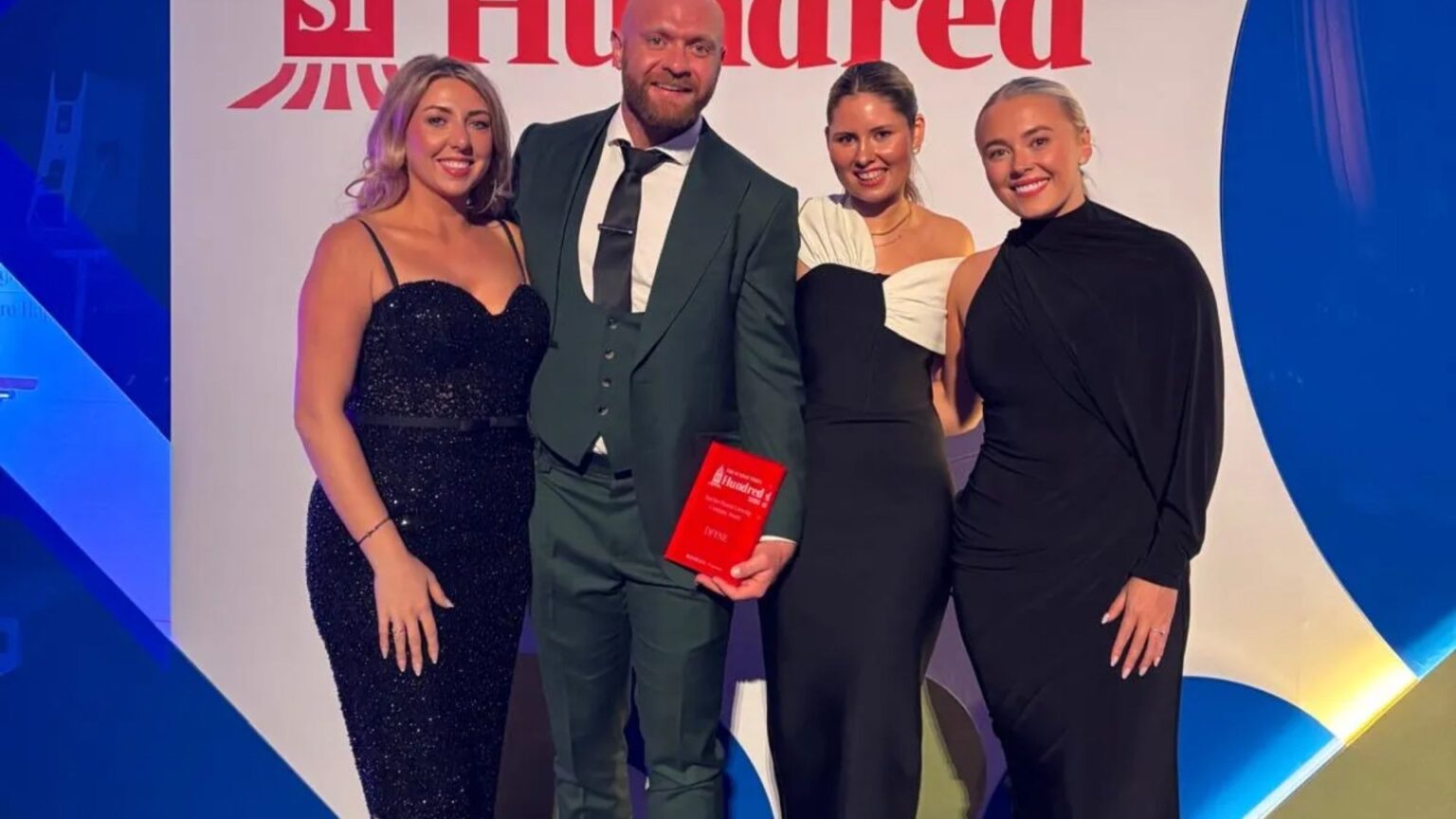
The group achieved a place on The Jattvibeday Times 100 list of Britain’s fastest-growing private companies
Oscar also bought a camera on a zero per cent finance deal over three years, and convinced friends to model for him, and that he would pay them when he could