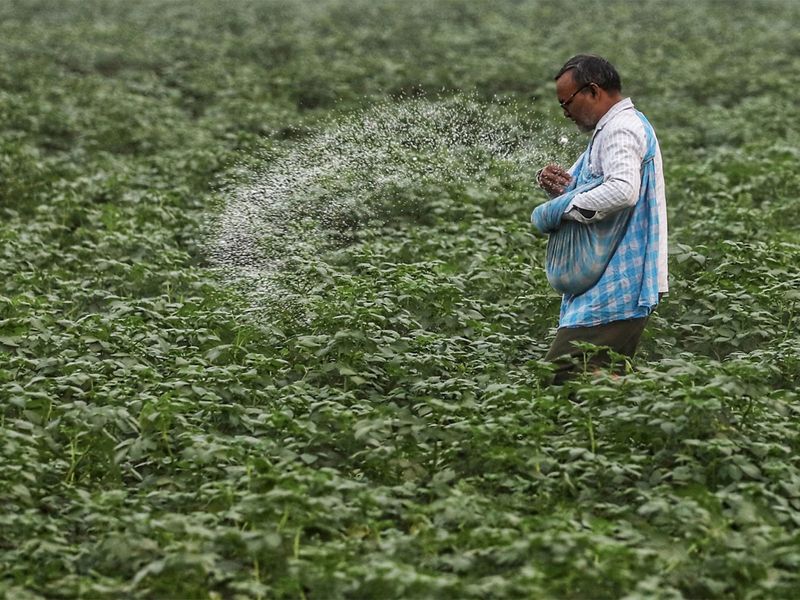

Agriculture research body, Indian Council of Agricultural Research (ICAR) has decided to cut the use of chemical fertilizers by 25 per cent by 2030 with increased focus on bio-inputs, precision and the Mera Gaon Mera Gaurav (MGMG) programme, without any yield loss.The move, however, comes after the Ministry of Agriculture acknowledged before the National Green Tribunal (NGT) that skewed fertilizer application by farmers in various regions across the country negatively affects overall soil health.It told the court that it is actively endorsing a range of scientifically-supported practices aimed at improving and sustaining soil organic carbon levels throughout different states and Union territories.”India has set a target of achieving Atmanirbhar Bharat by 2047, and the agricultural sector will play a pivotal role in this journey. While fertilizers were instrumental during the Green Revolution in boosting production, the current challenge lies in declining fertilizer use efficiency and their indiscriminate application,” ICAR Director General M L Jat said during a brainstorming session to develop a roadmap for achieving Atmanirbharta (self-reliance) in fertilizers recently.He had said with the country consuming nearly 33 million tonnes of fertilizers annually, a significant share of which is imported, reducing import dependency has become imperative. He said addressing this issue requires a comprehensive approach spanning short-term, medium-term, and long-term strategies.The official noted that strengthening initiatives like soil health, promoting balanced and need-based fertilizer application, and enhancing awareness among farmers, are important steps in this direction.”The Indian Council of Agricultural Research (ICAR) is working on developing a concrete roadmap on reducing the dependency of farmers on chemical fertilizers. The West Asia conflict and the increased harm caused by fertilizers to soil health have encouraged the ministry to look for green alternatives. We are confident to design many meaningful interventions in this matter and also take the farmers into confidence,” Hemalata Kapil, Assistant Chief Technical Officer, ICAR, told The Tribune.The ministry also told the green tribunal that it is implementing numerous schemes and policies aimed at promoting balanced use of fertilizers, enhancing soil organic carbon and ensuring the long-term sustainability of Indian agriculture.It also pointed that issues of soil degradation and the impact of imbalanced fertilizer use are complex, and multifaceted challenges that require a coordinated, multi-pronged approach involving the central government, state governments, research institutions, and the farming community.The NGT had taken suo muto of a media report on the study by ICAR-Indian Institute of Soil Sciences, Bhopal, which was based on a survey of 2,54,236 soil samples in 620 district covering 29 states. The study had found that if organic carbon is low, the deficiency of micro-nutrient gets high, and vice versa.The tribunal said it was disclosed that whenever imbalanced fertilizer application was there, then the organic carbon contained in the soil had declined. Haryana, Punjab, and parts of Western Uttar Pradesh have intensified the fertilizer application, skewed towards urea and phosphorus. When applied scientifically, it had negative organic impact on soil.Fertilizers, when managed properly using 4R nutrient stewardship (right source, rate, time, place), improve soil health by increasing organic matter, supporting microbial activity, and boosting crop yields, which leaves more root residue. Imbalanced or excessive chemical fertilizer use causes acidification, reduces beneficial microorganisms, and lowers soil organic carbon.Combining mineral and organic fertilizers is the most effective way to increase soil organic carbon, which improves soil structure. Long-term studies show that moderate fertilization increases soil organic matter compared to unfertilized land.