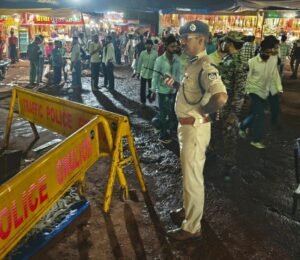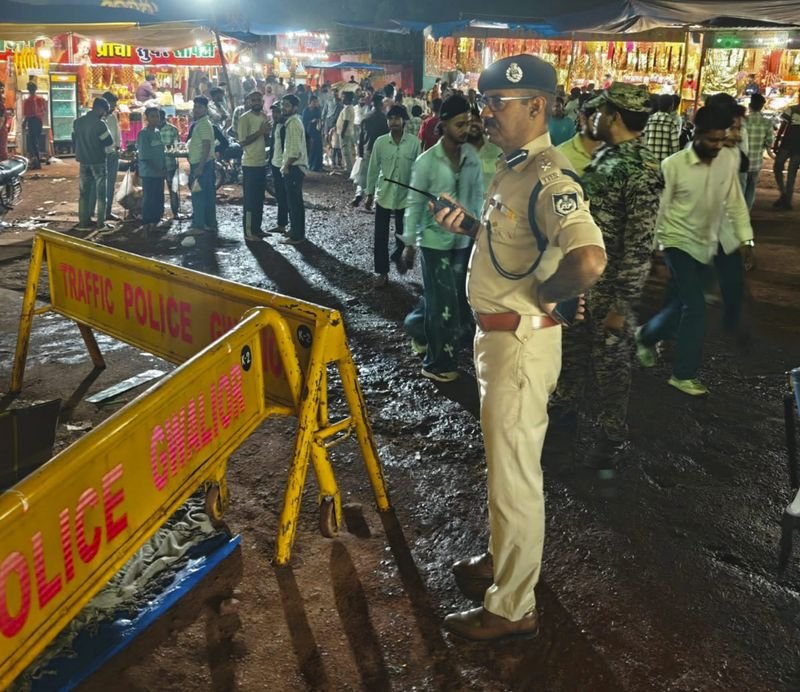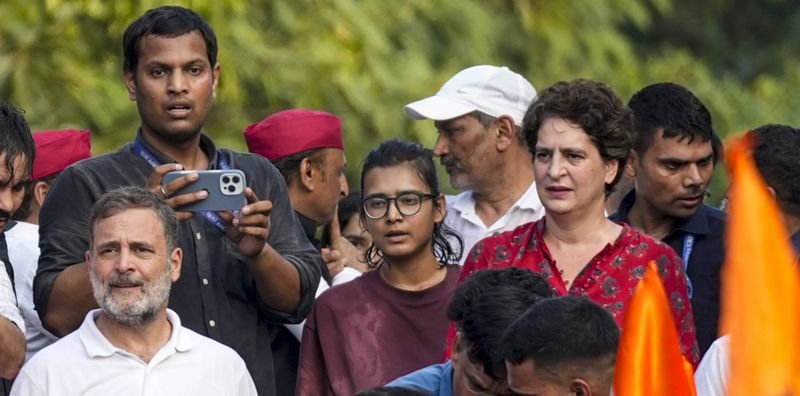

The government thwarted attempts of the CJP and several other groups of protesters and activists from holding a big ‘Lehra do Tiranga’ rally at Central Park in Connaught Place, Delhi, with the CJP’s top leadership being detained ahead of the rally. The stakes are high for the Modi government. It must shift headlines away from the continuing protests rocking the capital if it wants to retain control of the narrative, writes Editor-in-Chief Jyoti Malhotra in her weekly column, The Great Game , titled How to unfurl the Tiranga. Is the person who wants to unfurl the Tricolour, for example, a good or not-so-good person? The moral dilemma is upon us. To be or not to be anti-national is no longer the question, she writes.A right to protest at a place you cannot reach is a right on paper. It resembles a theatre ticket when the doors are locked, writes Supreme Court senior advocate Sanjay Hegde in his Edit article, A democracy needs its kopagriha. Drawing an analogy with Valmiki’s kopagriha in the Ramayana, where Kaikeyi expressed her anger to Raja Dashratha against making Lord Rama king, Hegde writes that Delhi has its own kopagriha; it is called Jantar Mantar. The designated place stays open, but the road leading to it is shut. When a police commissioner shuts a dozen Metro stations to stop a few hundred people, he inverts that order, treating the restriction as fundamental and the right as a favour, he writes.US Secretary of State Marco Rubio is visiting India from October 18 to 22 to discuss bilateral ties, trade, regional security and energy cooperation. His itinerary includes Gujarat’s Jamnagar and Mumbai, but not Delhi. Given the turbulence and setbacks in India-US ties, Delhi needs to make an objective and prudent assessment of the way ahead, writes C Uday Bhaskar, director of the Society for Policy Studies, in his Edit article, India must stay engaged with the US.The critical policy approach for India is to revisit the central assumption that has guided bilateral relationship since 2005: India and the US have corresponding security objectives vis-a-vis China, particularly in the Indo-Pacific. That assumption is no longer valid, he writes. India describes itself as a “resident power” in the Indo-Pacific, seeking freedom of strategic action without a bloc mentality. The US increasingly wants bloc discipline when it suits its interests, while retaining flexibility in its dealings with Beijing. Rubio’s visit is more than a review — it will be a reality check on the trajectory of the troubled India-US relationship, Bhaskar argues.Meanwhile, China has responded strongly to India’s move to standardise the names of 28 places in Ladakh. It is an irony that Beijing has opposed India’s move even as it has long pursued similar measures itself. As per China’s playbook, what it does is right, while similar actions by others are wrong, writes former Ambassador to China Gautam Bambawale in his Edit article, Chinese duplicity to the fore. Rather than flexing its muscles and attempting to exhibit its comprehensive national power, China should adopt a practical, solution-finding approach to lay the foundation for a more straightforward relationship between the two neighbours, he writes.On another front involving China, Afghanistan’s de facto authorities have inaugurated a 121-km unpaved transit route connecting Badakhshan with China’s Xinjiang bypassing Pakistan. Efforts to promote a Pakistan-proof gateway via the Wakhan Corridor face challenges, including Beijing’s security concerns, writes former Ambassador to Afghanistan Jayant Prasad in his Edit article, Afghan route to China faces hurdles. By preventing overland transit for Afghan goods destined for third countries, Pakistan thwarted Afghan aspirations, Prasad writes. That explains why Afghanistan is keen to promote the alternative Pakistan-proof transit routes through Chabahar Port and the Wakhan Corridor.The Nobel prizes have acquired an iconic status that is seen as universal benchmarks of excellence. While the judgments in the other five categories are regarded as largely objective, the literature prize is more subjective, writes Peter Ronald deSouza, former director of the Indian Institute of Advanced Study, in his Edit article, A Nobel that’s not so universal.The selection of Anne Carson, from Canada and Iceland, for the Nobel Prize in Literature has drawn widespread applause but also produced some lingering doubts. The larger question is the epistemic asymmetry between the Global North and the Global South. The Nobel committee members may have sincere intentions, but the ecosystem within which they make their selection is framed by bias, deSouza writes. The North’s way of seeing, he argues, becomes the universal way of seeing.