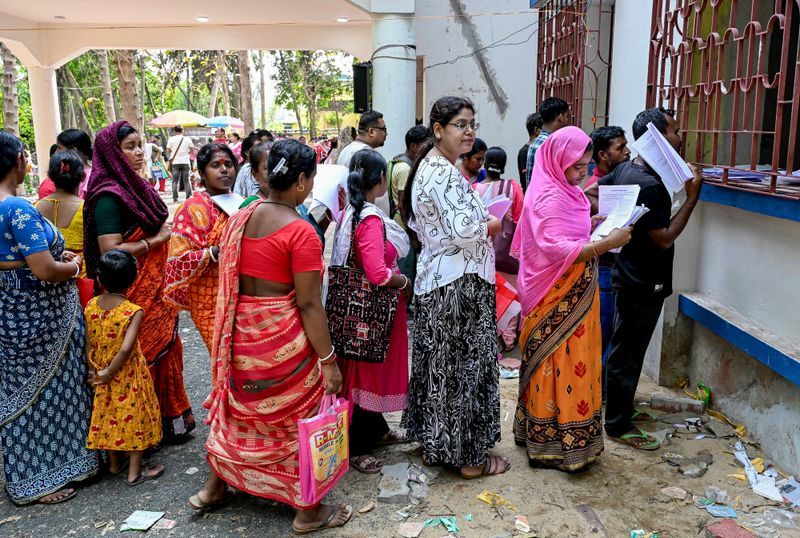

Most exit polls have already awarded West Bengal to the BJP. If the BJP wins Bengal, it will have proven its determination to take the state that has resisted its charms via saam, daam, dand, bhed and SIR, writes Editor-in-Chief Jyoti Malhotra in her weekly column The Great Game article Saam, daam, dand, bhed, SIR. In Bengal, the die is cast; in Punjab, AAP will certainly need to stay the course if it has to fight off the Opposition. The fact remains that the BJP has thrown the first punch; the bout has begun. It will end when Punjab votes in the Assembly elections less than ten months from now.Coming back to SIR, at the centre of the SIR controversy lies a simple but uncomfortable question: When the Constitution guarantees the right to be registered as a voter, can a process, however well-intentioned, end up undermining that right, questions former Chief Election Commissioner of India, writes former Chief Election Commissioner of India SY Quraishi in his Edit article Bengal SIR left many voters behind. The law, through Section 21(3) of the Representation of the People Act, 1950, permits revision of electoral rolls, whether intensive or summary. But it does not license exclusion as a by-product of administrative zeal. The perception of exclusion, when tied to something as fundamental as the right to vote, is itself a democratic injury, he writes. In moments of potential disenfranchisement at scale, the Court has often acted as a protective umbrella. In the SIR case, however, that umbrella appeared hesitant to open fully, he writes.Meanwhile, the announcement by Aam Aadmi Party (AAP) MP Raghav Chadha that he and six of his Rajya Sabha colleagues had “merged” with the BJP was a clever piece of political theatre. By invoking paragraph 4 of the Tenth Schedule, the seceding members sought to dress up what was plainly a defection in the constitutional vocabulary of merger. The architecture of the Tenth Schedule, however, was designed precisely to prevent such mischief, writes SC senior advocate Sanjay Hegde in his Edit article The Aaya Rams, Gaya Rams of Punjab today. The Rajya Sabha was conceived by the framers as the chamber of sober second thought. It risks becoming the chamber of arithmetical absorption, he avers.Talking about the US-Iran conflict, Trump desperately needs a way out from his self-made military disaster, one whose outcome will determine the remainder of his term keeping in mind this year’s upcoming US mid-term Congressional elections. Iran’s current hardline rulers see themselves as being in a stronger strategic position, writes Indian Foreign Service (retd) officer Gaddam Dharmendra in his Op-Ed article Iran’s new, wild card — Houthis on the Red Sea. Iran’s ruling security establishment has settled into a wait-and-watch mode. There is a ‘blockade-on-blockade’ situation, with Iran and the US competing to control shipping in the Strait of Hormuz. Iran, however, holds a wild card, ie, Yemen’s Houthis, who can impose a third blockade in the Red Sea, disrupting oil supplies from Saudi Arabia’s western Yanbu port.Coming to technology, AI is being slowly bypassed by the Internet of Things (IoT), a network of physical objects embedded with sensors, software and communication technologies, enabling them to connect to the Internet and exchange data automatically without direct human involvement. But the very ubiquity that makes IoT revolutionary also makes it terrifying, writes Lok Sabha MP and former I&B minister Manish Tewari in his Edit article The incredible Internet of Things. The marriage of IoT and AI is a transition that dwarfs the original Internet’s impact. The current state of affairs is both a staggering engineering triumph and a policy quagmire, he writes.A debate has ensued after MoD informed the Supreme Court that “…the complexities in implementation, possible legal complications and significantly large financial implications do not favour the grant of NFU (non-functional financial upgradation) to armed forces personnel.” Given that one of the signatories to the affidavit is a serving Major General, made matters worse. At the heart of the NFU contention lies the “remunerative edge” granted to the IAS and the Indian Foreign Service (IFS). Either dispense with NFU for all Services, or give it to all, including the defence forces, argues former chief of naval staff Admiral Arun Prakash (retd) in his Edit piece The military awaits a fair deal.