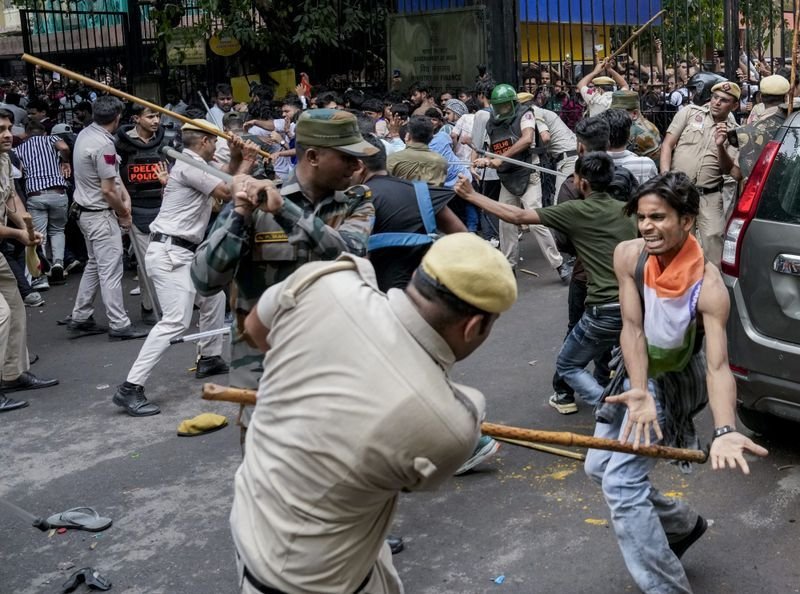

No accountability has been fixed yet for the July 20 police crackdown on protesters, even as the Opposition is trying to corner the government over this issue. The Tribune Edit and Op-Ed articles continue to ask questions and seek answers about the police action.Writing about the police atrocities committed on the eventful day, the authorities missed the window of preparation and planning for the July 20 march, writes Gurbachan Jagat, ex-Governor, Manipur, and former DGP, J&K, in his Edit article What went wrong at Jantar Mantar. Usually, whenever such a march is announced, the administration at the ground level goes into overdrive. Briefing is of the utmost importance so that they understand to the last man the threat and their response. Force must be used under supervision — controlled, measured and sufficient to achieve the objective of crowd dispersal, he avers. The objective is not to vanquish an enemy at all costs as that only results in more protests and provokes the people. He pins down the problem: much of the prescribed procedure is ignored or, at best, given scant attention.The application of force is sometimes necessary. However, force is not always the only answer,writes Julio Ribeiro in his Edit article Force must be used as a last resort. The principle of using the minimum necessary force must strictly guide a command officer at all times. In the Jantar Mantar protest, the Delhi Police reported that over 200 known anti-social elements embedded themselves among the protesters to incite violence. Preventive detention of such persons before major rallies is standard policing protocol across the country. Why weren’t they rounded up in advance? Leaving them unchecked invited predictable chaos. Handling volatile crowds is a complex task — backseat driving is easy. Field officers do not take pleasure in confrontation; they take high-stakes, split-second decisions under immense pressure.Coming to the main issue of the high-stakes NEET paper, from banking to medical colleges, just about every field now depends on the MCQ system to recruit candidates for education and employment. Why is it such a favourite? asks former NCERT director Krishna Kumar in his Edit article NEET is flawed to the core. Basically, MCQ-based tests allow the elimination of a large number of candidates. The process of elimination is mechanical and thus impartial. This is why the process is regarded as being legitimate even if it is not quite valid, he writes. No matter how advanced is the technology used for conducting NEET, its inner crude character will remain unaddressed.We must abolish the machine called the National Testing Agency (NTA). No meaningful reform is possible unless we abolish these two high-pressure tests and come forward with creative and life-affirming alternatives, says sociologist Avijit Pathak in his Op-Ed article NEET, JEE and death of critical thinking. We must constitute a committee of great educationists, teachers, pedagogues, good doctors and creative engineers and encourage them to evolve a decentralised pattern of tests that seeks to evaluate a young learner’s analytical and interpretative skills, social and moral sensibilities, and some basic understanding of what doctors and engineers actually do in their professional fields.Talking about the reforms needed in the education system, the amendments to the anti-paper-leak law may expedite investigation and trials, but the deterrent effect remains an open-ended question in a country that is over-legislated and under-enforced, writes Lok Sabha MP Manish Tewari in his Edit piece Education system must focus on job skills. The reform agenda should match the aspirations of the young generation, he writes. This chasm between ‘credentials’ and ‘capability’ is a consequence of an academic architecture that relegates employment integration to residual luck of campus placements and prestige hierarchy of limited eminent institutes. The failure of the education system to produce skilled workers is compounded by chronic underinvestment. The path forward cannot be a series of disjointed fire-fighting measures triggered by another paper leak or protest. It must be a comprehensive reimagining of the education-to-employment pipeline, built on the recognition that the outcomes we measure — employability, learning proficiency, research output — are the only legitimate benchmarks of public investment, he writes.The high level of unemployment among the GenZ is not because there are no jobs available. It is about the quality of jobs being offered, writes senior economic analyst Aunindyo Chakravarty in his Op-Ed article Why GenZ finally rebelled. A part of the reason is that GenZ consists of many more graduates than the generation preceding it. So, they want better jobs than their seniors were willing to settle for. That is why some of this high unemployment is voluntary — GenZ youth would rather wait for a suitable job than accept a position that pays poorly or lacks social status, he avers.Writing about the recent developments in Punjab in the wake of the impending Assembly polls next year, the Modi-Badal meeting indicates that the possibility of an alliance between the Akali Dal and the BJP is back on the table. Perhaps the PM feels the time has come to stitch together an anti-AAP coalition. Could Punjab move towards the BJP if India and Pakistan can work out a face-saving quid pro quo on the Kartarpur Sahib corridor? asks Editor-in-Chief Jyoti Malhotra in her weekly column The Great Game article What will it take to win Punjab today. The PM understands, that in the wake of the GenZ protest that has charged and galvanised a simmering despair in young people, he has to change the narrative across the country — and so his party must swallow some imperfect memories of the recent past.Some curious remarks were made about cow urine (gaumutra) in Parliament a few days ago. The context was the appointment of Veezhinathan Kamakoti, Director of the Indian Institute of Technology, Madras, as a member of the task force on entrance test reforms. During the debate on the subject, an indirect reference was made to Kamakoti’s support for the use of cow urine. Seeking scientific validation of ancient ideas and beliefs is not true science; the same validation approach is being applied to cow urine. When research starts with a preconceived notion, it tends to ignore or suppress negative results, writes science commentator Dinesh C Sharma in his Edit article Perils of promoting ancient remedies. Science funding agencies should stop sponsoring studies by dubious institutions & researchers. We can take a cue from China, which has taken a science-based approach to traditional medicine, instead of religious or ideology-based validation, he suggests.