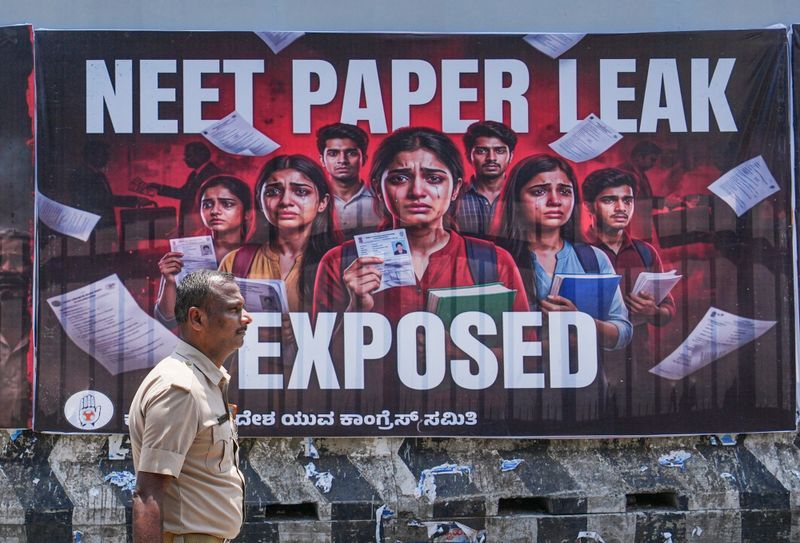

The NEET paper leak case has reached the Supreme Court, where petitions are seeking major reforms to the examination system and even an overhaul of the National Testing Agency (NTA). The Court has asked the Centre, NTA and the CBI to respond and provide status reports. The NEET scam has given the government another opportunity to do course correction, writes science commentator Dinesh C Sharma in his Edit piece Medical education needs a clean-up. The process of medical college admission needs fundamental structural changes. The admission process needs to be decentralised. Let states decide their own process for admission based on local factors, while ensuring accountability and transparency of the process they choose. The nature of medical admission tests has to change, he stresses.Meanwhile, the Supreme Court has also upheld the constitutional validity of the Special Intensive Revision (SIR) of the electoral rolls undertaken by the Election Commission, saying it advanced the constitutional imperative of free and fair elections. The SC judgment, in the process of settling issues, has unsettled people, writes Ashok Lavasa, former Election Commissioner of India, in his Edit article No twist in the SIR tale. It says nothing that is not already contained in law. The central issue of citizenship remains as ambiguous after the SC judgment as it was before the ECI issued the initial notification in June last year. The Supreme Court’s endorsement must not prompt the ECI to carry on with its present ways, he writes.Though the fall of the rupee created external stress, it produced a fiscal bonanza for the Union government. The same depreciation that hurts importers, raises the cost of oil, reduces India’s dollar GDP and unsettles foreign investors also boosts RBI profits when dollars are sold, writes noted economist Ajit Ranade in his Edit article Don’t turn RBI into govt’s cash cow. The rupee weakness has produced a fiscal windfall. A country can grow fast domestically and yet appear stagnant internationally if currency depreciation wipes out the gain. Persistent rupee weakness can therefore become a strategic concern, he avers.Renewable energy can make India resilient to oil price shocks, writes senior journalist TN Ninan in his Edit article Time to stop slipping on oil. For the first time in our history, solar and wind energy offer an alternative solution, not just because of their enormous generation potential, but also because they are now competitive when compared to new coal-based power plants. India should aim to become an electro-state, he opines. Many industrial processes that currently rely on hydrocarbons could also switch to electricity, as China has done on a massive scale. India needs to be made a more attractive destination. A more hydrocarbon-proof economy will take the country a big step to that goal, he writes.In Punjab, the Aam Aadmi Party (AAP) has swept the municipal polls in Punjab, while the Congress has finished a far second. If this election is, indeed, a dry run to the Assembly elections later this year or early next, it promises to be hotly contested, writes Editor-in-Chief Jyoti Malhotra in her weekly column The Great Game (Poll din gets louder in Punjab). This election has also more or less made clear the direction that both AAP and BJP are taking – the former will do everything to protect its turf and the latter will do everything else to break into the state, she writes.THE 2026 Review Conference (RevCon) of the Nuclear Non-Proliferation Treaty (NPT) concluded at the United Nations in New York on May 22. There was no final consensus document. The failure underscored the need to restore the sanctity of deterrence norms — it is more urgent now than ever before, writes C Uday Bhaskar Director, Society for Policy Studies in his Edit article Nuclear consensus remains elusive. The US, Russia and China have abdicated their responsibility in different ways. They are no longer the guardians they were expected to be. The world needs resolute stakeholders to repair the NPT pillars in an equitable, empathetic and consensual manner, he writes.