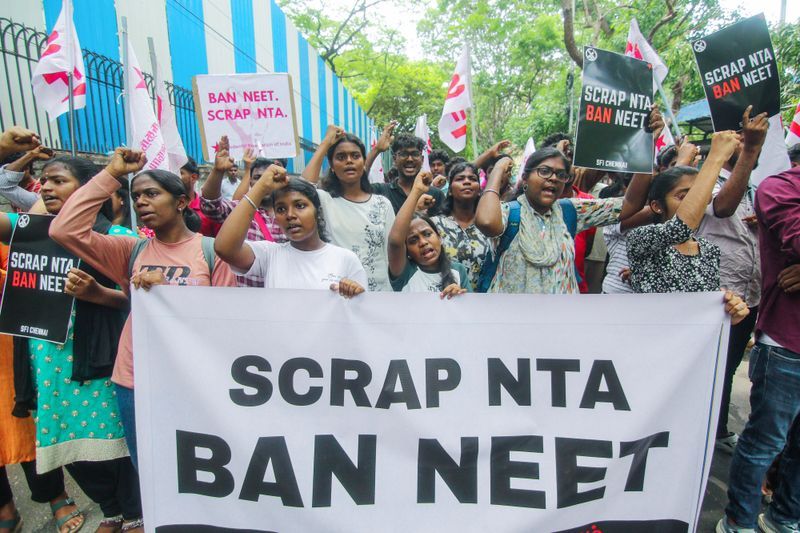

The NEET exam paper leak created quite a furore among the youth and anxious parents, while PM Modi’s austerity measures became a talking point across the nation.The Tribune carried a series of analysis-based and information-packed articles on the NEET paper leak issue. Sharing a simple model for conducting any exam without the fear of leakages, former Delhi University Vice-Chancellor Dinesh Singh in his Op-Ed article Is India becoming one big exam centre writes that the National Testing Agency (NTA) should invest massively in building a meticulously curated question repository. Educating a child has to be India’s goal, not testing whether she is capable of being educated, he writes. The business of inflicting one exam after another on young and impressionable minds flies in the face of the 2020 National Education Policy (NEP), he says.Repeated paper leaks suggest vulnerability at the paper-making or paper-distribution levels, writes ex-PGI professor Rakesh Kochhar in his Op-Ed article Paper leaks a recurring education menace. Question formulation is outsourced; the papers are typed and translated into 13 languages and then transported to different states and finally to individual centres. A pen-and-paper exam has these vulnerabilities that can be exploited, he writes.If the UPSC can conduct examinations year after year, with near-flawless professional expertise, maintaining absolute confidentiality and secrecy, why can’t the NTA do the same, writes former Panjab University Prof Rana Nayar in his article Exam scandals thrive under systemic collusion. Coming to Prime Minister Narendra Modi’s austerity appeal for forex conservation, our PM is following in the footsteps of Lal Bahadur Shastri, Madhu Limaye, or (by a stretch) Mahatma Gandhi in his national appeal for austerity, writes noted economist Ajit Ranade in his Op-Ed article Austerity without equity will fail. But spreading the pain evenly is not just unfair, it will fail. The rich have to bear a disproportionate burden, he writes. There is an undisputed tax demand of 9 lakh crore that remains uncollected, he writes.Why should only the middle class sacrifice? Why is there no windfall gains tax levied on exporters who are making hay because the rupee has weakened, writes senior economic analyst Aunindyo Chakravarty in his Op-Ed article Modi must tax the rich, not just middle class. Why was no tax levied on oil marketing companies for the massive gains they made when they were buying highly discounted crude from Russia? Why are there no curbs on the freebies distributed by governments to win elections, he asks.A full 10 days after it won in Kerala, leading the United Democratic Front to a landslide victory (102 seats/140-MLA Assembly), the Congress party named six-time MLA VD Satheesan as its chief minister-elect. Now, in Punjab, the faction-ridden party is waiting for Rahul Gandhi to decide — like waiting for salvation, writes Editor-in-Chief Jyoti Malhotra in her weekly column The Great Game article Kerala lesson for Punjab Congress. Perhaps Punjab should take a lesson from Kerala’s Satheesan, who has won respect from both sides of the aisle, she adds.Punjab’s woes are often discussed through the prism of issues like the drug menace, debt burden, unemployment, tax evasion, illegal sand mining, illicit liquor and agrarian distress. These are not separate crises but elements of a shadow/black economy that drains revenue, undermines governance, harms public health and hits economic activity, write Lakhwinder Singh, Visiting Professor, Institute for Human Development, and Deepratan Singh Khara, Asst Prof, Thapar School of Liberal Arts & Sciences, in their Edit article Black economy stifles Punjab’s growth. Persistent ills like drug menace and tax evasion are eroding the state’s fiscal capacity. Policy must shift from ex post facto enforcement to early detection, prevention and institutional accountability, the article suggests. Punjab needs more than leakage mapping, he suggests.An epidemic again in the form of Hantavirus has raised its head. Research into emerging and re-emerging viruses should be prioritised, along with surveillance. The hantavirus outbreak is yet another wake-up call, writes science commentator Dinesh C Sharma in his Edit article Hantavirus outbreak is a call to action. India is considered a hotspot for emerging infectious diseases, including zoonotic ones, he writes.Talking about debate over the NFU (non-functional upgradation), the problem with it is that a mechanism designed for administrative cadres was overlaid onto a military structure built on entirely different foundations, writes Lt Gen SS Mehta (retd), former Western Army Commander in his Edit article The covenant complete. NFU did not create the underlying problem; it exposed the design mismatch that already existed, he writes.Field Marshal Asim Munir emerged from Op Sindoor dramatically stronger, writes former High Commissioner to Pakistan and Canada Ajay Bisaria in his Edit article New doctrines, old dangers. Yet this political rebirth rests on structural weakness: Pakistan’s polycrisis of economic decline, security failures and political tension. Munir now accumulates roles — military supremo, chief economic planner, chief regional peacemaker — that in a functioning state would be distributed across accountable institutions. Munir’s political survival depends on maintaining calibrated tension with India — enough to justify the army’s primacy, but not enough yet to trigger another Sindoor, he writes.Turning to the increasing attack on the federal structure of the Constitution, the government has turned states into Centrally-controlled union territories, wagons (not double engines) attached to the all-powerful Central locomotive, writes former finance secretary Subhash Chandra Garg in his article Opposition states battle growing Central dominance. This government has misused federal institutions and instruments. The Bhishm Pitamahs in the SC watched the disrobing of democracy Draupadi nonchalantly, dismissing deleted voters’ cries, asking them to vote in the next election. This severe mutilation of constitutional federalism by a Centralist union must disturb the conscience of all Indians, he writes.