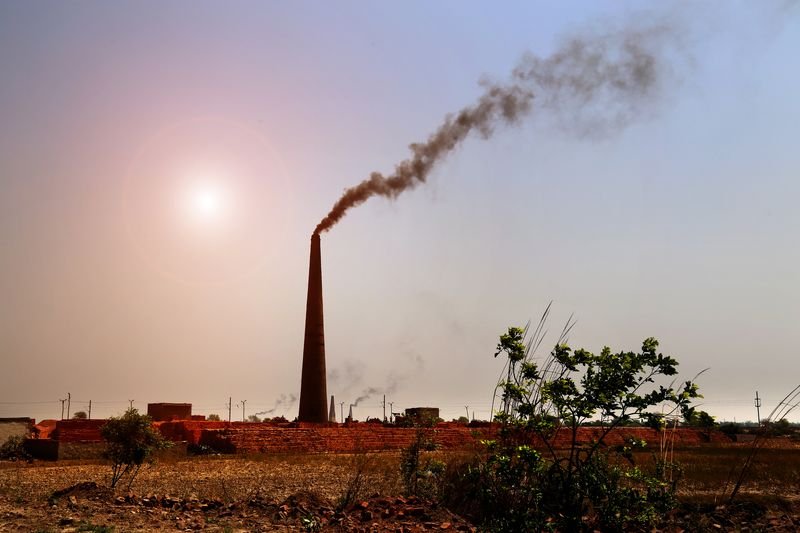

Researchers based in India and Europe have, for the first time, mapped the locations of brick kilns across India, a sector that contributes significantly to air pollution and carbon emissions due to outdated practices and non-compliance with environmental standards.Stressing that effective nationwide monitoring of kiln locations and types is needed to mitigate their environmental impact, the researchers said their study presents the first nationwide multi-year maps of brick kilns in India from 2019 to 2025, generated using Sentinel-2 satellite imagery and a deep learning-based model.“Precise knowledge of the spatial and temporal distribution of brick kilns is essential for evaluating their contribution to air pollution and carbon emissions, and for assessing progress toward cleaner production technologies,” the researchers said.India is the world’s second-largest brick producer, with more than a million kilns. The brick kiln sector is estimated to account for approximately 15 per cent of the country’s particulate matter emissions and six per cent of its carbon dioxide emissions, in addition to significant quantities of sulphur and nitrogen pollutants.Driven by rapid urbanisation and construction activity, the sector also consumes an estimated 35 million tonnes of coal and 25 million tonnes of biomass annually, the researchers observed.Undertaken by 10 researchers from the Indian Institute of Technology Bombay, University of Münster, Germany, University of Copenhagen, Denmark, University of Rostock, Germany, and Université Paris-Saclay, France, the study has been published in the International Journal of Applied Earth Observation and Geoinformation.The spatial distribution of brick kilns in India is primarily driven by the availability of raw materials and regional construction demand. Consequently, kilns are predominantly situated in rural, sparsely populated areas or along riverbanks, where clay-rich alluvial deposits are accessible.Their emissions adversely affect workers and degrade local air quality, while long-range atmospheric transport further contributes to pollution in nearby urban centres.“Recent Earth-observation-based emission inventories have identified brick kilns as one of the leading district-level sources of particulate matter over the Indo-Gangetic Plains, underscoring the value of accurate, up-to-date kiln location data,” the researchers said.Approximately 60 per cent of all kilns are concentrated in the Indo-Gangetic Plains due to the region’s abundant raw materials. However, their environmental impact extends well beyond this zone, influencing air quality across the country, according to the study.Uttar Pradesh accounts for the highest number of kilns, followed by Bihar. Rajasthan, West Bengal, Assam, Punjab and Haryana are among the other states that figure high on the list.The Central Pollution Control Board mandated a transition in 2017 from conventional chimney structures to improved designs that reduce energy consumption by 20-30 per cent and substantially lower harmful emissions.“Given the sector’s high emissions and energy demand, there is a pressing need for cleaner and more sustainable brick production technologies. However, the shift to cleaner brick production is slow due to high initial costs, lack of awareness, and weak enforcement of regulations,” the researchers observed.