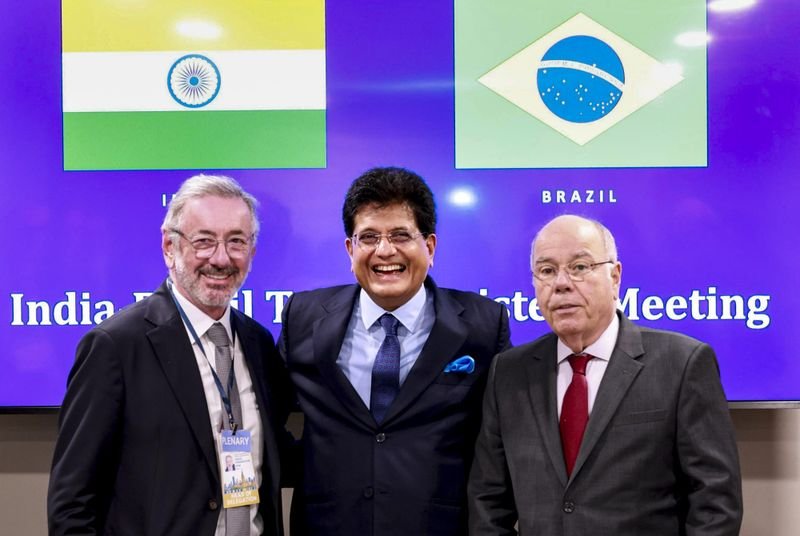

Brazil and India are working to significantly enhance their current preferential trade agreement with Mercosur, as both parties finalise the terms of reference that may lead to discussions on a more extensive trade deal.Brazil’s Minister of Development, Industry, Trade and Services, Márcio Fernando Elias Rosa stated that the existing agreement is quite restricted, encompassing merely about 450 tariff lines.After meeting with Commerce and Industry Minister Piyush Goyal during the G20 Trade Ministers’ Meeting in Milwaukee, Rosa stated that the finalised framework would enable both parties to start creating solid proposals.Goyal mentioned in an X post that he had a meeting with Brazilian Foreign Affairs Minister Mauro Vieira and Rosa during the G20 summit. He mentioned that the talks involved broadening the India-Mercosur PTA, boosting sectoral collaboration and investment relations, and improving coordination at the G20 and WTO (World Trade Organization).India and Mercosur, consisting of Brazil, Argentina, Uruguay, Paraguay, and Bolivia, declared on 14 September 2026 the commencement of talks to enhance their current Preferential Trade Agreement (PTA), which has been in effect since June 2009.The existing PTA offers preferential tariff reductions on 450 tariff lines from India and 452 from Mercosur, with decreases in tariffs varying between 10 per cent and 100 per cent. The suggested expansion aims to surpass the restricted product coverage and may ultimately evolve into an extensive Free Trade Agreement (FTA) that includes goods, services, and investment.Rosa mentioned that both parties had ‘just completed drafting a terms of reference’ and that, after the framework is established, they could develop detailed proposals. He also stated that additional efforts would persist in the coming months.The discussions on expansion also encompass steps to enhance trade. On September 14, India and Mercosur signed the First Additional Protocol to the PTA, enabling the acceptance of electronic Certificates of Origin to simplify customs processes and promote paperless trade.The wider discussions happen as India aims to widen its export markets in light of global economic instability, whereas Brazil strives to enhance trade connections beyond current tariff advantages.During Brazilian President Luiz Inácio Lula da Silva’s trip to India in February 2026, both nations agreed to aim for a doubling of bilateral trade to USD 30 billion by 2030.