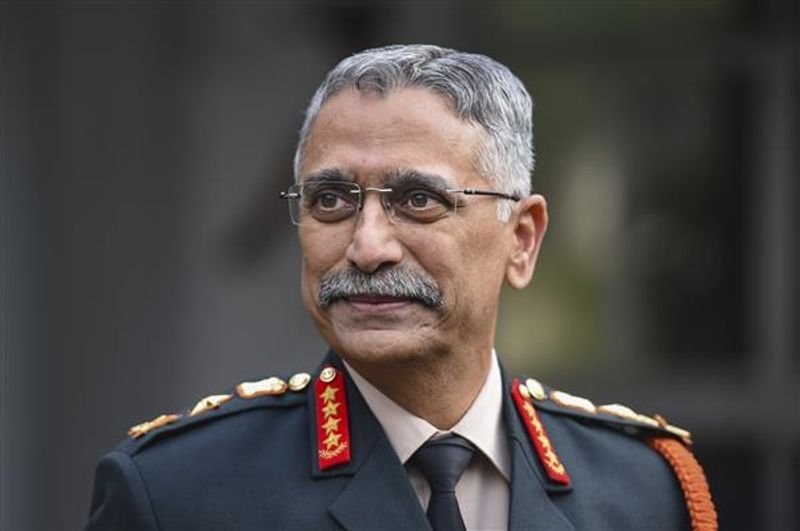

After Indo-Tibetan Border Police (ITBP) Director General Shatrujeet Kapur flagged face-offs with Chinese forces along the Line of Actual Control (LAC) in Arunachal Pradesh, saying they were still continuing, former Army Chief General Manoj M. Naravane (retd) said such face-offs were “not new” and had occurred in the past as well, given that the border between the two countries had not been formally demarcated.General Naravane was the Army chief at the time of the Galwan clash in eastern Ladakh in June 2020, which left 20 Indian soldiers dead, while China acknowledged the deaths of four of its soldiers.Speaking to The Tribune on the sidelines of the Kasauli Lit Fest in Kasauli (Solan), he said, “You see, we have to understand that the boundary between India and the Tibet region has never been formally demarcated or formally acknowledged by either side. And therefore, there are differences in perception about where the boundary actually lies. Because of these differences in perception, there are a few such areas that have been designated as sensitive or disputed areas, where both sides carry out patrolling up to their perceived lines of actual control.”“So whenever such patrolling takes place, there are occasions when the patrols arrive simultaneously at a particular point, resulting in what is called a face-off. So these face-offs are nothing new. They have happened in the past, and there are established protocols to follow to prevent such face-offs from escalating into anything more serious. So we should not read too much into it,” he added.After the Congress sought an explanation from Prime Minister Narendra Modi over the ITBP Director General’s video, the Ministry of External Affairs (MEA) said on October 23 that the LAC was disturbed from time to time when the People’s Liberation Army “deviates from established patrolling patterns”.However, the ITBP deleted its Director General’s video from its official YouTube channel.The border skirmishes continued despite the most recent meeting between Prime Minister Modi and Chinese President Xi Jinping, which took place on September 12 on the sidelines of the BRICS summit in New Delhi.Asked about the ITBP deleting its Director General’s video on face-offs with Chinese forces, General Naravane said, “I’m now retired. It’s been four years since I retired. I have no idea what is happening on a day-to-day basis in the border area. So it’s not possible for me to comment on this.”Asked about the Ministry of Defence (MoD) not clearing his memoir, Four Stars of Destiny, he said the question was off the table. “I have been asked too many times. I’ve answered it twice… Nothing new to add or delete.”Leader of the Opposition Rahul Gandhi read out passages from General Naravane’s unpublished book in the Lok Sabha on February 2 and claimed that Prime Minister Modi had abdicated responsibility during the 2020 Ladakh crisis and abandoned his Army chief.Boundary talks and Galwan clashAsked what should be the practical measure of success in boundary talks between India and China—an agreed framework, the resolution of specific disputed areas, or a final boundary settlement—General Naravane said, “You know, this boundary is nebulous; that’s why we call it a boundary. The border is very finely demarcated. There are boundary pillars on the ground, and they’re ratified as part of a bilateral agreement. None of this has happened as far as the LAC is concerned. So that is why these talks are very important. Delimitation is the first step. There’s delimitation, then there’s delineation, and then there’s demarcation. So delimitation is, you know, a conceptual framework on which the next steps are taken.”He added, “But while all this is happening, it does not mean that we can lower our guard. I’m sure the boys today are also doing as good a job as ever.”Asked whether the Galwan clash demonstrated that China had ruled out a military solution to the boundary dispute, he said, “See, we have always been against the unilateral use of force to alter the status quo, and that is what we demonstrated: it will not work. Now it is there for them to draw the correct lessons from it.”Asked about the single most important operational lesson from Galwan that India had yet to fully implement, General Naravane said, “We always learn lessons all the time. Whenever you do something, there are positives. There are ways in which it could have been done better. That is a continuous process. So we cannot say it is learned and done and dealt with… You always try to improve and improve and improve, and I’m certain that those in key positions today, wherever they are, are doing their best to be able to meet all possible future challenges.”Asked whether, in hindsight, there was any decision he would have taken differently during the Galwan situation, he said, “Not really. Whatever you do, you know, is the best in the given circumstances, and at the end of the day, the result was in our favour. So, I think all is well that ends well.”