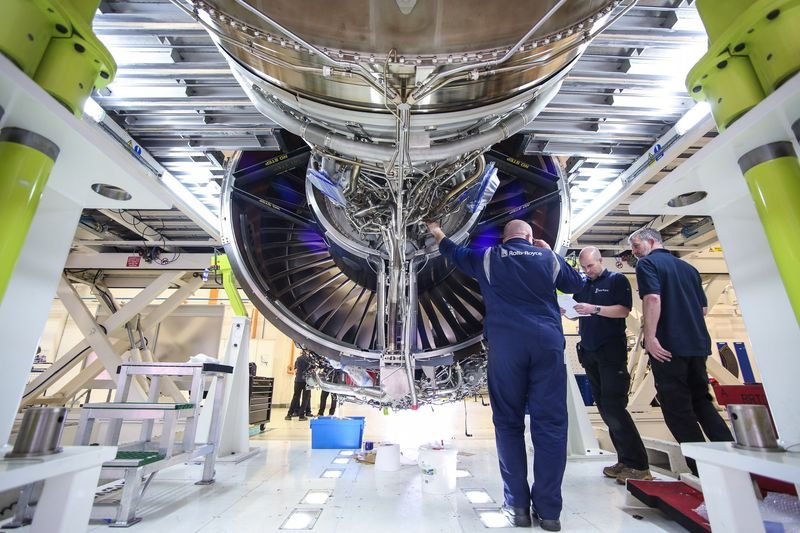

India will receive a full transfer of technology (ToT) and retain the intellectual property rights (IPR) for the engine being offered by British aerospace major Rolls-Royce to power the country’s under-development fifth-generation fighter aircraft, the Advanced Medium Combat Aircraft (AMCA).The core technology being offered to India by the UK is under an inter-governmental agreement (IGA) and is free from any US-imposed restrictions under the US International Traffic in Arms Regulations (ITAR), UK officials said.India is wanting ‘deep’ transfer of technology, including what is called the ‘single crystal blade’, a part of the engine, that does not heat up, allowing greater thrust.The British offer is about India and Rolls-Royce designing an engine for India, a ground-breaking, fifth-generational engine with a 120-plus kilo newton thrust with scope of increasing the thrust to 145 kilo newton. In aviation circles, an engine with such power has not been developed, so far, for fighter jets.Details of the British offer have emerged days after the Rolls Royce and Reliance Industries Limited, on August 14, announced a partnership to develop an indigenous combat engine for India’s under development fifth generation AMCA.Rolls Royce faces competition from Safran of France which has partnered the Gas Turbine Research Establishment (GTRE) under the DRDO – to make the 120 KN engine.Rolls Royce makes any engine entirely on its own. One such engine engines powers the F-35B, the marine variant of the fifth-generation plane used by US and its NATO allies. The technology and experience exists and the Rolls Royce’s engine making is free from any ties into the American system. Only three companies make an entire engine – the Rolls Royce and two US companies – others need to source some parts from US.UK officials Rolls-Royce bringing in knowledge base and is targeting a roll out the new engine by 2034.The UK India collaboration stems from the ‘India-UK Vision 2035’ released in June last year. Defence is one of the five key pillars of that ‘Vision 2035’. A 10-year Defence Industrial Roadmap has been adopted. This targets to deepen collaboration in advanced technologies and complex weapons, supporting innovation and co-development, through cooperation programs such Jet Engine Advanced Core Technologies (JEACT).The 120 kilo newton engine is to power the AMCA which is progressing. The Ministry of Defence has invited three companies to send in their Request for Proposal (RFP) for technical and commercial bids for the project.The bidders invited for the RFP are — Tata Advanced Systems Ltd (TASL), which is competing independently; a consortium led by Larsen & Toubro (L&T), State-owned Bharat Electronics Ltd (BEL), and Dynamatic Technologies Ltd; and another consortium of Bharat Forge, PSU BEML and Data Patterns.The winning partner will work with the Aeronautical Development Agency (ADA) under the Defence Research and Development Organisation to build five flying prototypes and one structural test aircraft. The shortlisted firms, selected based on their technical capabilities, will compete to build prototypes of the fighter aircraft.None of the three invited to bid, are engine makers hence the need to source an engine.