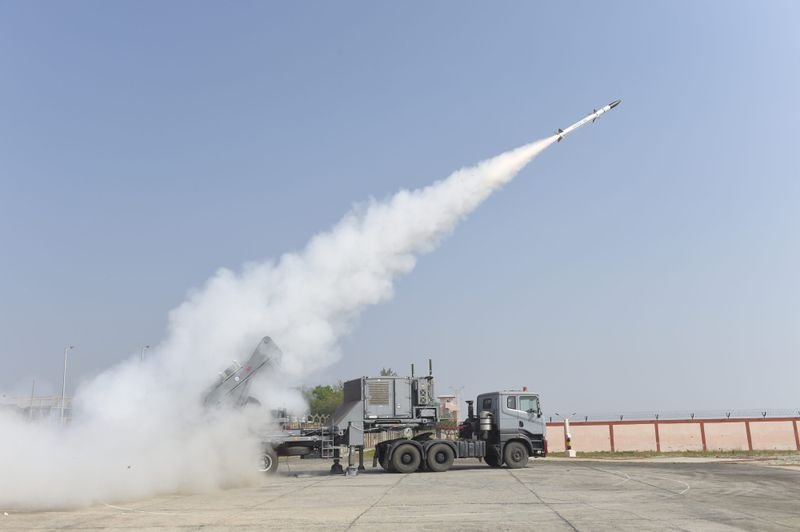

Missiles used by the armed forces are being upgraded to enhance their range and lethality. New variants of the Agni ballistic missile and the Akash air defence missile are under development, alongside glide-capable bombs designed to strike high-value targets at long distances.The Ministry of Defence outlined the capabilities and development status of multiple missile systems in its Annual Report 2025-26, released last week.The Akash missile system, which performed effectively during Operation Sindoor against Pakistan in May last year, is being upgraded as the Akash-New Generation (Akash-NG). “The weapon system is being designed with the capability of engaging multiple targets simultaneously and with 360° coverage,” the ministry said.The Akash-NG missile was successfully tested last year, and the Indian Air Force is now conducting its own trials. The system provides air-defence cover against fighter aircraft, helicopters, unmanned aerial vehicles (UAVs), anti-radiation missiles (ARMs) and subsonic cruise missiles.The Defence Research and Development Organisation (DRDO) is working with the Strategic Forces Command (SFC) on a 2,000-km-range Agni Prime missile capable of being launched from a rail-based mobile launcher. The first-of-its-kind launch was conducted last year from a specially designed launcher that can move across the existing rail network. The system provides cross-country mobility and the capability to launch within a short reaction time while maintaining reduced visibility. It is self-sustaining and equipped with independent launch capabilities, including state-of-the-art communication systems and protection mechanisms.The Agni missile family is capable of carrying nuclear warheads and comprises several variants already inducted into the armed forces. One of these, the Agni-V, is an intercontinental ballistic missile (ICBM) with a range of 5,500 km.Another major area of development is the 1,000-kg-class Long-Range Glide Bomb (LRGB), named Gaurav. Trials involving the release of the bomb from the Sukhoi Su-30MKI fighter aircraft have been completed. The weapon has demonstrated a range of 100 km with pinpoint accuracy. According to the ministry, “Gaurav is designed to strike high-value targets, including bunkers and airstrips, with pinpoint accuracy from a distance, keeping aircraft safe from enemy air defences.”The weapon is being developed in two variants with different warheads tailored for specific target sets. A licensing agreement for the transfer of technology has been signed with public-sector firm Munitions India Limited.Among other missile systems under development is the Naval Anti-Ship Missile (NASM-SR), which uses an indigenous guidance system and can correct its course in flight; Rudram-III, which offers both anti-radiation and ground-attack capabilities; and the Vertical Launch Short-Range Surface-to-Air Missile (VLSRSAM), designed to neutralise aerial threats at close ranges, including adversary sea-skimming missiles.The ministry also said the indigenous Kaveri engine had been designated as the power plant for India’s Unmanned Combat Air Vehicles (UCAVs). Manufacturing of the engine is currently underway through Indian Industry Partners (IIPs).