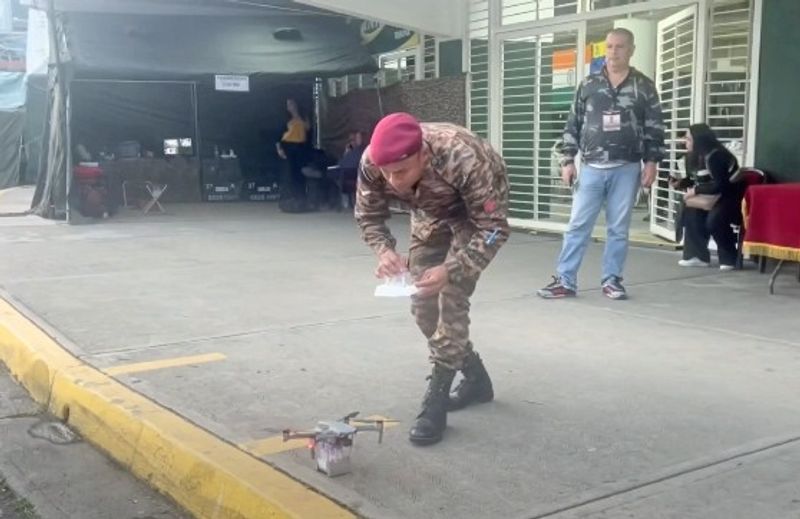

As the Indian Army contingent deployed in Venezuela under Operation Amistad to provide assistance to victims of a devastating earthquake that hit the South American country in June begins to wind up its operations, it leaves behind tales of innovation and compassion.A 69-year-old woman, Zunilde Silva, the oldest survivor under treatment at the Indian Army Field Hospital, faced difficulty in moving across the facility for medical requirements. Troops devised an innovative solution by employing mini drones to deliver medicines and laboratory reports.“Rising to the challenge, the innovative minds of Shatrujeet Brigade employed a customised drone-based delivery solution within the hospital. The drone transported blood test reports, prescriptions and essential medicines between departments, ensuring timely care without requiring the patient to move,” the Indian Army said.“When mobility was a challenge, technology carried care to the patient. This seamless integration of technology and empathy reflects the Indian Army’s commitment to finding innovative solutions in the service of humanity.”For another 79-year-old survivor, being rescued from a collapsed building marked only the beginning of her ordeal. Trapped beneath the debris with a fractured leg and suffering from peripheral arterial disease, delayed access to medical care led to a severe arterial ulcer and intense pain, according to the Army.“The medical team stabilised her fracture, initiated advanced wound care and established daily follow-up treatment, providing not only specialised medical support but also renewed hope for recovery,” the Army said.“Venezuela thanks Indian rescuers for their attention,” the country’s foreign ministry, Ministerio del Poder Popular para Relaciones Exteriores, said on its official X handle on July 8.“The humanitarian mission set up a field hospital at the National Hippodrome Institute in La Rinconada, Caracas, a space where more than 1,900 people were treated,” the post added. Elements of the 60 Para Field Hospital, a mobile hospital that is part of the Agra-based 50 (Independent) Parachute Brigade, were mobilised on June 26.The IAF deployed two C-17 heavy-lift aircraft to ferry the team along with its equipment and medical supplies over 14,000 kilometres across Africa and the Atlantic in 23 hours.The composite task force established a fully operational field hospital by June 28. During the mission, the medical team provided critical medical care to earthquake-affected people, working in close coordination with the local authorities to support relief efforts.“Following the successful completion of its Humanitarian Assistance and Disaster Relief mission, Operation Amistad, the Indian Army contingent has commenced its de-induction from Venezuela,” the Army said on July 8.”The Bolivarian Government of Venezuela bid farewell this Wednesday to 41 doctors and paramedics from the Army of the Republic of India, who arrived on June 27 as part of the international brigades that the South American country has received after the double earthquake of June 24,” the Venezuelan government said.