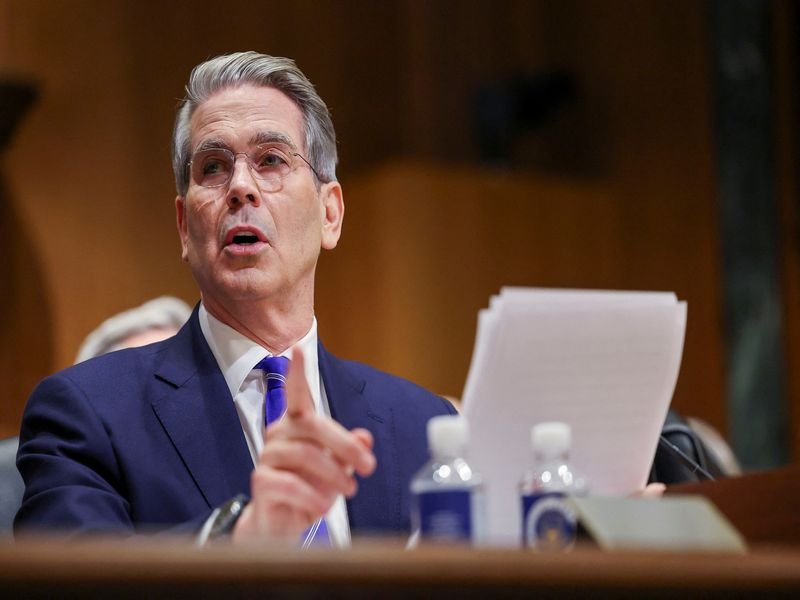

Washington DC [US], November 21 (ANI): US Treasury Secretary Scott Bessent has accused Iran’s leadership of prioritising its own interests over the welfare of ordinary citizens, claiming that Tehran has exhausted its seaborne oil supply and may never receive billions of dollars in revenue from oil it has already sold.In a post on X, Bessent said the Iranian regime was failing to address shortages of essential commodities, including bread and fuel, while attempting to recover outstanding payments from oil sales abroad.“Iran’s tyrannical regime never fails to put its own interests before those of its own citizens, even as ordinary Iranians face shortages of bread and fuel.The regime has exhausted its seaborne oil supply, and it may never see the revenue from the oil it has already sold. The ship is sinking,” he added.Iran’s tyrannical regime never fails to put its own interests before those of its own citizens, even as ordinary Iranians face shortages of bread and fuel. The regime has exhausted its seaborne oil supply, and it may never see the revenue from the oil it has already sold. The ship is sinking.— Treasury Secretary Scott Bessent (@SecScottBessent) November 20, 2026The remarks came as the US Department of the Treasury announced fresh sanctions against individuals it accused of facilitating Iranian oil sales and helping the regime recover funds held overseas.According to the Treasury Department, the action is part of Operation Economic Outcast, under which Washington is targeting key oil intermediaries, described as “oil trustees”, whom the Iranian regime relies on to facilitate the sale of oil abroad.The department said that there was no Iranian oil on the water outside the US military blockade and that no oil had been loaded onto vessels since the beginning of the operation. It alleged that the Iranian regime was now attempting to recover billions of dollars from its oil trustees, many of whom had retained the proceeds from previous oil sales for personal gain.Announced by Bessent on August 24, 2026, and described as Economic D-Day, Operation Economic Outcast is aimed at severing what the US calls the remaining economic lifelines sustaining the Iranian regime.The Treasury Department said it had mapped networks, facilitators and financial channels used by Iran to smuggle oil, evade sanctions and fund terrorism. Working with partners across the US government, the European Union, the United Kingdom, Gulf partners and other countries, Washington is targeting sources of what it describes as the regime’s illicit revenue, along with mechanisms used to circumvent sanctions and transfer funds.It further warned that Operation Economic Outcast had significantly increased sanctions risks for entities continuing to do business with Iran. Any entity facilitating money laundering or sanctions evasion on behalf of Tehran risks being cut off from the US financial system.The operation has also expanded sanctions exposure for non-US persons conducting business with the Iranian regime, with the Treasury Department warning that it would accelerate enforcement measures.As part of the latest action, the US designated Mohammad Javad Bavand and Majid Taj, whom it identified as members of a network of regime insiders tasked with obtaining cash for the Iranian government through the sale of its dwindling oil reserves.The Treasury Department said Bavand, a former Islamic Revolutionary Guard Corps (IRGC) intelligence officer, had spearheaded efforts to recover Iranian oil funds held in third countries by entrusting the task to a group of personal contacts, including Taj, who is the brother of the president of the Iranian Football Federation.According to the department, the Iranian regime continued to rely on the network operated by Bavand and Taj to facilitate oil sales despite its members owing billions of dollars to the regime from previous transactions.Bavand was also accused of working with several illicit oil-trading actors, including the IRGC and Sepehr Energy Jahan Nama Pars Company (SEJ), a US-designated front company tasked with selling oil on behalf of the Iranian Armed Forces General Staff.Both Bavand and Taj were designated under Executive Order 13902 for operating in Iran’s petroleum sector.The Treasury Department also designated Mohammadhossein Servati, the son of IRGC Brigadier General Mohsen Servati, for allegedly providing support to SEJ.Servati has held executive positions at companies operated by SEJ, including its front company Xin Rui Jin Trad Co., Limited, and Sepehr Energy Hamta Pars, a subsidiary of SEJ.The department alleged that Xin Rui Jin Trad Co., Limited brokered and received shipments of Iranian oil on behalf of SEJ for delivery to Chinese teapot refineries.Servati was designated under Executive Order 13224, as amended, for allegedly materially assisting, sponsoring or providing financial, material or technological support, or goods or services, to Sepehr Energy Jahan Nama Pars Company.Another individual targeted was Mojtaba Arabnejad, the son of designated Iranian businessman and Mahan Air CEO Hamid Arabnejad.According to the Treasury Department, Mojtaba used his family connections and special links with the Islamic Revolutionary Guard Corps-Qods Force (IRGC-QF) to procure aircraft parts for Mahan Air and weapons for the Iranian military under the cover of agricultural companies.He was also accused of overseeing oil sales for the Iranian regime, with the proceeds supporting Mahan Air.Mojtaba Arabnejad was designated under Executive Order 13224, as amended, for allegedly materially assisting, sponsoring or providing financial, material or technological support, or goods or services, to Mahan Air.Explaining the implications of the latest designations, the Treasury Department said all property and interests in property belonging to the designated or blocked individuals that are located in the United States, or are in the possession or control of US persons, would be blocked and must be reported to the Office of Foreign Assets Control (OFAC).It added that entities owned, directly or indirectly, individually or collectively, 50 per cent or more by one or more blocked persons would also be subject to the restrictions.Under OFAC regulations, transactions involving the property or interests in property of blocked persons are generally prohibited for US persons or within, or transiting, the United States, unless authorised through a general or specific licence or otherwise exempt.The department warned that violations of US sanctions could result in civil or criminal penalties for both US and foreign persons. OFAC can impose civil penalties for sanctions violations on a strict liability basis, meaning penalties may apply irrespective of whether a person intended to violate the restrictions.The prohibitions also cover contributions or the provision of funds, goods or services to or for the benefit of designated persons, as well as the receipt of funds, goods or services from them.Non-US persons are prohibited from causing US persons to knowingly or unknowingly violate American sanctions, as well as engaging in activities designed to evade or conspire to violate the restrictions.The Treasury Department further said individuals based in the United States or abroad who provide information about sanctions violations through the Financial Crimes Enforcement Network’s whistleblower incentive programme may be eligible for awards if their information leads to a successful enforcement action resulting in monetary penalties exceeding USD 1 million.Financial institutions and other entities could also face sanctions exposure for certain transactions or activities involving designated or otherwise blocked persons. In addition to blocking prohibitions, OFAC can prohibit or impose strict conditions on the opening or maintenance of correspondent accounts or payable-through accounts in the United States by foreign financial institutions that knowingly conduct or facilitate significant transactions on behalf of persons designated under the relevant authorities.The department said the effectiveness and integrity of OFAC sanctions depended not only on its authority to designate individuals and add them to the Specially Designated Nationals (SDN) List but also on its willingness to remove individuals when consistent with relevant laws and other authorities.It stated that the ultimate objective of sanctions was to bring about a positive behaviour change, adding that the circumstances required for removal from the list would vary depending on the broader geopolitical situation and the national security and foreign policy interests involved.Regarding Iran, the Treasury Department said OFAC was employing all available statutory, regulatory and policy tools to address what it described as persistent national emergencies posed by the country, alleging that Tehran had not changed its behaviour to align with US national security and foreign policy objectives.It added that decisions on sanctions, including removal from the SDN List, would remain consistent with the US administration’s foreign policy, national security policies and priorities.The department also referred individuals and entities seeking removal from an OFAC sanctions list to its official guidance on the process for requesting delisting. (ANI)(This content is sourced from a syndicated feed and is published as received. The Tribune assumes no responsibility or liability for its accuracy, completeness, or content.)