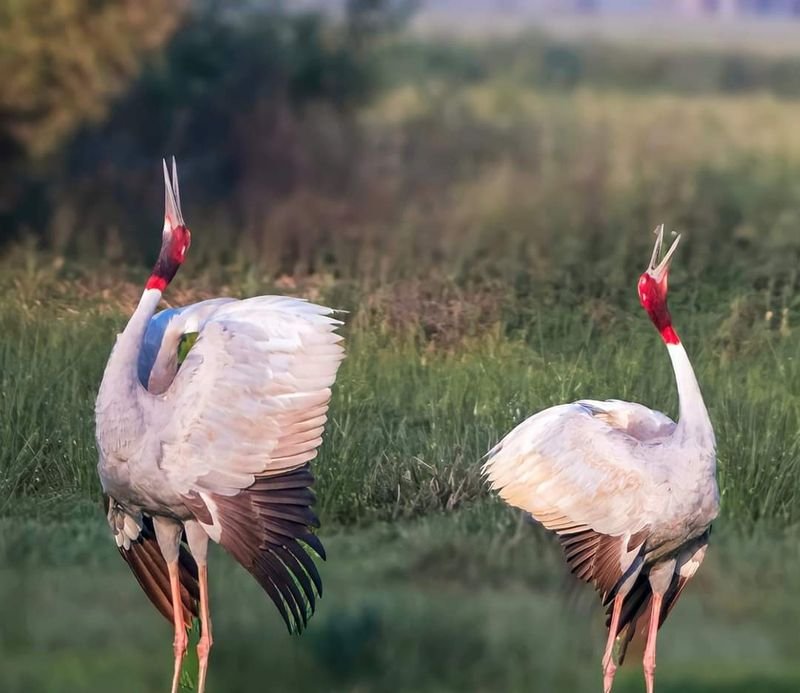

Nestled in the border district of Gurdaspur, the Keshopur wetland, popularly known as Chhamb in Punjabi, stands out as a vital freshwater marshland. Holding the distinction of being the country’s first-ever notified community reserve, it was designated as a Ramsar site of international importance in 2019. A community reserve is a protected area owned by private individuals or local communities who voluntarily agree to conserve wildlife and its natural habitat.Significantly, Keshopur is celebrated as the last stronghold in Punjab for Sarus Cranes. Standing up to 1.8 metres (5 feet 11 inches) tall, they are the tallest flying birds, easily distinguished by their overall grey plumage and contrasting red heads and upper necks. They forage in marshes and shallow wetlands for roots, tubers, insects, crustaceans and small vertebrate prey. Forming long-lasting pair bonds, they earmark territories to perform elaborate courtship displays, including loud trumpeting, leaps and dance-like movements. There are also considered symbols of marital fidelity, believed to mate for life and pine for lost partners, sometimes even starving to death.The wetland also serves as a major wintering ground for migratory birds travelling from Siberia, Central Asia and Tibet. Migratory birds have special routes and this wetland is on the Central Asian Flyway. During peak winter, the area transforms into a vibrant habitat hosting thousands of birds, including notable species such as the Gadwall, Common Teal, Northern Pintail, Northern Shoveler, Eurasian Wigeon, Bar-headed Goose and Common Crane.Anjan Singh, District Wildlife Officer (DFO)-Wildlife, Pathankot, who holds additional charge as DFO, Gurdaspur, said the overall bird population this year is expected to touch 15,000—a record in itself. He attributes the global weather situtation as a reason.The land comprising the Keshopur reserve was generously donated by five surrounding villages: Keshopur, Miani, Dala, Matwa and Magarmudian.Under this community-led initiative, villagers utilise the wetland for various sustainable purposes while actively collaborating to protect the biodiversity of the avian habitat.Manjit Singh Dala, whose family has lived adjacent to the wetland in Dala village for decades, noted: “The wetland is located in the Bari Doab region between the Ravi and Beas rivers, barely 15 kilometres from the Pakistan border. Unlike many other protected wetlands in Punjab that depend upon river inflows, Keshopur is unique because it is sustained almost entirely by annual rainfall runoff and subsequent groundwater recharge.”The primary factor that distinguishes Keshopur from other water bodies is its characteristic aquatic vegetation. This flora performs critical ecological functions, including water purification, water storage, carbon and nutrient processing, shoreline stabilisation and support of plants and animals.NGOs and concerned ornithologists are pulling out all the stops to protect the wetland from outside threats, guided by a shared consensus: Save nature and only then can nature save you.Once dismissed as useless, soggy wastelands prime for drainage or construction, areas like the Keshopur Chhamb are now recognised for what they truly are—vital ecological assets.