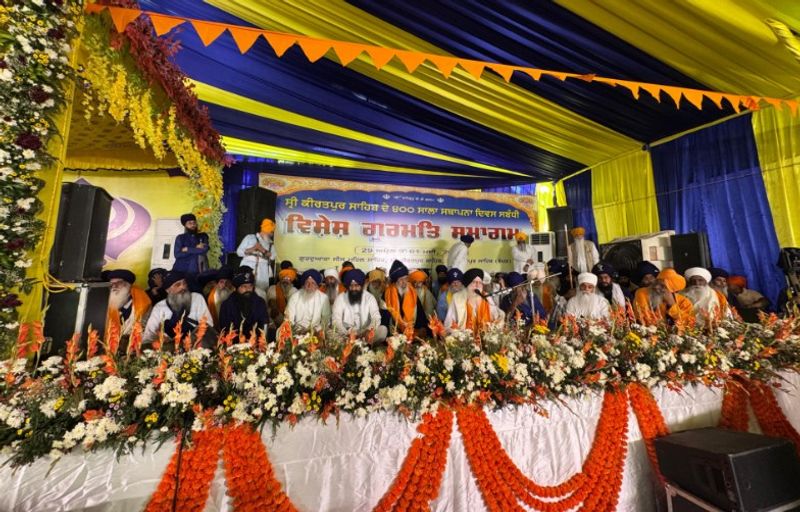

The historic town of Kiratpur Sahib today marked the 400th anniversary of its foundation with deep religious fervour and spiritual devotion, but the near-complete absence of political leadership turned the landmark occasion into a telling commentary on the evolving dynamics between religion and politics in Punjab.Founded in 1626 by Guru Hargobind Sahib, Kiratpur Sahib holds immense spiritual and historical significance in Sikhism. Nestled in the foothills of the Shivaliks along the Sutlej, it has long been regarded as a centre of peace, reflection and Sikh learning. Several Sikh Gurus, including Guru Har Rai and Guru Harkrishan, were closely associated with the town, which also marks the site where Guru Harkrishan attained divine light of life.The town’s sacred landscape featuring shrines such as Gurdwara Patalpuri Sahib, Gurdwara Charan Kamal Sahib, Gurdwara Sheesh Mahal Sahib and Gurdwara Baba Gurdittaki echoed with hymns, kirtan darbars and nagar kirtans as thousands of devotees gathered to commemorate four centuries of its founding today.The entire programme was organised by the Shiromani Gurdwara Parbandhak Committee (SGPC), which had been conducting religious events since April 29. At the centre of the stage today was SGPC president Harjinder Singh Dhami, who emerged as the only prominent Sikh leader present at the event besides the acting Akal Takht Jathedar, Kuldeep Singh Gargaj and heads of various Nihang sects.Yet, what stood out more than the scale of devotion was the conspicuous political vacuum.No senior leaders from major political parties, including Punjab’s traditional panthic parties such as the Shiromani Akali Dal (SAD), were seen participating in the event. The absence cut across party lines, with even those formations that have historically drawn strength from Sikh religious platforms choosing to stay away.This marks a stark departure from the past. There was a time when anniversaries of such magnitude at Kiratpur Sahib or Anandpur Sahib would draw the political elite in large numbers, turning them into powerful platforms for outreach and engagement with the Sikh masses. Leaders would often use these occasions not just to pay obeisance, but to signal their alignment with Sikh sentiments and issues.Today, however, that equation appeared to have shifted.Political observers see this absence as reflective of a cautious recalibration. The shadow of last year’s friction during the 350th martyrdom anniversary of Guru Tegh Bahadur at Anandpur Sahib where parallel events by the SGPC and the state government exposed tensions still looms large. Since then, both political and religious actors appear wary of overlapping spaces that could trigger controversy.The Punjab Government, for its part, maintained a deliberately limited role, focusing on law and order, traffic regulation and civic arrangements. Administrative machinery was active behind the scenes, ensuring smooth conduct, but remained absent from the religious forefront.Despite the political no-show, the spiritual intensity of the occasion remained undiminished. Devotees thronged the historic town, participating in prayers and reflecting on Kiratpur Sahib’s legacy as a place of humility, service and contemplation distinct from the more assertive historical narrative of Anandpur Sahib.As the celebrations concluded, Kiratpur Sahib stood as much a symbol of enduring faith as of a subtle but significant shift where religion continues to command devotion, but no longer guarantees political presence.