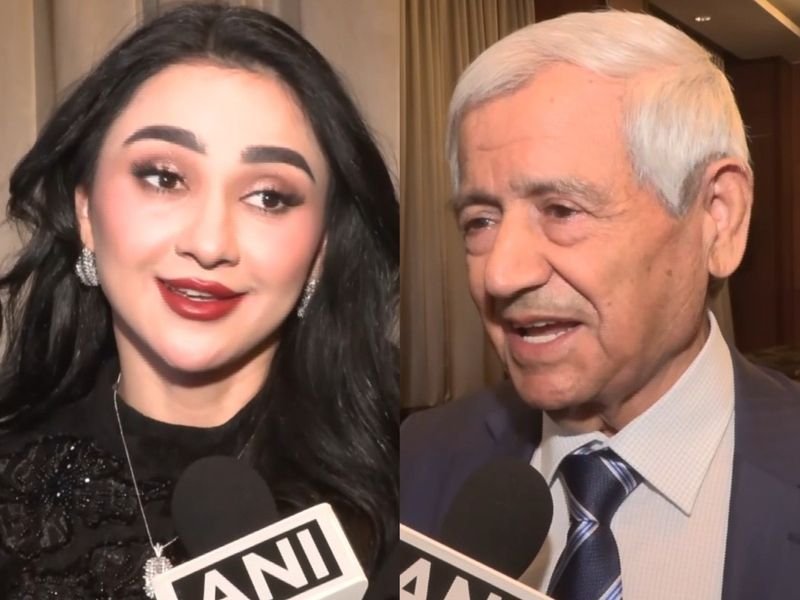

Dushanbe [Tajikistan], October 21 (ANI): Highlighting the ancient historical bonds and shared artistic legacy between India and Tajikistan, prominent Tajik cultural figures warmly welcomed Defence Minister Rajnath Singh during his visit to Dushanbe for the Shanghai Cooperation Organisation (SCO) Defence Ministers’ meeting and an Indian diaspora interaction.Professor Habibullo Rajabov, a Tajik scholar who was honoured with India’s prestigious Padma Shri award in 2018, praised India’s democratic journey, cultural icons, and the growing popularity of the Hindi language among Tajiks.”First of all, I would like to say that Tajikistan is a place closely connected to India,” Professor Rajabov said, praising the Indian Defence Minister. “If a country doesn’t have a strong Defence Minister, the country itself cannot stand. And your Defence Minister is a very strong man. He spoke about what India is today.”Rajabov reflected on India’s historic fight for independence and its cultural stature.”80 years ago, under British rule, India was not in this position—until through the strength and struggle led by Mahatma Gandhi, the British were forced to leave India,” he noted. “Today, it is our pride that India is home to such immense culture—Kalidasa, Tulsidas, Surdas, Premchand, Rabindranath Tagore, and the greatest among them, Mahatma Gandhi. The Hindi language is such a beautiful language. The Tajik people have a deep interest in it; our people are so fond of it.”Describing the interaction with the minister as memorable, Rajabov added, “Today’s meeting with Rajnath Singh is something we will cherish for a very long time. As a teacher with students, I will repeatedly share with them how wonderful this meeting was.”Underlining the bilateral connection, he concluded, “Tajikistan is a small republic, whereas India is a vast country with diverse languages. Our relationship shares such an ancient history. The genuine fondness that our people have for India is unique, because India is a great, ancient nation where legendary figures lived, and the people of India are peace-loving.”The sentiment was echoed by renowned Tajik singer Noziya Karomatullo, who previously stayed in India on an Indian Council for Cultural Relations (ICCR) scholarship to train in Hindi, classical music, and dance.”I feel that India is my second home. The cultures of Tajikistan and India are very close,” Karomatullo remarked. “Even now, I frequently visit India—it has become a habit of mine to go there and keep learning from my gurus. I truly love India.”Karomatullo highlighted a prominent cross-cultural musical collaboration involving her popular Tajik song Har Shab Dar Lab (also known as Ishq Bukhara), which was adapted into Hindi for an Indian film and performed by playback singer Shreya Ghoshal.”I am thrilled about the growing friendship between our two countries and that Shreya-ji sang my song in the movie,” Karomatullo said.Earlier on Tuesday, India conveyed to the Shanghai Cooperation Organisation (SCO) that a greater number of institutions does not necessarily translate into greater achievements, pressing the bloc to maintain operational efficiency, steer clear of duplicating mechanisms, and concentrate on delivering practical value to member states.Defence Minister Rajnath Singh articulated these observations while representing India at the 25th meeting of the SCO Council of Heads of Government (CHG) in Dushanbe.“India believes that the SCO must remain efficient and steadfast in its adherence to the principles of sovereign equality, consensus, and mutual respect. A greater number of institutions does not necessarily translate into greater achievements. New mechanisms should focus on clearly identified needs, avoid duplication, and prioritise delivering practical value to Member States,” Singh was quoted as saying by the Ministry of Defence at the Dushanbe meeting.The Defence Minister exhorted the grouping to build upon the groundwork established over the preceding quarter-century and delineate a forward-looking roadmap centred on consensus-driven collaboration and concrete outcomes.Highlighting citizen-centric benchmarks, he stated that success ought to be evaluated through opportunities generated for young people, fresh markets unlocked for entrepreneurs, technologies extended to farmers and micro-business proprietors, as well as societal linkages fostered.As per ministry accounts, the delegation heads endorsed the joint communique of the meeting, alongside financial and administrative resolutions encompassing the SCO budget for 2027 and the Action Plan for the Multilateral Trade and Economic Cooperation Programme (PMTEC) spanning 2026 to 2030, which received India’s backing.The assembly evaluated headway achieved in economic and trade cooperation among member countries while deliberating avenues to intensify collaboration across transportation, finance, the digital economy, and social development. (ANI)(This content is sourced from a syndicated feed and is published as received. The Tribune assumes no responsibility or liability for its accuracy, completeness, or content.)